Ligiu Uiorean
- Home: https://www.uiorean.com/
- Posts: https://www.uiorean.com/posts/
- Our second Red Dot, and why the second one counts: https://www.uiorean.com/posts/second-red-dot/
- Untold, costul nevăzut: https://www.uiorean.com/posts/2026-08-03-untold-costul-nevazut/
- Passengers don't want your airport app: https://www.uiorean.com/posts/2026-07-24-passengers-dont-want-your-airport-app/
- Scaling Down Is the Hard Part: https://www.uiorean.com/posts/2026-07-13-architecting-for-small/
- Data Integration Is a Home Renovation. Most Airports Are Living in the Gut Job.: https://www.uiorean.com/posts/2026-07-10-data-integration-is-a-home-renovation/
- I still read every support ticket: https://www.uiorean.com/posts/2026-07-07-i-still-read-every-support-ticket/
- Bani publici, cod public: am analizat inițiativa legislativă privind codul sursă deschis în sectorul public.: https://www.uiorean.com/posts/2026-07-01-bani-publici-cod-public-analiza-legii-codului-sursa-deschis/
- Two things airports get wrong about replacing an AODB.: https://www.uiorean.com/posts/2026-06-30-two-things-airports-get-wrong-about-replacing-an-aodb/
- LOFIC sensors and the promise of huge dynamic range: https://www.uiorean.com/posts/2026-06-29-lofic-sensors-and-dynamic-range/
- My mom asked me if AI is going to affect us.: https://www.uiorean.com/posts/2026-06-29-my-mom-asked-me-if-ai-is-going-to-affect-us/
- We are working through the design of a new performance-linked bonus at AirportLabs.: https://www.uiorean.com/posts/2026-06-25-we-are-working-through-the-design-of-a-new-performance/
- Division of Labour in the Time of AI: https://www.uiorean.com/posts/2026-06-22-division-of-labour-in-the-time-of-ai/
- My son finished kindergarten today.: https://www.uiorean.com/posts/2026-06-19-my-son-finished-kindergarten-today/
- Two months ago I wrote: vendor-managed AI degrades silently.: https://www.uiorean.com/posts/2026-06-16-two-months-ago-i-wrote-vendor-managed-ai-degrades-silently/
- The most uncomfortable number in aviation this year is not in the profit forecast.: https://www.uiorean.com/posts/2026-06-15-the-most-uncomfortable-number-in-aviation-this-year-is-not/
- I was in Paris with my family the other week.: https://www.uiorean.com/posts/2026-06-13-i-was-in-paris-with-my-family-the-other-week/
- The FIDS (Flight Information Dissemination System) should present the most relevant Information for passengers at each touchpoint.: https://www.uiorean.com/posts/2026-06-11-the-fids-flight-information-dissemination-system-should/
- What is an acquisition?: https://www.uiorean.com/posts/2026-06-10-what-is-an-acquisition/
- Brilliant showcase of the AirportLabs RealTime platform, proudly running at DOH: https://lnkd.in/du79DGZy: https://www.uiorean.com/posts/2026-05-13-brilliant-showcase-of-the-airportlabs-realtime-platform/
- A customer told me, recently, that he was told gate allocation at an airport is rather like playing Tetris.: https://www.uiorean.com/posts/2026-05-07-a-customer-told-me-recently-that-he-was-told-gate/
- You watch the news.: https://www.uiorean.com/posts/2026-05-05-you-watch-the-news/
- 𝐓𝐡𝐞 𝐪𝐮𝐞𝐬𝐭𝐢𝐨𝐧 𝐢𝐬 𝐧𝐨 𝐥𝐨𝐧𝐠𝐞𝐫 "𝐢𝐬 𝐭𝐡𝐞 𝐀𝐈 𝐮𝐩?" 𝐈𝐭 𝐢𝐬 "𝐢𝐬 𝐭𝐡𝐞 𝐀𝐈 𝐬𝐭𝐢𝐥𝐥 𝐝𝐨𝐢𝐧𝐠 𝐰𝐡𝐚𝐭 𝐢𝐭 𝐮𝐬𝐞𝐝 𝐭𝐨 𝐝𝐨?": https://www.uiorean.com/posts/2026-04-28-the-question-is-no-longer-is-the-ai-up-it-is-is-the-ai/
- Our BA interns did not spend their first weeks in a training room.: https://www.uiorean.com/posts/2026-04-23-our-ba-interns-did-not-spend-their-first-weeks-in-a/
- A "Black Swan" used to be the rare event that reshaped a season.: https://www.uiorean.com/posts/2026-04-22-a-black-swan-used-to-be-the-rare-event-that-reshaped-a/
- Boston Consulting Group (BCG) just published one of the clearest articulations of where leading airports are headed, and it is the model that AirportLabs customers are already running.: https://www.uiorean.com/posts/2026-04-21-boston-consulting-group-bcg-just-published-one-of-the/
- Fraport Greece deployed the AirportLabs Community App across their entire Greek network in four months:: https://www.uiorean.com/posts/2026-04-20-fraport-greece-deployed-the-airportlabs-community-app/
- ACI Just Confirmed: AirportLabs runs the World's Busiest Airport: https://www.uiorean.com/posts/2026-04-15-aci-just-confirmed-airportlabs-runs-the-world-s-busiest/
- Setting the pace in the industry and on the track. Inspiring work!: https://www.uiorean.com/posts/2026-04-03-setting-the-pace-in-the-industry-and-on-the-track-inspiring/
- I think energy price arbitrage through AI load shifting is going to be a real business.: https://www.uiorean.com/posts/2026-04-03-i-think-energy-price-arbitrage-through-ai-load-shifting-is/
- Weird weekend flex from the AirportLabs SkyCore AODB team.: https://www.uiorean.com/posts/2026-03-27-weird-weekend-flex-from-the-airportlabs-skycore-aodb-team/
- Tocmai am revenit de la PTE după anul cel mai încărcat de până acum.: https://www.uiorean.com/posts/2026-03-26-tocmai-am-revenit-de-la-pte-dupa-anul-cel-mai-incarcat-de/
- Speed creates opportunities.: https://www.uiorean.com/posts/2026-03-24-speed-creates-opportunities/
- Emil Boc e cel puțin incompetent și incompetența lui ne omoară.: https://www.uiorean.com/posts/2026-03-20-emil-boc-e-cel-putin-incompetent-si-incompetenta-lui-ne/
- So - at PTE 2025 we announced the contract, went live by August and this PTE the team is ready to discuss how we achieve faster time to value for airports.: https://www.uiorean.com/posts/2026-03-16-so-at-pte-2025-we-announced-the-contract-went-live-by/
- The weekend is when I remember that airports don’t care it’s Saturday.: https://www.uiorean.com/posts/2026-03-13-the-weekend-is-when-i-remember-that-airports-don-t-care-it/
- Aviation does not have time for 2-year software projects.: https://www.uiorean.com/posts/2026-03-12-aviation-does-not-have-time-for-2-year-software-projects/
- Following the recent events in the Middle East, I watched the AirportLabs team step up with a level of commitment that honestly blew me away.: https://www.uiorean.com/posts/2026-03-11-following-the-recent-events-in-the-middle-east-i-watched/
- A lot of airport tech still assumes that if the system knows something, the airport knows it.: https://www.uiorean.com/posts/2026-03-10-a-lot-of-airport-tech-still-assumes-that-if-the-system/
- Infinitely scalable.": https://www.uiorean.com/posts/2026-03-09-infinitely-scalable/
- To recap this roller-coaster week: it was a reminder that “the cloud” is still made of buildings, cables and people on the ground.: https://www.uiorean.com/posts/2026-03-06-to-recap-this-roller-coaster-week-it-was-a-reminder-that/
- Pentru prima dată într-un studiu din România, motivația principală a angajaților nu mai e salariul.: https://www.uiorean.com/posts/2026-03-05-pentru-prima-data-intr-un-studiu-din-romania-motivatia/
- I always thought (and hoped) "battle tested" would ONLY mean that our systems are proven in operation.: https://www.uiorean.com/posts/2026-03-04-i-always-thought-and-hoped-battle-tested-would-only-mean/
- An airport has a fixed number of gates, stands, check-in desks, baggage belts, and jet bridges.: https://www.uiorean.com/posts/2026-03-03-an-airport-has-a-fixed-number-of-gates-stands-check-in/
- Happy Mărțișor! 🌸: https://www.uiorean.com/posts/2026-03-02-happy-martisor/
- The "Cloud" is still physical.: https://www.uiorean.com/posts/2026-03-02-the-cloud-is-still-physical/
- We know how much is being asked of everyone in the region right now.: https://www.uiorean.com/posts/2026-02-28-we-know-how-much-is-being-asked-of-everyone-in-the-region/
- Airlines that went all-in on one engine option for the A320neo have spent years dealing with groundings, lost capacity, and repair backlogs.: https://www.uiorean.com/posts/2026-02-27-airlines-that-went-all-in-on-one-engine-option-for-the/
- Apparently there's a tension in tech right now: companies are adopting AI fast, and at the same time cutting the pipeline of junior talent.: https://www.uiorean.com/posts/2026-02-26-apparently-there-s-a-tension-in-tech-right-now-companies/
- Airports are spending more on IT, but many still aren’t satisfied with the results.: https://www.uiorean.com/posts/2026-02-25-airports-are-spending-more-on-it-but-many-still-aren-t/
- McKinsey & Company’s research on smart airports is clear: the right integration and digital solutions can boost airport EBITDA by 6-8%, with much of that gain achievable within a few years.: https://www.uiorean.com/posts/2026-02-24-mckinsey-company-s-research-on-smart-airports-is-clear-the/
- Pilots that never land: https://www.uiorean.com/posts/2026-02-23-pilots-that-never-land/
- Cei mai buni colegi au ajuns la noi prin programe de internship.: https://www.uiorean.com/posts/2026-02-21-cei-mai-buni-colegi-au-ajuns-la-noi-prin-programe-de/
- “Why is your stand so big?”: https://www.uiorean.com/posts/2026-02-20-why-is-your-stand-so-big/
- Nu am mai deschis o poziție de acest fel de 4 ani.: https://www.uiorean.com/posts/2026-02-06-nu-am-mai-deschis-o-pozitie-de-acest-fel-de-4-ani/
- Fast deployment deserves a fast deep-dive.: https://www.uiorean.com/posts/2026-02-05-fast-deployment-deserves-a-fast-deep-dive/
- Heading into the weekend with some great news from Mexico! 🇲🇽: https://www.uiorean.com/posts/2026-01-30-heading-into-the-weekend-with-some-great-news-from-mexico/
- Why do the world’s biggest operations trust AirportLabs Allegra RMS?: https://www.uiorean.com/posts/2026-01-29-why-do-the-world-s-biggest-operations-trust-airportlabs/
- Inside the Brain of the World’s Busiest International Airport ✈️🧠: https://www.uiorean.com/posts/2026-01-22-inside-the-brain-of-the-world-s-busiest-international/
- It’s one thing to be a large airport; it’s another to operate with the efficiency required to be Number 1.: https://www.uiorean.com/posts/2026-01-21-it-s-one-thing-to-be-a-large-airport-it-s-another-to/
- 1 Million Workflows. Zero Paperwork.: https://www.uiorean.com/posts/2026-01-20-1-million-workflows-zero-paperwork/
- Watching the AirportLabs "Wrapped" video, I’m struck by one thing: Momentum.: https://www.uiorean.com/posts/2025-12-23-watching-the-airportlabs-wrapped-video-i-m-struck-by-one/
- For all Cluj people, AirportLabs will be participating in an open doors event that is becoming a tradition here.: https://www.uiorean.com/posts/2025-10-14-for-all-cluj-people-airportlabs-will-be-participating-in-an/
- Another year, another AirportLabs team running event in the books!: https://www.uiorean.com/posts/2025-09-21-another-year-another-airportlabs-team-running-event-in-the/
- Three years ago, we started the AirportLabs Online Learning Academy.: https://www.uiorean.com/posts/2025-08-27-three-years-ago-we-started-the-airportlabs-online-learning/
- This is what partnership looks like.: https://www.uiorean.com/posts/2025-08-26-this-is-what-partnership-looks-like/
- Absolutely thrilled and immensely proud to share that AirportLabs has won a Skift IDEA Award for 2025 for our Airport Community App!: https://www.uiorean.com/posts/2025-08-12-absolutely-thrilled-and-immensely-proud-to-share-that/
- Untold nu aduce prosperitate: https://www.uiorean.com/posts/2025-08-08-untold-nu-aduce-prosperitate/
- An de an, auzim aceeași poveste, susținută fără rușine inclusiv de primar: Untold aduce prosperitate economică în Cluj-Napoca.: https://www.uiorean.com/posts/2025-08-07-an-de-an-auzim-aceeasi-poveste-sustinuta-fara-rusine/
- For engineers who thrive on technical challenges: Alexandra Moca is seeking new members for her team at AirportLabs.: https://www.uiorean.com/posts/2025-08-06-for-engineers-who-thrive-on-technical-challenges-alexandra/
- 2 Million Strong: AirportLabs Community App - the People and Data Platform That's Moving Aviation!: https://www.uiorean.com/posts/2025-08-05-2-million-strong-airportlabs-community-app-the-people-and/
- Yesterday's technical issue at the Swanwick Centre put UK air traffic operations to the test.: https://www.uiorean.com/posts/2025-07-31-yesterday-s-technical-issue-at-the-swanwick-centre-put-uk/
- It takes a global community to keep the world's airports running smoothly, and a huge part of that community is connected through the AirportLabs Airport Community App.: https://www.uiorean.com/posts/2025-07-18-it-takes-a-global-community-to-keep-the-world-s-airports/
- Ever notice how airports and airlines start telling you about your flight experience long before you even board?: https://www.uiorean.com/posts/2025-07-09-ever-notice-how-airports-and-airlines-start-telling-you/
- Are You Tracking Your 'Time To Wow'?: https://www.uiorean.com/posts/2025-07-07-are-you-tracking-your-time-to-wow/
- See our products live!: https://www.uiorean.com/posts/2025-07-04-see-our-products-live/
- Officially, it was a celebration of 10 years of innovation.: https://www.uiorean.com/posts/2025-07-04-officially-it-was-a-celebration-of-10-years-of-innovation/
- We do not see reality, we see our reality: https://www.uiorean.com/posts/2025-06-26-we-do-not-see-reality-we-see-our-reality/
- ✈️ Airports are emotional environments — not just logistical ones.: https://www.uiorean.com/posts/2025-06-24-airports-are-emotional-environments-not-just-logistical-ones/
- At the beginning of the year I said we will be activating an airport a week this year.: https://www.uiorean.com/posts/2025-06-20-at-the-beginning-of-the-year-i-said-we-will-be-activating/
- ....a partner who never blinked – AirportLabs": https://www.uiorean.com/posts/2025-06-03-a-partner-who-never-blinked-airportlabs/
- 🇷🇴🇷🇴🇷🇴: https://www.uiorean.com/posts/2025-05-18-post/
- Intern to department head in 5.5 years?: https://www.uiorean.com/posts/2025-05-08-intern-to-department-head-in-5-5-years/
- We're hiring a DevOps engineer for our Cluj office.: https://www.uiorean.com/posts/2025-05-07-we-re-hiring-a-devops-engineer-for-our-cluj-office/
- 🇷🇴🇷🇴🇷🇴: https://www.uiorean.com/posts/2025-05-03-post/
- At least 50% of the world's busiest airports (by intl.: https://www.uiorean.com/posts/2025-04-16-at-least-50-of-the-world-s-busiest-airports-by-intl/
- International Gate Control (IGC)has chosen AirportLabs —proven in the world’s largest and most complex airports—to elevate operations at Chicago O’Hare International Airport!: https://www.uiorean.com/posts/2025-04-10-international-gate-control-igc-has-chosen-airportlabs/
- Thrilled to announce a paradigm shift in the aviation tech industry! 🚀: https://www.uiorean.com/posts/2025-04-01-thrilled-to-announce-a-paradigm-shift-in-the-aviation-tech/
- The increasing global focus on tech sovereignty highlights the strategic importance of infrastructure independence, particularly for providers of critical services.: https://www.uiorean.com/posts/2025-03-24-the-increasing-global-focus-on-tech-sovereignty-highlights/
- Over 2.5M messages were pushed out this morning over the AirportLabs Community App regarding the flights disruption in the London area.: https://www.uiorean.com/posts/2025-03-21-over-2-5m-messages-were-pushed-out-this-morning-over-the/
- As AirportLabs turned 10, I’ve been thinking this morning about the moments that have truly defined us.: https://www.uiorean.com/posts/2025-03-08-as-airportlabs-turned-10-i-ve-been-thinking-this-morning/
- I usually steer clear of mainstream news and hype, but the recent wave of disruption caused by DeepSeek in the stock market is too impressive to ignore.: https://www.uiorean.com/posts/2025-01-28-i-usually-steer-clear-of-mainstream-news-and-hype-but-the/
- We just had one month with 0 critical incidents across hundreds of production systems.: https://www.uiorean.com/posts/2025-01-13-we-just-had-one-month-with-0-critical-incidents-across/
- Hey David LAVOREL Anamaria Beleiu did you really name your Cluj Office AirportLab?: https://www.uiorean.com/posts/2025-01-07-hey-david-lavorel-anamaria-beleiu-did-you-really-name-your/
- 🎉 Celebrating 10 Years of AirportLabs! 🎉: https://www.uiorean.com/posts/2025-01-05-celebrating-10-years-of-airportlabs/
- My last post about the need for 99.99% system availability in airports generated a lot of buzz – both within the aviation industry and beyond.: https://www.uiorean.com/posts/2024-12-13-my-last-post-about-the-need-for-99-99-system-availability/
- At AirportLabs, we live and breathe aviation high technology.: https://www.uiorean.com/posts/2024-12-06-at-airportlabs-we-live-and-breathe-aviation-high-technology/
- Been geeking out with the AirportLabs team over various companies' annual reports lately.: https://www.uiorean.com/posts/2024-11-29-been-geeking-out-with-the-airportlabs-team-over-various/
- One thing that AirportLabs may have triggered over the past 10 years is the change in system availability requirements in tenders.: https://www.uiorean.com/posts/2024-11-22-one-thing-that-airportlabs-may-have-triggered-over-the-past/
- At AirportLabs, we've spent the last decade transforming airports into dynamic, responsive hubs.: https://www.uiorean.com/posts/2024-11-15-at-airportlabs-we-ve-spent-the-last-decade-transforming/
- 10 years ago, I made a risky bet for AirportLabs: we built EVERYTHING in-house.: https://www.uiorean.com/posts/2024-11-08-10-years-ago-i-made-a-risky-bet-for-airportlabs-we-built/
- Nine years ago, when we first presented the 'Report a Fault' feature in the AirportLabs Airport Community App, an airport executive looked at me skeptically.: https://www.uiorean.com/posts/2024-11-01-nine-years-ago-when-we-first-presented-the-report-a-fault/
- It's been almost 9 years since AirportLabs launched the Airport Community App and I've just noticed that now we send over 40 million push notifications per month.: https://www.uiorean.com/posts/2024-10-25-it-s-been-almost-9-years-since-airportlabs-launched-the/
- The Red Dot Design Award certificate has landed just as we're about to on-board our 10th SkyCore customer!: https://www.uiorean.com/posts/2024-10-18-the-red-dot-design-award-certificate-has-landed-just-as-we/
- At AirportLabs we invest heavily in user interfaces, but for an AODB, a UI can actually be a sign of lack of automation.: https://www.uiorean.com/posts/2024-10-09-at-airportlabs-we-invest-heavily-in-user-interfaces-but-for/
- Forget code sprints, we just did a literal sprint! 🏃♀️: https://www.uiorean.com/posts/2024-09-22-forget-code-sprints-we-just-did-a-literal-sprint/
- What an incredible journey it's been!: https://www.uiorean.com/posts/2024-09-20-what-an-incredible-journey-it-s-been/
- Red Dot?: https://www.uiorean.com/posts/2024-09-05-red-dot/
- If your airport staff spends more time fighting with their software than actually working, it's time for an upgrade.: https://www.uiorean.com/posts/2024-08-30-if-your-airport-staff-spends-more-time-fighting-with-their/
- Behind every seamless airport experience is a team empowered by great design.: https://www.uiorean.com/posts/2024-08-29-behind-every-seamless-airport-experience-is-a-team/
- I've always been drawn to innovative management concepts.: https://www.uiorean.com/posts/2024-08-09-i-ve-always-been-drawn-to-innovative-management-concepts/
- AirportLabs' "unmeasured time off" policy is a shining example of how companies can empower employees and drive results.: https://www.uiorean.com/posts/2024-08-05-airportlabs-unmeasured-time-off-policy-is-a-shining-example/
- I believe the days of ugly, clunky corporate software should be over.: https://www.uiorean.com/posts/2024-07-31-i-believe-the-days-of-ugly-clunky-corporate-software-should/
- We're hearing about tonight's Azure and DigiCert incidents.: https://www.uiorean.com/posts/2024-07-30-we-re-hearing-about-tonight-s-azure-and-digicert-incidents/
- ✈️🛫 Calling all Senior Backend Developers! 🛫✈️: https://www.uiorean.com/posts/2024-07-26-calling-all-senior-backend-developers/
- In the fast-paced world of aviation SaaS, talent is a prized asset.: https://www.uiorean.com/posts/2024-07-24-in-the-fast-paced-world-of-aviation-saas-talent-is-a-prized/
- Tough day for aviation and IT and as many of you may know, I'm always on top of events that impact our customers.: https://www.uiorean.com/posts/2024-07-19-tough-day-for-aviation-and-it-and-as-many-of-you-may-know-i/
- Throwback to that time I tried to inspire the public...: https://www.uiorean.com/posts/2024-07-05-throwback-to-that-time-i-tried-to-inspire-the-public/
- 🎉 Congrats to the amazing team at AirportLabs on the launch of PocketFlights!: https://www.uiorean.com/posts/2024-06-07-congrats-to-the-amazing-team-at-airportlabs-on-the-launch/
- At the Dubai Airport Show, I had an incredible opportunity to meet a true leader in UAE aviation, HH Sheikh Ahmed bin Saeed Al Maktoum.: https://www.uiorean.com/posts/2024-05-14-at-the-dubai-airport-show-i-had-an-incredible-opportunity/
- So excited to see Ioana speak at the Dubai Airport Show!: https://www.uiorean.com/posts/2024-05-10-so-excited-to-see-ioana-speak-at-the-dubai-airport-show/
- Excited to announce that AirportLabs will be attending Passenger Terminal Expo in Frankfurt (April 16-18)!: https://www.uiorean.com/posts/2024-03-18-excited-to-announce-that-airportlabs-will-be-attending/
- Impressive view of AirportLabs' RealTime passenger flow in action!: https://www.uiorean.com/posts/2024-03-09-impressive-view-of-airportlabs-realtime-passenger-flow-in/
- Happy International Women's Day!: https://www.uiorean.com/posts/2024-03-08-happy-international-women-s-day/
- 🇯🇵🇯🇵🇯🇵 Welcome Japan!: https://www.uiorean.com/posts/2024-02-13-welcome-japan/
- I will be holding a presentation and Q&A session on the 15th of Feb.: https://www.uiorean.com/posts/2024-02-09-i-will-be-holding-a-presentation-and-q-a-session-on-the/
- Excited to share a project close to my heart - working together towards greater accessibility in travel for passengers with reduced mobility.: https://www.uiorean.com/posts/2024-02-05-excited-to-share-a-project-close-to-my-heart-working/
- What a fantastic year it's been in AirportLabs!: https://www.uiorean.com/posts/2023-12-20-what-a-fantastic-year-it-s-been-in-airportlabs/
- When your office has its very own Harvey Specter, you know the digital transformation talk is about to get as sharp as his suits.: https://www.uiorean.com/posts/2023-12-18-when-your-office-has-its-very-own-harvey-specter-you-know/
- Our team is mostly complete and high performing but this is a rare occasion when we're #hiring junior/mid in our product team.: https://www.uiorean.com/posts/2023-10-21-our-team-is-mostly-complete-and-high-performing-but-this-is/
- I've noticed that the disaster recovery requirements stipulated in contracts often demand service recovery within 24h.: https://www.uiorean.com/posts/2023-10-09-i-ve-noticed-that-the-disaster-recovery-requirements/
- I'll be holding a keynote speech at the World Aviation Festival in Lisbon.: https://www.uiorean.com/posts/2023-09-22-i-ll-be-holding-a-keynote-speech-at-the-world-aviation/
- Exciting news from AirportLabs!: https://www.uiorean.com/posts/2023-09-15-exciting-news-from-airportlabs/
- Conway's law posits that software often mirrors the structures of the organizations that create it.: https://www.uiorean.com/posts/2023-09-15-conway-s-law-posits-that-software-often-mirrors-the/
- Many airports fear that having critical systems in the cloud may pose a risk in case all Internet links are lost.: https://www.uiorean.com/posts/2023-09-13-many-airports-fear-that-having-critical-systems-in-the/
- Super proud of this one: AirportLabs can run its entire product lineup on any cloud and across multiple clouds, including private and bare metal infrastructure.: https://www.uiorean.com/posts/2023-09-11-super-proud-of-this-one-airportlabs-can-run-its-entire/
- First in a series of articles I coauthored, on how we build our products in AirportLabs: https://www.uiorean.com/posts/2023-09-08-first-in-a-series-of-articles-i-coauthored-on-how-we-build/
- The Community App team at AirportLabs wrote a review of how the app was used during yesterday's nation wide air traffic control system failure in the UK.: https://www.uiorean.com/posts/2023-08-29-the-community-app-team-at-airportlabs-wrote-a-review-of-how/
- Read about the powerhouse behind the AirportLabs product suite - our planet scale integration engine - the AirportLabs Data Router.: https://www.uiorean.com/posts/2023-08-28-read-about-the-powerhouse-behind-the-airportlabs-product/
- In the past, business software often received minimal investment in UI/UX due to its limited evaluation in tenders, and end users had limited points of comparison.: https://www.uiorean.com/posts/2023-08-22-in-the-past-business-software-often-received-minimal/
- Dive into the pages of our inaugural post from an ongoing series spotlighting our products, technology, and the vibrant pulse of life within AirportLabs: https://www.uiorean.com/posts/2023-08-21-dive-into-the-pages-of-our-inaugural-post-from-an-ongoing/
- We've just had a cool team outing at AirportLabs & our bi-annual Peer Bonus Points session: https://www.uiorean.com/posts/2023-07-14-we-ve-just-had-a-cool-team-outing-at-airportlabs-our-bi/
- It's great to witness AirportLabs making a notable entrance into the public eye and actively engaging with the international aviation and tech community!: https://www.uiorean.com/posts/2023-07-07-it-s-great-to-witness-airportlabs-making-a-notable-entrance/
- I am humbled and proud to be part of such an exceptional team.: https://www.uiorean.com/posts/2023-06-19-i-am-humbled-and-proud-to-be-part-of-such-an-exceptional/
- Great way to end the week - AirportLabs Airport Community App launched in New York's airport system!: https://www.uiorean.com/posts/2023-05-12-great-way-to-end-the-week-airportlabs-airport-community-app/
- Building a company is incredibly hard and can only be achieved by lots of hard work and passion: https://www.uiorean.com/posts/2023-04-03-building-a-company-is-incredibly-hard-and-can-only-be/
- Heading towards #PTExpoConf in Amsterdam.: https://www.uiorean.com/posts/2023-03-10-heading-towards-ptexpoconf-in-amsterdam/
- Yesterday's global outage of the Lufthansa systems caught me with the entire family waiting for a LH flight in Munich Airport.: https://www.uiorean.com/posts/2023-02-16-yesterday-s-global-outage-of-the-lufthansa-systems-caught/
- Diseară voi schimba idei cu studenții de la FSEGA despre cum se construiesc companii.: https://www.uiorean.com/posts/2023-01-19-diseara-voi-schimba-idei-cu-studentii-de-la-fsega-despre/
- AirportLabs is 8 today and I thought it’s a good time to look at where we’ve been and think of where we’re heading.: https://www.uiorean.com/posts/2023-01-05-airportlabs-is-8-today-and-i-thought-it-s-a-good-time-to/
- ⚽⚽⚽ Do you have to travel during great sport events?: https://www.uiorean.com/posts/2022-11-10-do-you-have-to-travel-during-great-sport-events/
- AirportLabs just opened a new senior role in our Cluj office - do you know anyone interested?: https://www.uiorean.com/posts/2022-09-26-airportlabs-just-opened-a-new-senior-role-in-our-cluj/
- Super stoked when we get feedback like this, congrats to our partner airports and the AirportLabs VisionAir FIDS team!: https://www.uiorean.com/posts/2022-09-20-super-stoked-when-we-get-feedback-like-this-congrats-to-our/
- Avem un rol nou deschis în Cluj.: https://www.uiorean.com/posts/2022-07-19-avem-un-rol-nou-deschis-in-cluj/
- Congratulations AirportLabs team for a very successful first half of the year!: https://www.uiorean.com/posts/2022-07-13-congratulations-airportlabs-team-for-a-very-successful/
- Mulțumesc Andreea Rosca pentru acest interviu, sper că am reușit să adaug valoare pentru publicul tău!: https://www.uiorean.com/posts/2022-05-27-multumesc-andreea-rosca-pentru-acest-interviu-sper-ca-am/
- Hey, we can run more than just airport systems!: https://www.uiorean.com/posts/2022-05-23-hey-we-can-run-more-than-just-airport-systems/
- It's internship season once again!: https://www.uiorean.com/posts/2022-05-03-it-s-internship-season-once-again/
- We have recently completed our profit share round of almost €300.000.: https://www.uiorean.com/posts/2022-04-22-we-have-recently-completed-our-profit-share-round-of-almost/
- On International Women's day I'd like to express my gratitude to all the women that I am lucky to surround myself with.: https://www.uiorean.com/posts/2022-03-08-on-international-women-s-day-i-d-like-to-express-my/
- Happy to see one of our team's innovations in the space of airport efficiency is gaining traction!: https://www.uiorean.com/posts/2022-03-03-happy-to-see-one-of-our-team-s-innovations-in-the-space-of/
- As storm Eunice is making a landfall in Europe we're already seeing a 2x-3x increase in use of the Community App.: https://www.uiorean.com/posts/2022-02-18-as-storm-eunice-is-making-a-landfall-in-europe-we-re/
- Hiring for our devops team!: https://www.uiorean.com/posts/2022-01-31-hiring-for-our-devops-team/
- So excited to see Alexandra Moca's presentation tonight - you might remember her from our internship videos a few years back.: https://www.uiorean.com/posts/2022-01-27-so-excited-to-see-alexandra-moca-s-presentation-tonight-you/
- Sorry network - this is in Romanian and of local relevance only.: https://www.uiorean.com/posts/2022-01-19-sorry-network-this-is-in-romanian-and-of-local-relevance/
- Many years ago I was working on the client side (i.e.: https://www.uiorean.com/posts/2022-01-05-many-years-ago-i-was-working-on-the-client-side-i-e/
- More than twice a second (on average) but sometimes 50 times per second (during major events)...: https://www.uiorean.com/posts/2022-01-03-more-than-twice-a-second-on-average-but-sometimes-50-times/
- AirportLabs has barely reached school age and some consultants think it already deserves to hang out with the grandparents of the industry – as a key player 😁: https://www.uiorean.com/posts/2021-12-27-airportlabs-has-barely-reached-school-age-and-some/
- Now you can make sure SANTA1 has everything it needs for visual approach and watch the landing in real time 🦌🦌🦌: https://www.uiorean.com/posts/2021-12-20-now-you-can-make-sure-santa1-has-everything-it-needs-for/
- The Airport Community App was launched in production 6 years ago.: https://www.uiorean.com/posts/2021-12-01-the-airport-community-app-was-launched-in-production-6/
- New paid internship starting this September!: https://www.uiorean.com/posts/2021-07-30-new-paid-internship-starting-this-september/
- AirportLabs is super excited to see our partner DXB's Terminal 1 lights back on!: https://www.uiorean.com/posts/2021-06-24-airportlabs-is-super-excited-to-see-our-partner-dxb-s/
- Cloud airport systems make cutting edge solutions available and affordable even for the smallest of airports while also allowing the largest of airports to stay nimble and get the latest features fast.: https://www.uiorean.com/posts/2021-04-23-cloud-airport-systems-make-cutting-edge-solutions-available/
- On International Women's Day, we want to take a moment to celebrate all the women in our lives, whether professional or personal.: https://www.uiorean.com/posts/2021-03-08-on-international-women-s-day-we-want-to-take-a-moment-to/
- New roles available in AirportLabs Cluj - Improve the life of billions of passengers worldwide!: https://www.uiorean.com/posts/2021-01-11-new-roles-available-in-airportlabs-cluj-improve-the-life-of/
- Hey network - wish you were here with us!: https://www.uiorean.com/posts/2020-12-17-hey-network-wish-you-were-here-with-us/
- DevOps role opening for our Cluj Office - improve the life of billions of passengers !: https://www.uiorean.com/posts/2020-12-14-devops-role-opening-for-our-cluj-office-improve-the-life-of/
- Looking for a DevOps/SRE for our Cluj office, to work with the best in the industry!: https://www.uiorean.com/posts/2020-12-03-looking-for-a-devops-sre-for-our-cluj-office-to-work-with/
- A new opportunity at our Cluj office - Frontend Developer to work with the best in the industry!: https://www.uiorean.com/posts/2020-11-27-a-new-opportunity-at-our-cluj-office-frontend-developer-to/
- Dubai' The Model Centre has produced and impressive study regarding the journey and impact of adopting Community App in Dubai's airports.: https://www.uiorean.com/posts/2020-03-07-dubai-the-model-centre-has-produced-and-impressive-study/
- Excited to see multiple AirportLabs products featured in DA's CEO report for the third year in a row!: https://www.uiorean.com/posts/2020-02-05-excited-to-see-multiple-airportlabs-products-featured-in-da/
- Dubai Airports CEO mentions AirportLabs RealTime and Community App in his update on the progress in the first half of 2019!: https://www.uiorean.com/posts/2019-09-04-dubai-airports-ceo-mentions-airportlabs-realtime-and/
- On the UAE's 43rd anniversary: https://www.uiorean.com/posts/2014-12-02-on-the-uae-43rd-anniversary/
- Scrutiny and made-up numbers: https://www.uiorean.com/posts/2012-10-11-scrutiny-and-made-up-numbers/
- Despre educația din România: https://www.uiorean.com/posts/2012-08-08-despre-educatia-din-romania/
- Vor romanii sa lucreze in strainatate?: https://www.uiorean.com/posts/2010-04-03-vor-romanii-sa-lucreze-in-strainatate/
- Popular Mechanix, 1922: https://www.uiorean.com/posts/2009-09-27-popular-mechanix-1922/
- ADAC is hiring Passive Network Specialist: https://www.uiorean.com/posts/2008-12-30-adac-is-hiring-passive-network-specialist/
- ADAC is hiring Senior Network Architect: https://www.uiorean.com/posts/2008-12-30-adac-is-hiring-senior-network-architect/
- Hello, World: https://www.uiorean.com/posts/hello-world/
- Ideas: https://www.uiorean.com/ideas/
- Projects: https://www.uiorean.com/projects/
- Wireless links in the field (2006): https://www.uiorean.com/projects/wireless-links-in-the-field-2006/
- CREC (2003): https://www.uiorean.com/projects/crec-2003/
- SpamTUNNEL (2003): https://www.uiorean.com/projects/spamtunnel-2003/
- The x86 Assembler guide (2000-2001): https://www.uiorean.com/projects/x86-assembler-guide-2000-2001/
- Springfree trampoline S113: https://www.uiorean.com/projects/springfree-trampoline-s113/
- Opinions: https://www.uiorean.com/opinions/
- Book reviews: https://www.uiorean.com/opinions/book-reviews/
- Quotes: https://www.uiorean.com/opinions/quotes/
- The Dacia Tender Was a Masterclass: https://www.uiorean.com/opinions/the-dacia-tender-was-a-masterclass/
- In the media: https://www.uiorean.com/media/
- About: https://www.uiorean.com/about/
- Diploma Thesis 2006: https://www.uiorean.com/about/diploma-thesis-2006/
- Contact: https://www.uiorean.com/about/contact/
- For Investors (why I don't answer): https://www.uiorean.com/about/for-investors/
- Genealogy: https://www.uiorean.com/about/genealogy/
This page is a record of what I have been able to establish about my family, from surviving
parish registers, Hungarian state civil registers, official gazettes and old newspapers.
On my father's side the **Uioreans of Feldioara Săcuiască** run back five generations from my
grandfather, to a couple married in the 1850s and to a man buried in 1813 whom I cannot attach
to the rest. My grandmother's family, the **Sanislavs**, turn out to be incomers from the next
village, and there is a Sanislav woman in my direct line three generations before her. The
**Liteans** and the **Triteans** come in on my great-grandmother's side, and the Triteans are a
direct line rather than a family that merely married in.
On my mother's side the **Conț** are now documented back four generations, to a man born about
1822 in a village nobody in my family had ever mentioned. That section used to be three dates
from a gravestone. It also carries the largest correction on this page: my maternal grandmother
was a **Chiorean**, not an Antohi, and the Antohi belong one step further out than I had them.
I am writing it down for one reason: so it exists somewhere durable and searchable. I have no
plans for it beyond that. It is not a project, I am not building a family tree application, and
I will probably not maintain this page. If it is wrong in places, and some of it certainly is,
it is wrong in public where a relative can correct it, which is better than being wrong in a
folder on my laptop.
The families come first, then the twentieth century, then my mother's side, then the archives
and the method. The full lists of spellings, occupations, newspaper citations and records are at
the foot of the page.
## What this page covers
**Both sides, unevenly, but less unevenly than it was.** My father's side is the fuller one and
always will be, because one of its parishes was transcribed and put online by a university
project. My mother's side rested for a long time on a grave cross and a handful of gazette
entries. It no longer does: the National Archives have digitised the Orthodox parish register of
the village my mother's family came from, along with the Hungarian state civil registers of the
same district, and between them they gave me four generations in an afternoon.
So the two halves of this page are still built from different sources, and they fail in
different places. On my father's side I have depth and a wall at about 1813, where the registers
begin. On my mother's side I have a documented line to about 1822 and then a hole in the
generation nearest to me, because my grandmother's own baptism sits on seven leaves of a
register that were catalogued and never scanned.
Even within my father's side the coverage is lopsided. His father's line reaches the 1850s with
parents named. His mother's line, the Sanislavs, stops short of naming her parents at all.
### Nothing here is more recent than fifty years
That is deliberate, and it is the one rule I have applied throughout.
**Every person named on this page was born between 1763 and 1923**, and every reference to a
named person stops in 1974. A few citations are later than that, and they are all about a place
rather than a person: a 1983 article explaining why the railway station carries the neighbouring
village's name, and two from the 2000s still puzzling over the same thing. I have living
relatives, and so does everyone else descended from these families, and none of them asked to be
catalogued on a stranger's website. Public archives happily surface names of people who are
alive, or recently dead, along with their addresses, their jobs, and occasionally their court
appearances. Fifty years is a blunt line but it is an easy one to hold, and it keeps this page
firmly in the realm of history rather than anybody's private life.
**The rule bites in a new place now.** My grandfather Alexandru Conț was one of five, and I have
all five baptisms in front of me, but the four younger ones were born between 1926 and 1937 and
their descendants are alive. So the maternal tree below stops with my grandparents, exactly as
the paternal one does, and the four siblings are counted rather than named. The same rule keeps
off a documented death date for my grandmother, several members of the Teoreanu branch whom my
mother can name and follow to the present day, and a good deal of what the registers gave me
about the generation born after 1923. That material stays in my notes.
## Where the family is from
**My father's side: one village, for the whole span of these records.** **Feldioara Săcuiască**,
Hungarian *Székelyföldvár*, today **Războieni-Cetate** in Alba county. In the older records it
sits in Torda-Aranyos county; the birth records from 1921 onward spell the full chain as
"Feldioara, Vințul de Sus, Turda Arieș, Transilvania, România". Its official interwar
administrative name was a fourth thing again, **Feldioara-Războieni**, which is what a 1930
government gazetteer calls it.
The Turda local paper *Aranyosvidék* obligingly used three of the names in one breath when it
reported a large fire there on 26 July 1930: "a vármegyénkben Făldioara Războieni
Székelyföldvár községben".
**My mother's side: two counties and a move south.** The Conț are recorded at **Dipșa** in
Bistrița-Năsăud, but they are not from there. Three generations of them were born at **Coșma**,
today Cozma in Mureș county, and the family moved north to Dipșa some time between 1873 and
1892. My grandmother was born at **Lechința**, ten kilometres from Dipșa. Both of them ended up
a hundred kilometres south, at **Aiud** in Alba, in my grandfather's own generation.
| As recorded | Today |
|---|---|
| Feldioara, Feldiora, Feldióra Săcuiască, Szekely Feldiora, Székelyföldvár, Feldioara Războieni | Războieni-Cetate, Alba |
| Veresmort, Veresmart, Marosveresmart | Unirea, Alba |
| **Székelykocsárd, Cucerdea Secuiască, Kocsárd, Cucerdea**, as the name of the *station* | the junction at Războieni-Cetate. See below |
| Székelykocsárd, Cucerdea Săcuiască, as the name of the *village* | Lunca Mureșului, Alba, the neighbouring commune |
| Cucerdea Română, later just Cucerdea | Cucerdea, Mureș |
| Uioara, Marosújvár, Uywar, Wywar | Ocna Mureș, Alba |
| Kozmatelke, Coșma | Cozma, Mureș |
| Dipse, Dürrbach | Dipșa, in Galații Bistriței, Bistrița-Năsăud |
| Szászlekence, Lechnitz | Lechința, Bistrița-Năsăud |
| Felső-Marosváradja | Oarba de Mureș, Mureș |
| Bazéd, Bazidu | Bozed, in Ceuașu de Câmpie, Mureș |
| Oroszfája | Orosfaia, in Milaș, Bistrița-Năsăud |
| Des, Dees | Dej, Cluj |
**Four place names in this research collide badly, and each one has cost me a session.** There
are **four Feldioaras**: mine in Alba, one in Brașov (the Teutonic Marienburg), one in Cluj
county in the Cătina commune, and one in Făgăraș. Only mine is *Székelyföldvár*, so any
Hungarian-language source separates them for free and any Romanian one after 1920 does not.
There are **three Cucerdeas**, set out below. There are **three Lechințas**, including a
Lechința de Mureș near Iernut about a hundred kilometres from mine. And there are **two
Vermeșes**, one in Lechința commune and one in the Banat.
### The station has a different name from the village, and it is the neighbour's
Worth its own note, because it is the single most useful search fact in the whole exercise.
**The railway junction at my family's village was not called Feldioara or Székelyföldvár. It was
called Székelykocsárd, in Romanian Cucerdea Secuiască**, after the *neighbouring* commune, and it
kept that name until it was renamed Războieni after 1918. *Új Élet* of 25 March 1983 spells it
out: the junction everyone knows as Székelykocsárd is actually Székelyföldvár's station, and the
halt before it is the one that belongs to Székelykocsárd, today Lunca Mureșului. Hungarian
speakers still call the junction Székelykocsárd, and *Krónika* and *Hargita Népe* were still
writing puzzled articles about the mismatch in 2004 and 2010.
So the pre-1918 and post-1918 names of the same platform share no word at all, and anyone
searching for this family on the railway before 1919 has to search **Székelykocsárd**, not
Székelyföldvár. In 1918 the Romanian press was also calling it simply **Cucerdea**, which is a
fourth label to carry. And three different Cucerdeas have to be kept apart:
| Name | What it is |
|---|---|
| **Cucerdea Secuiască / Székelykocsárd** | the junction station, at Războieni-Cetate, which is mine |
| **Cucerdea Săcuiască**, the village | Lunca Mureșului, Alba, the neighbouring commune, and the seat of the civil registration district |
| **Cucerdea Română**, later just Cucerdea | a village in Mureș county, a different place entirely |
## How to read the diagrams
There are two of them, one for each side of my family, and they use the same conventions. The
point of drawing them this way is that the gaps and the guesses are the interesting part, so they
are on the picture rather than hidden in the prose.
- **Solid box, solid line.** Documented in a parish register, a state civil register, an official
gazette or on a gravestone. I can point at the record.
- **Dotted box.** A person I can name but not document, or cannot name at all. The label says
which.
- **Dotted line.** A connection I believe but cannot prove. Every one is labelled with what it
rests on: *family memory*, *unproven*, or *hypothesis*.
- **Purple box.** A named candidate, on age and place, with nothing tying them to the family.
- **Dotted line with an arrow** runs parent to child. **Dotted line without one** means the two
are somehow connected but not by descent, so a suspected brother or cousin hangs off the side
rather than sitting above anybody.
**Neither diagram reaches me.** Both stop at my grandparents, because the generation below them
is alive and the fifty-year rule keeps it off this page. The two halves of my family therefore
meet in a marriage I have not drawn.
## The direct line, my father's side
```mermaid
flowchart TD
U13["Thirteen Uioreans at Feldioara, 1813 to 1849 link to Petru not proven Iacov (b. c. 1783) and Mihail fit on age"]:::unk
FP["Filon Periat farmer of Veresmort dead by January 1896"]
MSA["Maria Sanislav of Feldioara alive January 1896"]
m0((" ")):::u
FP --- m0
MSA --- m0
P["Petru Uiorean b. c. Jun 1820, d. 14 Feb 1882 Plugariu, later Econom"]
E["Eva Buta b. c. Jun 1821, d. 16 Jan 1879"]
m1((" ")):::u
U13 -.->|"parents unproven"| P
P --- m1
E --- m1
I["Ioan Uiorean b. 4 Sep 1852, d. 6 May 1912 Agronom, and a railway warehouse worker in 1906"]
MP["Maria Periat b. c. 1856 at Veresmort d. 11 Jan 1896, aged 39"]
m2((" ")):::u
m1 --> I
m0 --> MP
I --- m2
MP --- m2
V["Vichentie Uiorean / Ujvári b. 8 Nov 1880 Econom, and a royal postal servant in 1906"]
VL["Victoria Litean / Liptai b. 7 Feb 1889"]
m3((" ")):::u
m2 --> V
V --- m3
VL --- m3
G["Ioan Uiorean b. 8 Jul 1913 my grandfather"]:::start
MS["Minerva Sanislav my grandmother birth record not in any register I can reach"]:::start
m4((" ")):::u
m3 --> G
G --- m4
MS --- m4
SP["Minerva's parents unknown. Her people came from Veresmort"]:::unk
C1["Ioachim Sanislav b. Veresmort 26 Jul 1879 widowed Dec 1916"]:::cand
C2["Ilie Sanislav Lup m. 1916, sons 1918 and 1919"]:::cand
SP -.->|"parents unproven"| MS
C1 -.->|"candidate"| SP
C2 -.->|"candidate"| SP
NEXT(["my father's generation alive, kept off this page"]):::off
m4 -.-> NEXT
classDef u fill:#444,stroke:#444,color:#fff
classDef start fill:#1f6feb,stroke:#1f6feb,color:#fff
classDef unk fill:none,stroke:#8b949e,color:#8b949e,stroke-dasharray: 5 4
classDef cand fill:#8957e5,stroke:#8957e5,color:#fff
classDef off fill:none,stroke:#484f58,color:#6e7681,stroke-dasharray: 2 3
```
Two unproven joins on this side, one at each end. **Petru's parents** are unknown, because his
1843 marriage record names none and no birth record survives for him, so the thirteen earlier
Uioreans in the village sit above him unattached. **Minerva's parents** are unknown for a
different reason: her people came from a parish that has not been transcribed and whose books I
have not seen.
The generation at the top left is new, and it is the deepest documented point on this side. It
comes from a register series I did not know existed when I first wrote this page.
In plain text, with the marriages:
```
Filon Periat farmer of Veresmort, dead by Jan 1896
x Maria Sanislav of Feldioara, alive Jan 1896
|
+- Maria Periat b. c. 1856 at Veresmort d. 11 Jan 1896, aged 39
Petru Uiorean b. c. Jun 1820 d. 14 Feb 1882 ploughman, later Econom
x Eva Buta b. c. Jun 1821 d. 16 Jan 1879 m. 31 Jan 1843, Feldioara
|
+- Ioan Uiorean b. 4 Sep 1852 d. 6 May 1912 Agronom
x Maria Periat b. c. 1856 at Veresmort
x Ileana Boldor m. 13 May 1896 (he was 43)
|
+- Vichentie Uiorean b. 8 Nov 1880 Econom
x Victoria Litean b. 7 Feb 1889 m. 12 Nov 1906, engaged 21 Oct 1906
|
+- Ioan Uiorean b. 8 Jul 1913 my grandfather
x Minerva Sanislav my grandmother
```
My grandfather was one of seven. His parents married when Vichentie was 26 and Victoria
was 17, and their children arrive between 1907 and 1923.
Vichentie married on the same day as his sister Maria, 12 November 1906, in what must have
been a double wedding. Both acts are in the state register, two pages apart.
## The earliest ancestors on record
The oldest document in all of this is a death record. On **11 November 1813** the parish
buried **Ion Uiorean**, aged 50 years and 7 months, which puts his birth around **April
1763**. That is as far back as these registers reach, and he is the earliest person I can
attribute to the family with any confidence. Nothing names his parents, his wife or his
children, so he stands alone at the top of the page: a name, an age, and a date.
Behind him the paper stops. The Feldioara registers in this database begin in 1813, and
everyone who died before that is simply outside the record.
A handful of others from that first generation, all reconstructed the same way, by
subtracting an age at death from a date of death:
| Person | Born (estimated) | Recorded | What else is known |
|---|---|---|---|
| **Ion Uiorean** | c. April 1763 | d. 11 Nov 1813, aged 50y7m | Nothing further. The earliest ancestor on record |
| **Grigor Uiorean** | c. 1775 | d. 4 Mar 1817, aged 42y | Nothing further |
| **Iacov Uiorean** | c. 13 Jan 1783 | d. 17 Mar 1848, aged 65y2m4d | Father of Teodoră, baptised 1823. The earliest man here with a documented child |
| **Irincă Uiorean** | c. Feb 1792 | d. 4 Apr 1822, aged 30y2m | Nothing further |
| **Sie Litean** | c. May 1792 | d. 21 Nov 1842, aged 50y6m4d | The earliest Litean, my great-grandmother's side |
| **Mitru Litean** | c. Oct 1792 | d. 23 Dec 1845, aged 53y2m4d | Father of Kostantin, Nistor and Luca, baptised 1839 to 1843 |
| **Ilie "Roșca" Uiorean** | c. Oct 1808 | d. 8 Jan 1849, aged 40y3m4d | Five children 1840 to 1848. Carried the nickname Roșca |
These ages are given to the day in the register, which is why the estimates look
suspiciously precise. They are exactly as good as the clerk's arithmetic and whatever the
family told him.
**The earliest ancestor I can actually prove a descent from is younger than all of them.**
That is **Petru Uiorean**, born around 7 June 1820, my three times great-grandfather. His
1843 marriage record names no parents and no birth record survives for him, so the chain
from Ion in 1763 down to Petru in 1820 cannot be closed. On age, Iacov or Mihail would fit
as Petru's father. The records do not say, and I am not going to decide it for them.
One tempting record I have set aside: a **Georgius Ujvári**, an innkeeper (*Caupo*) who died
in 1820 aged 60, which would mean a birth around 1760, earlier than anyone above. But his
record gives no residence, and an innkeeper with a Latinised Hungarian name does not fit a
village of Orthodox Romanian ploughmen. I think he belongs to someone else's family.
## There are two registers of this village, and I had only ever used one
This is the single biggest change to my father's side since I first wrote this page, and it is a
change of source rather than of method.
Hungary took civil registration off the churches on **1 October 1895**. So for the years 1895 to
1918 there are **two independent records of every birth, marriage and death in the village**: the
Orthodox parish books, which a university project transcribed and which everything above rests
on, and the **Hungarian state civil registers**, which nobody had transcribed and which sit
digitised and name-indexed in the National Archives of Romania.
They are catalogued under the modern name of the commune, but the registrar sat at
**Székelykocsárd** and his district covered Székelyföldvár, Székelykocsárd and Vajdaszeg. Every
act I have read was drawn up by the same man, **Kovács Árpád**. They are in Hungarian, they use
Gregorian dates where the parish used Julian, and for a marriage or a death they give **parents,
birthplaces and exact birth dates**, which the parish books do not.
Where the two overlap they agree to the day, once the calendars are reconciled. Where they
differ, the state act is usually the fuller document. Four acts out of the nine I have read
changed something.
### Maria Periat's parents, which nothing else reaches
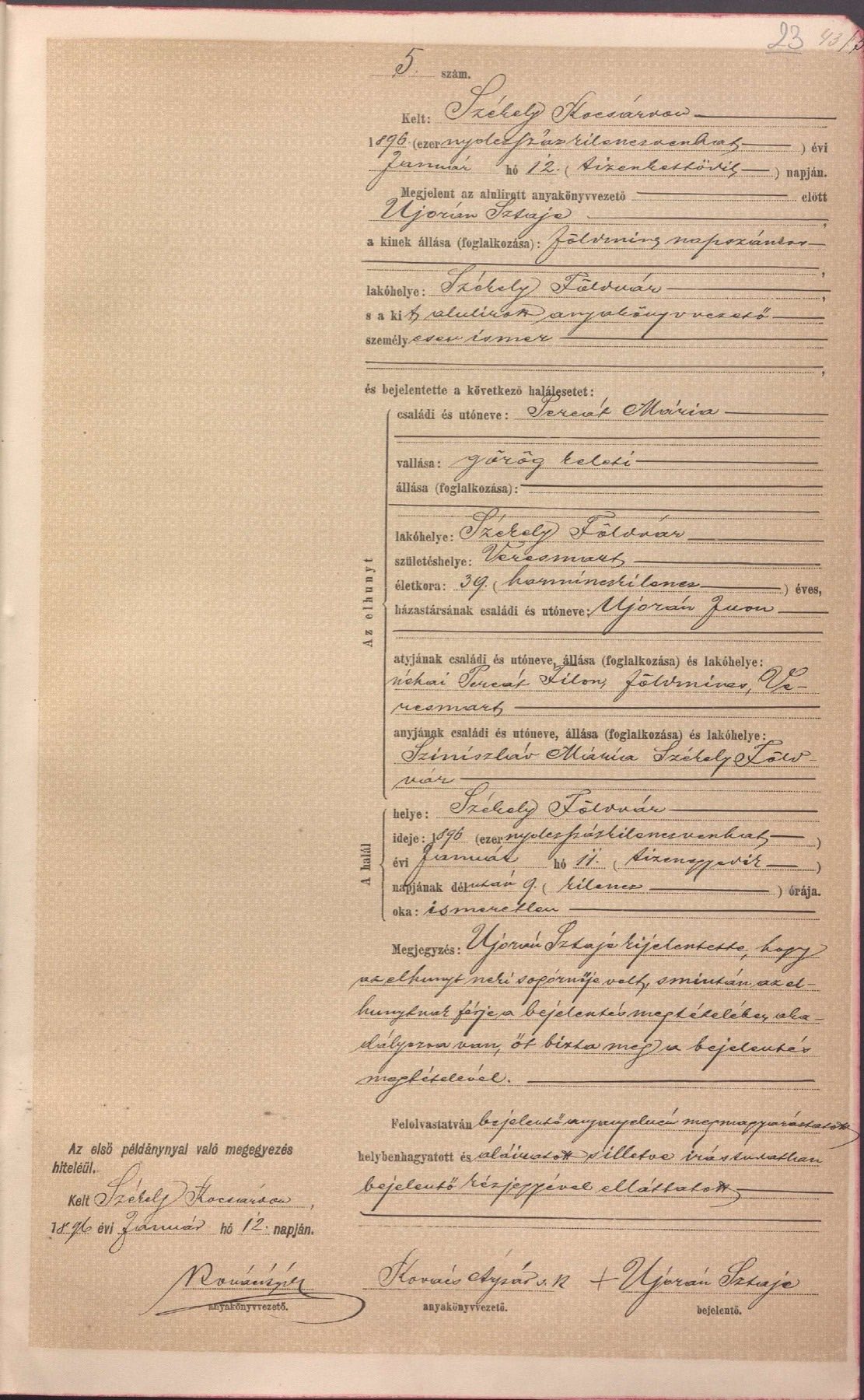
Death act 23 of 1896, Székelykocsárd registry district. My great-great-grandmother, entered as Pereák Mária, Orthodox, resident Székely Földvár, born at Veresmart, aged 39, wife of Ujórán Juon. The two fields that matter are the parents: néhai Pereák Filon, földmíves, Veresmart and Szaniszláv Mária, Székely Földvár. The declarant, a Uiorean day-labourer who gave the deceased as his sister-in-law, was illiterate and signed with a cross.
So a whole generation goes onto the tree: **Filon Periat**, a farmer of Veresmort, dead by
January 1896, and **Maria Sanislav**, living at Feldioara in 1896. No parish record, newspaper or
gazette in nine archives had managed that.
**And the mother's surname is the surprise.** I had the Sanislavs entering this family only with
my grandmother Minerva, in the twentieth century. This act puts a **Sanislav woman in my direct
ancestry three generations earlier**. Maria Periat was born about 1856, so that marriage was made
around the 1850s, twenty years before the earliest Sanislav household the parish registers show
in the village. How she relates to those households is entirely open.
The act also fixes the calendar for everything else here. The parish register dates this death 30
December 1895, keeping Julian time; the state registrar dates it 11 January 1896. Those are the
same day.
### My great-grandparents' marriage, and the trade the parish did not record
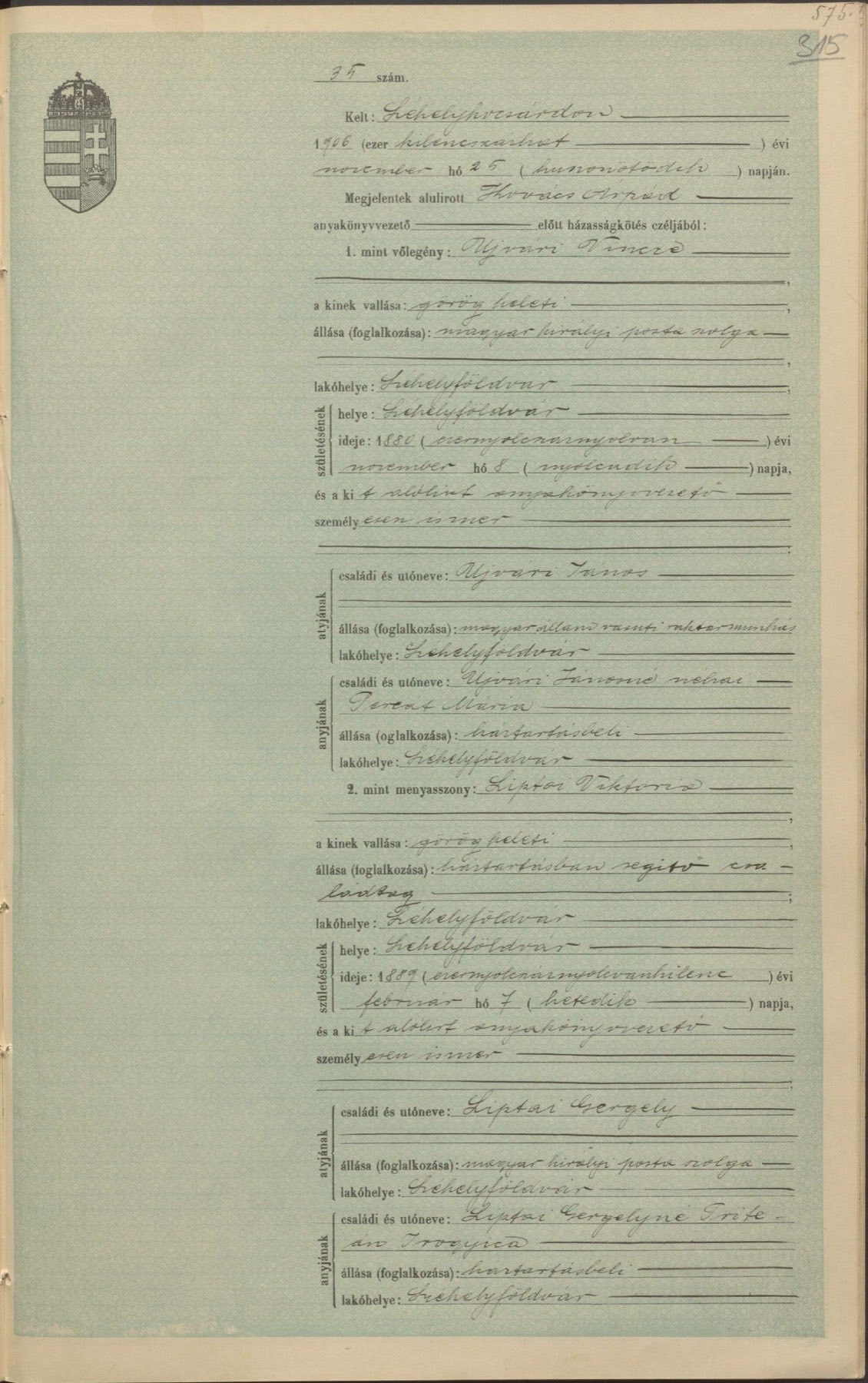
Marriage act 575, drawn up at Székelykocsárd on 25 November 1906, which is 12 November Julian and the date the parish gives. Groom Ujvári Vincze, Orthodox, born Székelyföldvár 8 November 1880; bride Liptoi Viktoria, born Székelyföldvár 7 February 1889. Both signed their own names. The occupation lines are the reason this act matters beyond confirming a date.
The parish register calls these men farmers. The state register, in the same years, calls them
something else:
| Man | Parish register | State register, 25 November 1906 |
|---|---|---|
| Vichentie Uiorean, my great-grandfather | *Econom* | **magyar királyi posta szolga**, Royal Hungarian Post servant |
| Ioan Uiorean, his father | *Agronom* | **magyar állami vasúti raktár munkás**, Hungarian State Railways warehouse worker |
| Gregorie Litean, his father-in-law | *Ziler* | **magyar királyi posta szolga** |
Both were true at once. The same registrar wrote Ioan down as *kisbirtokos*, smallholder, on the
very next act two pages later, so the household held land and drew state transport wages in the
same year. What it kills is a conclusion I had drawn from the newspapers, that this family came
off the land and onto the railway after 1923. That is about two decades late, and the section on
the railway below is rewritten because of it.
The two witnesses were **Negrea János**, 29, and **Negrea Galahteon**, 27, both smallholders of
the village. Ten months later, in September 1907, the second of them appears in the official
name-change column of a Budapest daily: **Negrea Galaction of Székelyföldvár, with his minor
children Valér and János, changed the family name to Fekete** by interior-ministry licence. And
*negru* is *fekete*. A man standing at my great-grandparents' wedding translated his Romanian
surname into Hungarian by formal act within the year, which is the exact mechanism the surname
argument below rests on, performed next door.
### The two Vichenties, separated, and a death date from 1948
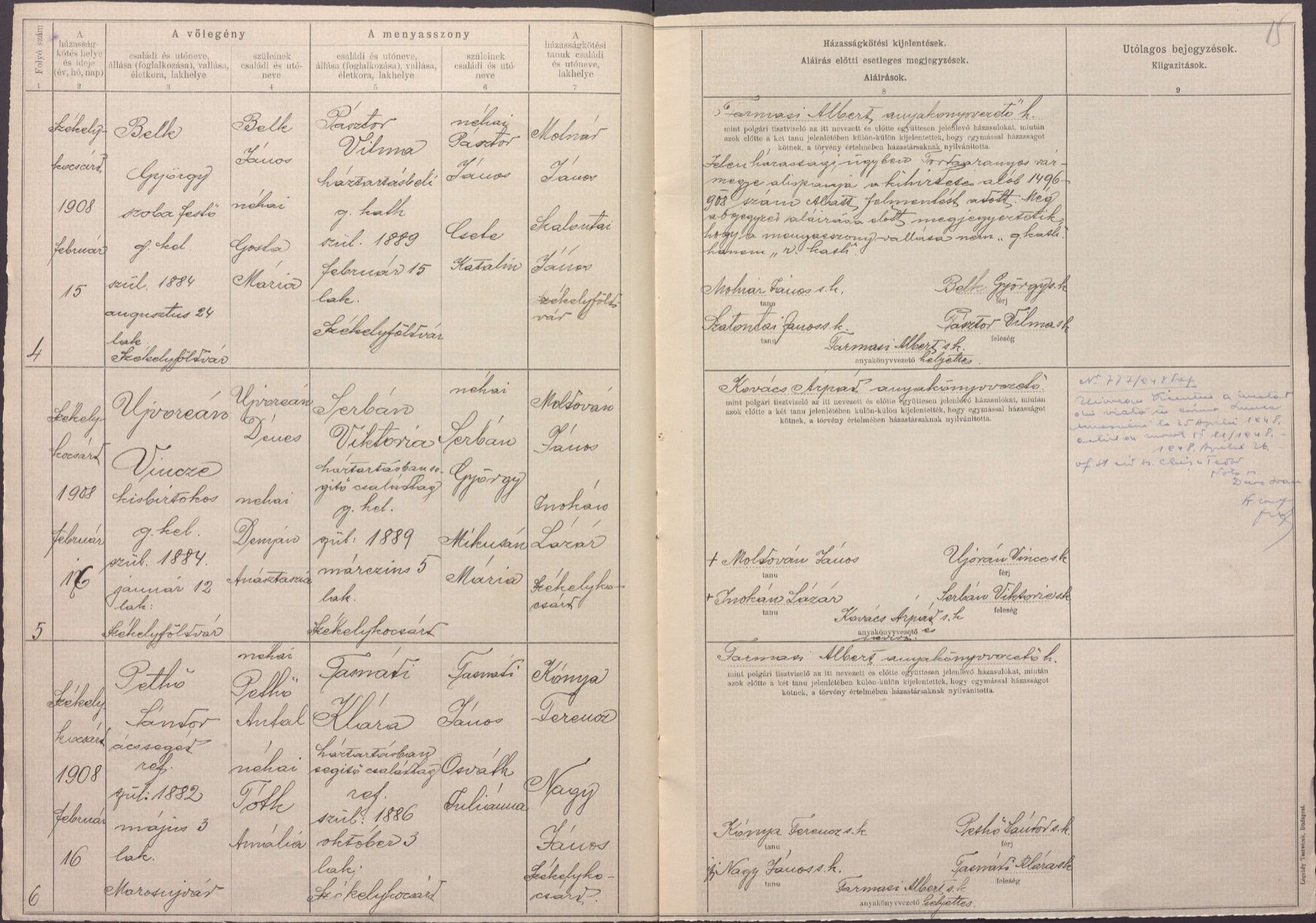
Marriage act 15 of 1908, middle row. This is the other Vichentie: Ujvoreán Vincze, born 12 January 1884, son of Ujvoreán Dénes and the late Demján Anásztaszia, marrying Serbán Viktória of Székelykocsárd. The blue ink in the last column was added forty years later and records his death at Lunca Mureșului on 25 April 1948.
Two men called Vichentie Uiorean lived in this village at the same time, and an index that groups
people by name will merge them. The state register separates them by their own parents and their
own birth dates, which is the only way it can be done: mine born 8 November 1880 to Ioan and
Maria Periat, the other born 12 January 1884 to a father the state clerk writes *Dénes* and the
parish priest writes *Onisim*. The mother matches in both, so it is one man; the two clerks
disagree about which of Petru Uiorean's sons his father was, so the cousinship is now probable
rather than certain.
**The annotation is a finding in its own right.** These marriage registers were kept live and
annotated with later deaths for at least forty years. So a volume of 1907 to 1917 marriages can
yield a death date from **1948**, which is well past the 1923 ceiling on the transcribed parish
books and past the hundred-year rule that keeps state death registers out of the archives. It is
the first documented death date I have for anyone of that generation, and it is the only route
this research has found past 1923.
### Romulus Tritean, and a question closed
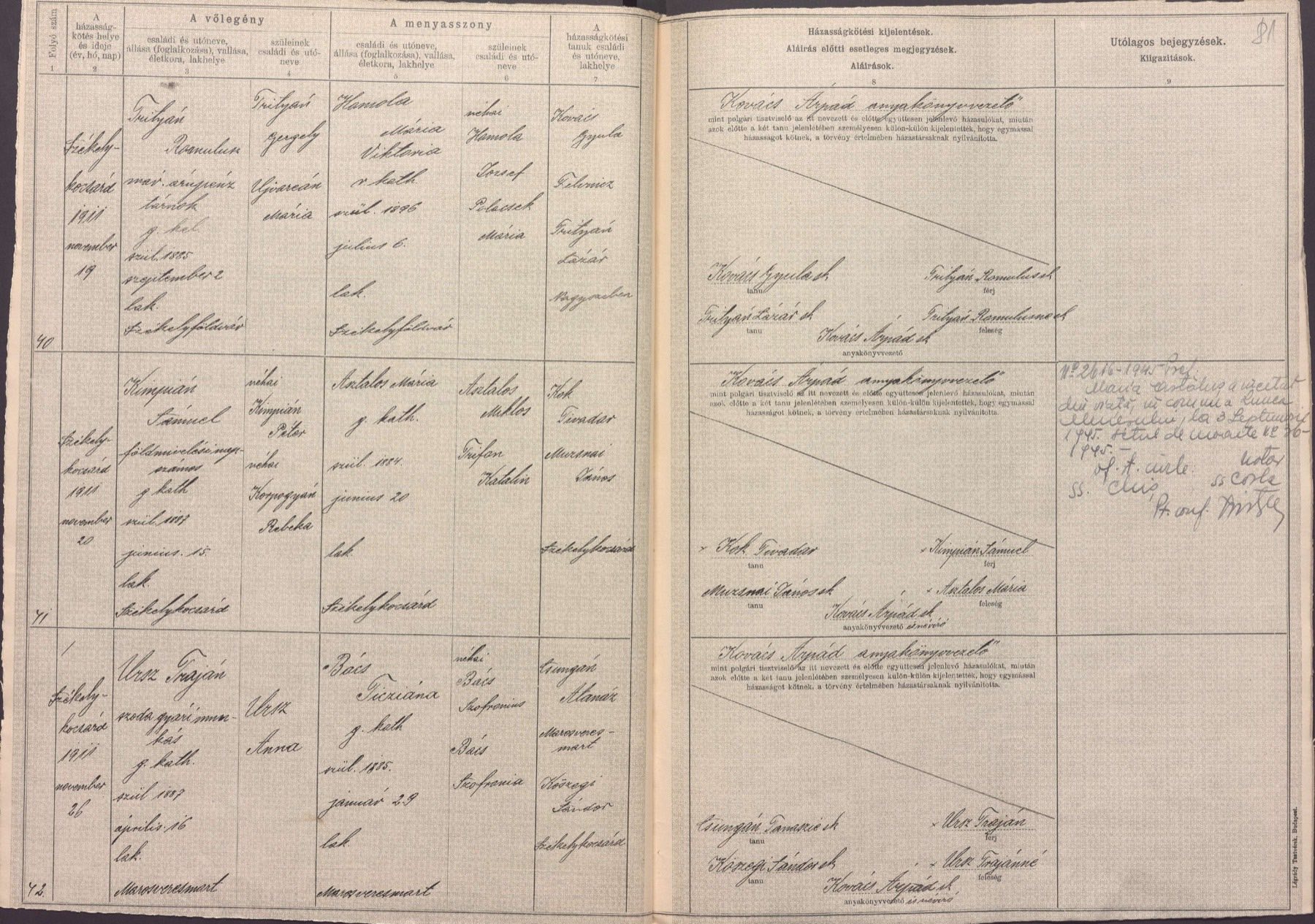
Marriage act 81 of 19 November 1911, top row. Trityán Romulus, occupation máv. áruraktár tárnok, a Hungarian State Railways goods-warehouse storekeeper, Orthodox, born 2 September 1885, resident Székelyföldvár, son of Trityán Gergely and Ujvareán Mária. The witnesses were Kovács Gyula and Trityán Lázár, and all four signed their own names.
I had been carrying an open question for months: whether the **Romul Tritean, inspector at the
CFR** who gave the village church sixteen icons in 1929 was the **Romulus Tritean born 2
September 1885** in the parish register, son of Gregorie Tritean and Maria Uiorean, and therefore
Petru Uiorean's grandson. The stated test was his father's name, and this act meets it: birth
date to the day, the right village, and both parents exactly as the parish gives them.
It adds the thing the argument actually turned on. He was already a railway warehouse official
in **1911**, at 26, fifteen years before the press picks him up as a line chief at Cluj. Once I
knew the register's own spelling of the surname, *Trityán*, the Hungarian press filled in the
whole career between the two ends:
| Date | Source | What it says |
|---|---|---|
| 1897, 1898 | Kolozsvár civic boys' school year-end lists | A pupil, at 11 and 12, in the practical school that fed railway and postal clerkships |
| 8 May 1906 | *Magyarország*, 12 May 1906 | An open letter to Romanian voters after the 1906 elections, signed **"Trityan Romulus"**, dated from Torda-Aranyos county. He was 20 |
| 19 Nov 1911 | state marriage act 81 | MÁV goods-warehouse storekeeper |
| 4 Jan 1914 | *Vasutas Szövetség* | *Állomásfelvigyázó* at **Székelykocsárd**, and elected to the committee of the Kolozsvár district of the Railwaymen's Federation at a founding assembly of five hundred men |
| 4 Jan 1919 | *MÁV Hivatalos Lapja* | *Kocsimester*, wagon master, raised a pay grade |
| 1926 to 1935 | Romanian press and *Monitorul Oficial* | CFR line chief at Cluj, then inspector, principal inspector, inspector general |
| Dec 1941 | *Tribuna*, *Țara* | **Mayor of the village**, founding its culture house |
| Mar 1943 | *Transilvania* | President of the local cultural circle, running a month-long peasant women's school in the village |
**I now treat that as settled on the balance of the evidence.** The one gap left is literal: no
single document writes both *Romul* and *Romulus* of the same man. Two things follow. My
great-great-grandmother's nephew rose from a village school to inspector general of the railways
and then came home to be its mayor. And the family's presence on the railway is a generation
older than the newspapers suggested.
The same 1914 federation slate carries, among the committee alternates, a **retired points
operator at Székelykocsárd** whose surname is printed *Liptat*, which is an obvious misreading of
**Liptai**, my great-grandmother's family name in its Hungarian form. He cannot be placed in the
Litean household from anything I have, so he goes down as an unplaced family-surname railwayman
at the right station in the right decade.
## Why the surname keeps changing
This is the thing that makes the family hard to search for.
The name is one name in two languages, and the parish scribes wrote whichever they felt
like. Across the records it appears as Uiorean, Uioreanu, Uiuorean, Uiărean, Uiuvorean,
Uivărean, Ujuorean, Ujuărean, Ujuvorean, Ujuvoreanu, Ujuoren, Ujeorán, Uioran, and in
Hungarian as Ujvári and Uivari. Several records give both at once: *Uiorean(ujvári)*,
*Ujvári(uiorean)*, *Vichentie Uiorean Ujvári*, *Ujuvoreanu&Uiărean*, *%Uivari% Uiărean*.
The reason is geography. **Uioara is the old Romanian name of Ocna Mureș**, twelve
kilometres away, and Hungarian *Marosújvár*. So *Uiorean* means "the man from Uioara" and
*Ujvári* means "the man from Újvár". They are the same toponymic surname, translated. The
double entries are not a scribe hedging his bets, they are a bilingual clerk writing the
name twice. A 1930 government gazetteer states the equivalence flatly in its
Hungarian-to-Romanian concordance: "Maros-ujvar = Uioara".
There is a reason beyond simple carelessness, and it is political. This village changed state
more than once inside the span of these records. It was Habsburg, then part of the Hungarian
half of Austria-Hungary after 1867, then Romanian from 1918. Each administration had its own
view of what a name officially was and which language it belonged in, and each one leaned on
whoever was holding the pen. The registers sit right on that seam, so you can watch the
pressure change from one page to the next.
**And the state registers add a third system on top of the two.** Their clerks used the
Hungarianised form and a phonetic transliteration side by side, sometimes in the same year:
| Ours | Hungarianised | Written phonetically |
|---|---|---|
| Uiorean | Ujvári | Ujvoreán, Ujvorán, Ujvarán, Ujvoán, Ujórán |
| Litean | Liptai, Liptoi | Lityán, Lityan, Lityáu |
| Tritean | | Trityán |
| Periat | | Pereák, Pereát |
| Sanislav | | Szaniszláv, Sinislav |
A sweep of that register index for *Ujvári* alone finds about a third of what is there, and my
first sweep of it missed my own great-great-grandmother, because her surname is written
*Pereák*. Hungarian *gy* also stands in for Romanian *di*, which is why Erodița Tritean is
entered as *Tritean Irogyica*.
You can date the pressure from the documents themselves, and the calendar gives it away. My
grandfather's 1913 birth record is Julian, in Romanian, with the Hungarian form of the place
name. The 1915 and 1916 birth records of his cousin Lucreția's daughters are in Hungarian
throughout, down to *Székelyföldvár* and *Postaszolga*, and they are **Gregorian**, because
that is what the Hungarian civil registry used. Meanwhile the Orthodox parish a few streets
away was still keeping Julian dates, and went on doing so through 1919. By 1921 the same
village is recorded with the full Romanian administrative chain, and the parish has switched to
Gregorian too.
So for a stretch of years, two authorities in one village were writing the same families down
in different languages, under different versions of their names, on two different calendars.
The variants are not really spelling mistakes, then. They are the same people being recorded
by successive states with different rules about names, plus a village priest doing his best
with whichever rule was current. A surname here is less a fixed string than something that
got translated every time the border moved.
The best single proof sits outside the parish register. Lucreția Uiorean was born in the
village on 26 March 1894. Her own daughters' birth records, from 1915 and 1916, are
written in Hungarian and give her name as **Lukrécia Ujvári** and **Lukrecia Ujeorán**, at
*Székelyföldvár*.
The same doubling happens on my great-grandmother's side, where **Litean** doubles as
**Liptai**. She appears as "Victoria Litean Liptan" on her marriage record and "Victoria
Liptai(litean)" on her children's. Her brother Valeriu Litean, born 1 May 1895, turns up
in the Hungarian Royal Army personnel gazette of September and October 1918 as **"Liptai
Valér, 1895, Székelyföldvár"**. An Austro-Hungarian military clerk and an Orthodox village
priest, with no connection to each other, wrote down the same man under both surnames.
### The suffix is not the name
`-ean` and `-eanu` are a **productive demonym suffix** in Romanian. They build "the one from X"
out of a place name, and the suffix is still live, which is why it sits on so many unrelated
surnames. In these records alone: Uiorean, Chiorean, Teorean, Tritean, Litean, Cordean,
Moldovean, Someșan, Sângeorzan, Zăgrean, Gegeșan, Hopârtean, Șpălnăcean, Selejan.
Two things follow, and I got the second one wrong for a while. **Two surnames sharing the ending
are not variants of one name**: they are separate coinages on different stems, and they rhyme,
and that is the whole of the relationship. And **a name built this way can be coined
independently in several places**, so a surname's distribution is a statement about where its
bearers were numerous, not about one family's territory.
Which makes one collision in these registers worth naming, because it lands exactly on my
earliest ancestor. My line begins with **Petru Uiorean, born about 1820 at Feldioara
Săcuiască**. The same parish baptised a **Petru Ciorean in 1820**, son of a Iacob Kiorean, and
buried a Sinzieană Kiorean in 1821, and Chiorean is settled in that village through to 1921. Two
men, one forename, one village, one year, two different surnames. **Match on the stem, never on
the ending.** Chiorean also happens to be my maternal grandmother's maiden name, which is
precisely what makes this collision easy to talk oneself into.
Two similar looking surnames in the same registers are **not** this family: **Uifelean /
Uifelianu** and its Hungarian pair **Ujfalusi / Ujfalvi**, which come from Uifalău, a
different place. I have excluded them throughout.
Every spelling I found, exactly as the clerks wrote it, is listed under [all the names in
these records](#all-the-names-in-these-records) at the foot of the page.
## Four men of this surname born about 1880 in one village
Worth stating plainly, because it is the trap in these records, and it got worse rather than
better as I found more sources.
**Vichentie born 8 November 1880**, son of Ioan Uiorean and Maria Periat, an *Econom*, a
farmer with land, and a royal postal servant. He married **Victoria Litean** on 12 November
1906 aged 26, which matches his birth date exactly. My grandfather is his son.
**Vicentiu born 12 January 1884**, son of Onisim (or Dionisie) Uiorean and Anastasia Demian, a
*Ziler*, a day labourer. He married **Victorie Șerban** on 3 February 1908 at Cucerdea, and died
at Lunca Mureșului on 25 April 1948. Their children were Margaretă (1908), Ioan (1910) and
Traian (1912).
And then two more, from the Austro-Hungarian casualty lists, neither of them in any parish
record I have:
| Name | Born | Unit | Fate |
|---|---|---|---|
| **Ujvári Axenta** | 1880 | IR 50, 6th company | prisoner of war, reported 1 December 1915 |
| **Ujvári Károly** | 1880 | IR 50, 11th company | killed between 23 November and 9 December 1914 |
**Neither of those is Vichentie.** Vince is the Hungarian for Vichentie, and a clerk writing this
family's names in Hungarian would not render Vince as Károly or as Axenta. What they establish is
that the village held at least four men of this surname born within a few years of each other, so
the separation has to be done on parents and exact dates every single time. Any index that groups
them by surname and approximate age will fuse them, and one of the fusions would put my
great-grandfather in a Russian prison camp.
Any index will also make Traian, born 9 June 1912 in the same village, look like my
grandfather's brother. He is not. His mother is Victoria Șerban and both his parents are
recorded as day labourers, where my great-grandparents are recorded as Econom and Economă.
## Namesakes who are not family
Recorded so nobody later mistakes them for relatives. An **Ion Uioreanu** was an
investigating judge in Cluj, prominent in the early 1930s: a different man entirely, sitting
as a judge while my grandfather was a schoolboy. A **Lt. Maj. I. Uioreanu** appears throughout
the army paper *Apărarea Patriei* in 1957 and 1958, writing and taking photographs about
engineer troops and the Military Engineering School. Given the arm, that one is a genuine trap,
but it is a staff photographer on a Bucharest paper, and my grandfather was teaching in
Războieni throughout. A **Sándor Ujvári** was a pharmacist at Marosújvár who died in 1891. A
**Georgius Ujvári**, innkeeper, died in 1820. And an **Ioan Uioran**, a day labourer, died at
Dej in 1860, a different county altogether.
The bigger trap is that both of my paternal grandparents' surnames are also Transylvanian place
names. *Uiorean* is the ordinary adjective for Ocna Mureș, so the archive is full of "publicul
uiorean" and an "Ansamblul folcloric Uiorean" that have nothing to do with anyone's family.
*Sanislău* is a commune in Satu Mare county, and *Sanislau* was also a live forename in this
region, because St Stanislaus has a name-day in the Catholic calendar. Most hits for either word
are the place or the saint, not a person.
## My grandmother's family, the Sanislavs
My grandmother was **Minerva Uiorean, born Minerva Sanislav**. Hers is still the one name on
this side that I cannot trace to her parents, and the reason is where the records stop rather
than anything about her. The transcribed parish books end in 1923 and no Minerva Sanislav
appears in them, so she was most likely born after that. Her marriage to my grandfather falls
outside the coverage too.
What the records do show is that a Sanislav family was settled in the same village across the
whole period. Six households appear, and nothing in the parish registers links them to one
another:
| Household | Recorded | Notes |
|---|---|---|
| **Mateiu Sanislav** and Marie Fogarasi | 1875 to 1881 | *Agronom*, **greek catholic, born at Veresmort**. His wife is orthodox and the children baptised orthodox. Four children, three of whom died young |
| **Georgie Sanislav Lup** | m. Iuliana Hertia, 10 Nov 1885, aged 23 | **Groom born at Veresmort**; the bride is of Feldiora |
| **Maria Sanislav** | m. Georgie Chimpean, a *Ziler* | **Her birthplace is given as Veresmort.** Three Chimpean children, 1886 to 1891 |
| **Dionisie Sanislav** | m. Adolfina Demian, 11 Feb 1902, aged 25 | **Groom greek catholic, of Vereșmort**; the bride orthodox, of Feldiora |
| **Ioachim Sanislav** and Sofia Antonia | m. 18 Jul 1904 | **Groom greek catholic, of Veresmort**; the bride orthodox, of Feldióra. *Econom*, later *Ziler*. Five children, three died young. Sofia died 29 Dec 1916, aged 31 |
| **Ilie Sanislav Lup** | m. Eleonora Antonie 1909, then Gervița Hetea 1916 | *Econom*. Sons Rubin (1918) and Iulius (1919) |
The last two are the only plausible candidates for Minerva's parents, because they are the
only ones still in a position to have children after 1923: Ioachim was widowed at the end of
1916 and would almost certainly have remarried, and Ilie married Gervița Hetea in 1916 and
was still having children in 1919. I cannot get closer than that, and I would rather say so
than pick one.
### They were not an old village family, and the state register proves it
The parish books record the 1902 and 1904 marriages but not where the grooms came from or who
their parents were. The state acts do both.
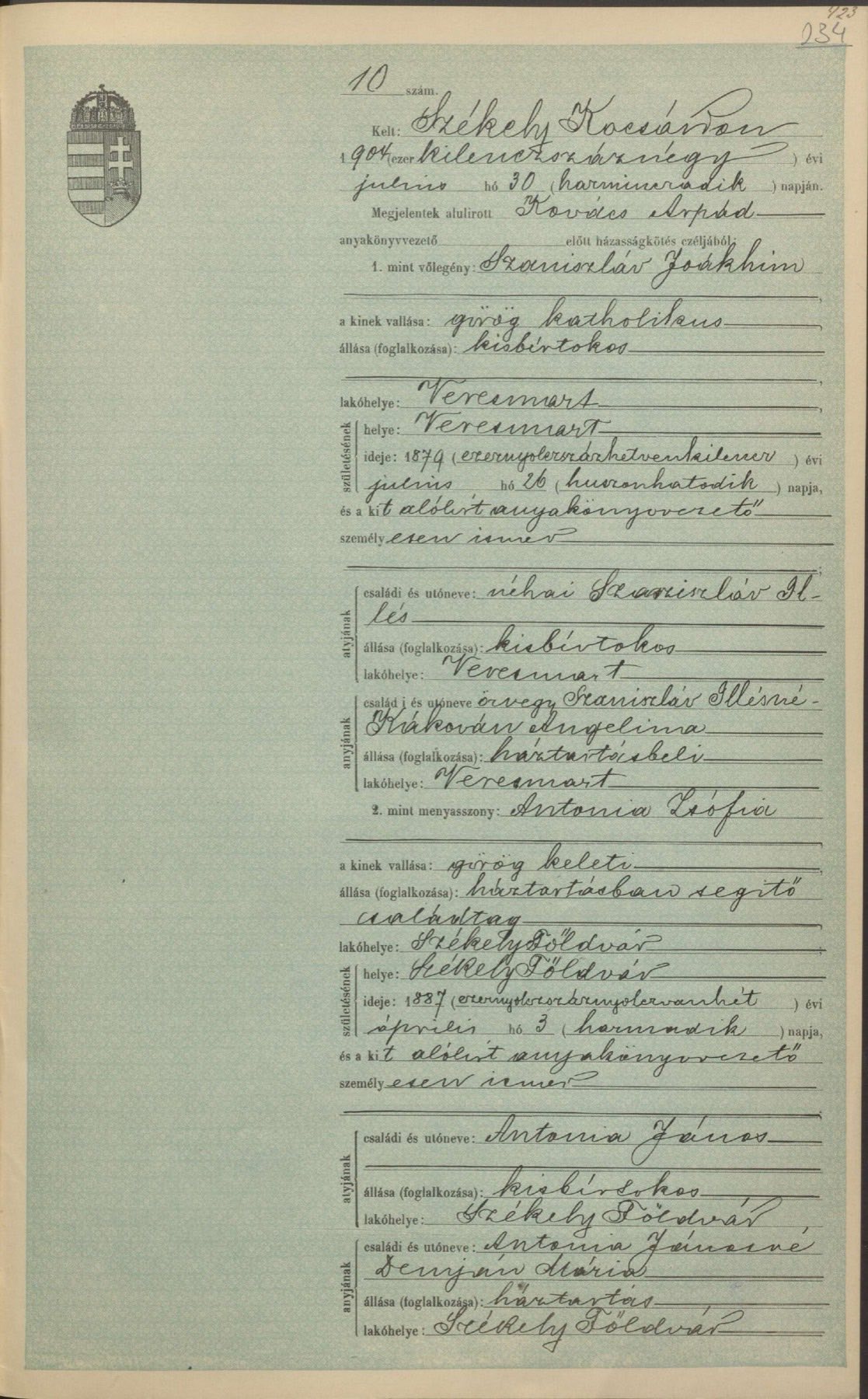
Marriage act 423 of 30 July 1904. Szaniszláv Joákhim, Greek Catholic, smallholder, resident Veresmart, born Veresmart 26 July 1879, son of the late Szaniszláv Illés, farmer of Veresmort, and his widow Krákován Angelina. The bride is Antonia Zsófia, Orthodox, born Székely Földvár 3 April 1887.
| Groom | Act | Born | Rite | His parents, all of Veresmort |
|---|---|---|---|---|
| **Dionisie Sanislav** | 311, 24 Feb 1902 | **Veresmart, 27 Sep 1875** | Greek Catholic | **Gheorghe Sanislav** and **Dochia Mureșan** |
| **Ioachim Sanislav** | 423, 30 Jul 1904 | **Veresmart, 26 Jul 1879** | Greek Catholic | **the late Ilie Sanislav** and **Angelina Crăcovan**, his widow |
So the Feldioara Sanislavs were **Greek Catholic men from Veresmort** who married Orthodox women
of the village and settled there, between about 1875 and 1904, raising Orthodox children. The
children are why the household reads as an old Orthodox village family at a glance: they were.
Their first child is documented too, a **Maria born at Feldioara on 16 December 1906**, entered
Orthodox after her mother although her father was Greek Catholic, on an act the registrar noted
he had explained to the father **in Romanian, his mother tongue**, and which the father signed
with three crosses.
**This matters for my grandmother rather than being a detail of nomenclature.** Her people were
**incomers**, and her own birth record is as likely to be in the **Veresmort** books as the
Feldioara ones, and as likely to be **Greek Catholic** as Orthodox. That widens the search rather
than narrowing it, but it points at a specific second parish, and the request can now quote two
named couples instead of a surname.
One of those two women turns up again independently, in the catalogue of the Turda mixed court:
a 1927 damages suit against a "Sinislav Dofina l Gheorghe", which is Dochia, wife of Gheorghe, of
Veresmort. The same woman reached twenty-five years apart through a court index and a civil
register, which is the kind of agreement that says both readings are right.
### The Lup alias
The Sanislavs of this village carried a second name, **Lup**, Romanian for wolf. Ilie's 1909
marriage record puts it beyond doubt by spelling him *Sanislav Alias Lup*, and it recurs as
*Georgie Sanislav Lup* (1885), *Ilie Sanislau Lup* (1916), *Rubin Sanislau Lup* (1918) and
*Iulius Sanislau Lup* (1919).
This is a different habit from the Uiorean and Ujvári pair. Uiorean and Ujvári are one name
translated between two languages. Lup is a byname, the sort of nickname a village used to
tell apart households that shared a surname. Both are at work in the same registers, and
both will defeat anyone searching naively for a name.
One caution. There is a Hungarian equivalent of Sanislav, *Szaniszló*, and the parish books do
contain it, but I have no evidence it was ever used for this family. The only Szaniszló
connected to the village is **József Szaniszló**, a calvinist from Kolozsvár who married Róza
Mihocsa of Székely Földvár on 8 April 1912: a Hungarian marrying in, not a village Sanislav
written in Hungarian. So unlike Uiorean and Ujvári, I am not claiming a translated pair here.
## Both families connect to the same neighbouring village, by opposite routes
A pattern I did not expect. **Veresmort**, now Unirea, about eight kilometres away, turns up on
both sides of my paternal grandparents' families, and the traffic runs in opposite directions.
On my grandfather's side it is brides. **Maria Periat**, my great-great-grandmother, was born at
Veresmort and married Ioan Uiorean into Feldioara. Her father Filon Periat was a Veresmort man
too, and her mother a Feldioara woman, so that couple had already made the same journey a
generation earlier.
On my grandmother's side it is the men. The **Sanislav** grooms are the ones recorded as being
of Veresmort, and their wives are local Feldioara women: Iuliana Hertia, Adolfina Demian and
Sofia Antonia are all entered as *of Feldiora*.
So one family took its wives from the next village, and the other **was** the next village,
moving in. Two separate lines of my father's ancestry run into a parish that has not been
transcribed and whose books I have not seen, which makes Veresmort the biggest single gap on
this side of the page.
## The Triteans, and a bishop born in the village
This part of the page exists because somebody asked me a direct question: is the family
connected to **Lucian Triteanu**, born Lazăr Triteanu on 15 August 1872, Orthodox bishop of
Roman from 1923 to 1947? He was born in this village, and the answer turned out to be yes,
twice over, with one step I cannot close.
**First, I am descended from the Triteans.** My great-grandmother's mother, **Erodița
Tritean**, whom I previously had with no birth date and no parents, was born **14 January
1868** at Feldioara, daughter of **Toma Tritean**, a *Plugariu* and later *Agronom*, and
**Efimie Popa**. She married Gregorie Litean, and their daughter Victoria Litean married
Vichentie Uiorean in 1906. So Erodița is my great-great-grandmother, and Tritean is a direct
line, not a family that merely married in.
**Second, her brother married a Uiorean.** **Gregorie Tritean**, born 29 January 1860 to the
same parents, married **Maria Uiorean** on 13 February 1883, he 23 and she 16. Maria was
Petru Uiorean's daughter and my great-great-grandfather Ioan's sister. A brother and a sister
out of Toma Tritean's household married into the two lines that later joined in 1906. Their son
is the Romulus Tritean of the marriage act above.
Both Tritean houses lost their mother in the same fortnight of 1877. Efimie Popa died on 5 May,
aged 42, when Erodița was nine. Eight days later, on 13 May, Ana Vințeler died in the other
Tritean house at the age of 34, leaving seven children, the fifth of them Lazăr, then four.
The register contradicts itself slightly here: the seventh of those children, an Ioan, is
entered as born on 1 August 1877, eleven weeks after his mother's recorded death, so one of
those two dates has to be wrong.
### Identifying the bishop in the parish register
The register has him, under the transcriber's reading of the priest's hand: **"Ladiar
Tritean"**, [hpdt.ro/tlooks/4428](https://hpdt.ro/tlooks/4428), born **15 August 1872**,
Julian, at Feldiora Secuiască, orthodox, son of **Georgie Tritean**, *Agronom*, and **Ana
Vintieleriu**. Four things confirm it against the published biography, which has him as the
fifth of the seven children of George Triteanu and Ana née Vințeler:
- his parents' marriage, 3 November 1863 at Feldiora
- exactly seven children in the register between 1864 and 1877, with Ladiar the fifth
- his mother's death on 13 May 1877, aged 34, which is the biography's "motherless at five"
- his father's remarriage to Maria Dragan on 12 February 1878
The eparchial weekly *Renașterea* independently lists him in 1923 as a Transylvanian-born
hierarch "din Feldioara", alongside Miron Cristea of Toplița and Nicolae Bălan of Blăjel. It
does not say which Feldioara, and there are four, so the register is what settles it.
### How close the kinship is, and where it stops
The bridge between the two Tritean households is a wedding. The biography records that on 6
November 1911 Lazăr Triteanu officiated in the new church at Feldioara-Războieni at the
marriage of "vărului său, Triteanu Romulus" to Homola Maria Victoria. That marriage is in the
parish register: Romulus Tritean, 25, and Maria Victoria Homda, 17, on 6 November 1911, which is
the same wedding the state register records on 19 November. And **Romulus was the son of
Gregorie Tritean and Maria Uiorean**, born 2 September 1885. So the future bishop stood at the
altar for the wedding of Petru Uiorean's grandson, and called him cousin.
If *văr* is meant strictly, then Georgie and Toma were brothers, which would make the bishop
a first cousin of my great-great-grandmother Erodița, my own first cousin four times removed,
and my descent a descent from his uncle.
**I cannot prove that step, and I am not going to assert it.** Toma's death record names no
father, neither man's marriage record has parent fields at all, and the word *văr* is used
loosely in Romanian for kin of roughly one's own age. The ages allow brothers: Toma was born
about 1828 and Georgie about 1839. There is a Georgie Tritean born 1839 to an Ioan Tritean,
but the transcriber recorded that family's surname as `Nistor%%Tritean%%`, two readings at
once, so it will not carry the weight. What is solid is that both households were Tritean and
orthodox in one small village, that they treated each other as cousins, and that I descend
from one of them.
### The branch was educating its sons
Two things say the Tritean household my great-great-grandmother came out of was doing better
than day labour, and both come from Hungarian school lists. **Trityán Lázár of Sz. Földvár**
appears in class V of the **Nagyszeben state gymnasium** in its 1890 yearbook, so a village
Tritean of about fifteen was at a full state gymnasium in Sibiu, born around 1875. And a
Trityán Lázár signed as one of the two witnesses on Romulus's 1911 marriage act, in his own
hand, so the witness is very probably that man. Romulus himself was at the Cluj civic boys'
school in 1897 and 1898.
Two boys of one village branch in secondary education by 1898, one of them at Sibiu, is the
readiest explanation for how it produced railway officials and, eventually, a mayor.
## The parish and the school
None of this names a Uiorean. All of it describes the institution every person above was
registered in and the school my grandfather attended as a boy, and it comes out of the eparchy's
own weekly, *Renașterea*.
- **A class I parish in the protopopiat of Turda**, in the eparchy of Vad, Feleac and Cluj. In
June 1924 it sat at the edge of the Ludoșul de Mureș tract; by December 1927 it belongs to
Turda.
- **167 families in December 1927**, one of which was Vichentie Uiorean's. The parish held 32
iugăre of glebe and took half a *ferdelă* of maize and a day's labour from each family, a third
of it going to the cantor and the sexton.
- **Vasile Maximinian** was parish priest in 1924, so his is the hand in the registers of that
decade. He was promoted to chaplain to the protopop before December 1927, which is what created
an advertised vacancy; **Dumitru Giurgiuca**, priest of the neighbouring parish, signed for the
parish council in April 1928; and **George Onițiu** held the parish in 1929 and 1930.
- **Simeon Bogdan** was head teacher, with **Iuliu Răduleț** and **Simeon Crainic** under him. On
21 June 1924 Bogdan conducted the village school choir at the station to welcome bishop
Nicolae Ivan, who had come by the morning train from Cluj. **My grandfather was ten years and
eleven months old and a pupil of that school.** He is not named, and a village choir is not a
list, but it is the closest any source comes to him as a child.
- In April 1928 **Dr Ilarie Ilea**, a native of the village practising as an advocate in Brașov,
gave the parish a bell of 70 kg worth 15,000 lei and a foundation of 100,000 lei in the names
of his parents Ioan Ilea and Maria Coston.
- At Easter 1930 a CFR clerk named **Amărască** trained a **church choir made out of the railway
station's own staff**, which gave the liturgical responses. That is the world the section below
describes, a decade before the newspapers pick it up.
- The village was holding *șezători*, cultural evenings, in its school by 1929, when the Cluj
Orthodox theological academy came out for a mission day. The same institution is where an M.
Sanislav turns up in 1944.
## The First World War
Transylvania was Hungary until December 1918, so every man in this family of military age in
1914 was an Austro-Hungarian conscript. Austria-Hungary published named casualty lists by the
hundred, 709 of them plus supplements, and the whole run has been transcribed. That makes it the
one war this research can reach at the level of a person.
**Before any archive, the parish registers say something on their own.** Vichentie and Victoria's
children arrive in 1907, 1909, 1911 and 1913, and then stop dead until 19 September 1919. A
six-year hole in an otherwise two-yearly rhythm, opening in 1914 and closing nine months after
the armistice. Across the whole family, births run two to four a year before the war and **none
at all in 1914 and none in 1917**. And no family man dies between 1914 and 1918, so nobody was
killed at the front and entered in the home parish book.
Austro-Hungarian casualty list no. 326 of 1 December 1915, page 43: "Ujvári Axenta, Inft., IR. Nr. 50, 6. Komp., Ungarn, Torda-Arynyos, Székelyföldvár, 1880; kriegsgef." Right surname in its Hungarian form, right village, right county, and my great-grandfather's exact birth year. The forename is not his, and the print is clean, so this is not an OCR problem.
**Is Axenta the same man as Vichentie?** For it: the surname, the commune, the county, the birth
year to the digit, and a capture in 1915 followed by repatriation at the end of 1918, which fits
the gap in his children exactly. Against it: Hungarian paperwork renders Vichentie as *Vince*,
not *Axenta*, and no Vince Ujvári appears in the lists at all. Axente existed as a name in the
village, borne by other families, but **no Uiorean carried it in any parish record**. I have read
the printed page and *Axenta* is set in bold, clean and legible. So it stays a strong
circumstantial case and not an identification.
**The Hungarian National Archives then produced a second man of the surname, and I had missed
him for a year.** **Ujvári Károly**, also born 1880 at this village, IR 50, 11th company, killed
between 23 November and 9 December 1914. He was invisible to every search because the clerk
abbreviated the village to *Sz. Földvár*, so no query on the full name reaches him. The lesson is
worth more than the man: **a sweep by place is never complete, and a sweep by surname is not
optional.**
**The village's whole war record is 28 loss events**: twelve taken prisoner in Russia, from
Nerechta and Tula to Samarkand and Primorye, two in Serbia at Niš, six dead. IR 50, the Alba
Iulia regiment, carries most of them. The surnames confirm the village is the right one, because
they are this family's in-laws written in Hungarian: Bugnár is Bugnariu, Demián is Demian,
Kosztoj is Costoiu, Negrea and Nyegra are the Negrea whose son magyarised into Fekete in 1907.
Veresmort, where both the Sanislav and the Periat came from, gives seven more, every one of them
IR 50, including a Muresán who carries Dochia Mureșan's surname. And one entry there is worth
testing when the Veresmort books are finally read: **Szaniszláv János, born Marosveresmart 1883**,
of a Hungarian Landwehr regiment, a prisoner of war at Astrachan in Russia, reported in September
1915. A János born at Veresmort in 1883 would sit neatly as a younger brother of the Ioachim
Sanislav born there in 1879, and that is a shape rather than a finding.
**Everything else on this side is a documented negative.** Liptai in Torda-Aranyos: nothing.
Szaniszláv in Torda-Aranyos or Alsó-Fehér: nothing. Periát: nothing, and the four Periat records
in the index are Banat men. Tritean and Trityán give six records, all Torda-Aranyos, and none
from this village.
## The Second World War is a different kind of silence
My grandfather was commissioned in the engineers in 1940 and the family account is that he served
as a *genist*, was engaged in demining, and was wounded. The commission is documented below. The
rest I cannot document, and the reason is structural rather than a search failure: **Romania did
not publish named casualty lists in the Second World War.** What appeared was aggregate figures
only, and a Council of Ministers communiqué giving a national total is the closest the press gets
to a person. Named Romanian service records for that war sit in the military archives at Pitești,
which are not online and not searchable from a desk.
The National Archives portal holds no military service records at all. Its only war series
catalogued down to the individual is the invalids, orphans and war widows administration, and for
Alba county that is catalogued at fond level with no dossiers, so it cannot be searched by name
from here either.
Two things have to be said about the Hungarian side of this, because both were hopes and both are
closed. The **Soviet camp card index** in Budapest holds 679,319 registration cards carrying
birthplace, birth year and the father's forename, which would have named my maternal
great-grandfather from a document rather than from memory. It cannot: the database has **no
Romanian nationality value at all**, because it is the set of people the Soviets registered as
Hungarian nationals. That closes the item on provenance, not on a blank search. It does not mean
nobody was a prisoner, it means that archive would not know. And the **Hungarian conscription
lists** for 1756 to 1918 are built from the microfilms of twenty-one county archives, every one
of them inside present-day Hungary, so they cover no part of Transylvania.
## What the Y chromosome says, which is not what I expected
My Y-DNA haplogroup is **I-M253**, that is **I1**, and it traces the strict male line: me, my
father, Ioan born 1913, Vichentie born 1880, Ioan born 1852, Petru born about 1820, and then the
records stop.
**I1 is a Northern European and Germanic lineage.** Romanian Y-DNA is dominated by I2a, the
Balkan branch, not by I1. Where I1 turns up in this part of Europe it is generally attributed to
German and Austrian settlement, running at roughly 8% among Hungarians, 11% among Czechs and 6%
among Poles and Slovaks.
So a Germanic male line sits at the head of a family the parish registers show as Romanian
Orthodox peasants for as far back as they reach. That is worth an explanation, and the village
supplies a plausible one: Feldioara was thoroughly mixed. Its own casualty list has Szabó,
Szabados, Tolnai-Kun and Malya standing beside Bugnár, Negrea and Molea, and this family's
surname existed in two languages at once. **If a Saxon or Hungarian male line was absorbed here,
it happened before Petru**, which puts it in exactly the gap the diagram above marks: the thirteen
unattached Uioreans recorded between 1813 and 1849.
I want to be careful about how much that is worth. A haplogroup is one line out of hundreds of
ancestors, it says nothing about the rest of the family, and a single absorbed male line four
hundred years ago would produce exactly this result. It is a fact about a chromosome, not about
anybody's nationality.
**A trap worth naming before someone falls into it.** Searching for genetics and Feldioara turns
up a real study of mitochondrial DNA from a twelfth-century necropolis at Feldioara in
Transylvania. **That is the wrong Feldioara**: it concerns the Brașov one, the Teutonic Knights'
Marienburg, two hundred kilometres away, and it is mtDNA rather than Y.
## The village before the registers
The parish books begin in 1813. For anything earlier the only reachable material is charters,
and the medieval holdings of the National Archives contain exactly **three documents** touching
this village. No family surname appears in them and none could: they are the records of kings,
princes and Saxon town magistrates, and Orthodox Romanian villagers of the Arieș valley are not
the kind of people who get named.
- **9 April 1460.** Mihail Szilágyi de Horogszeg, count of Bistrița and governor of Transylvania,
orders **the nobles of Fewldwar** to compensate the Sibiu merchants they had beaten up, and to
let Sibiu men and their goods pass freely to the fair at Buza. The earliest reachable mention,
and a good one: the village has its own nobles and sits on the road merchants took north from
Sibiu.
- **24 April 1585.** A charter of **Sigismund Báthory**, signed in his own hand, ordering that
the goods and revenues owed to the Aiud deanery be given back, because the inhabitants of the
market towns of **Felvinc** and **Uywar** and the tenants on the estates of Mirăslău, Cârcedea,
Hărăstaș and **Feoldwar** had been using them for themselves. This is the best of the three. It
puts the village inside the **Székely seat of Arieș**, which is what the "Săcuiască" in its
name records, so the qualifier is a jurisdiction and not a statement about who lived there. It
administers Feldioara together with the same tight cluster of neighbouring villages that the
nineteenth-century registers show the family marrying within, four hundred years earlier. And
it names **Uioara as a market town with a royal salt chamber and its keeper**, which is the town
both halves of my surname are built on. It also names Aiud, where my mother's whole side ends
up three and a half centuries later, which is a coincidence of geography and the only document
in that archive holding both halves of the family's map at once.
- **1596 and 1597.** A possession order and its reply, for an estate in Alba county, catalogued to
this village under the spelling *Feldiod*. I do not trust that gloss: the same archive glosses
*Gyod* to Stremț, so *Feldiod* could as easily be upper Stremț, and I would want the scan read.
The lesson from that archive is a cataloguing one. *Fewldwar*, "earth fort", is one of the
commonest place names in the old kingdom, and searching the raw spelling returns sixty-odd
documents of which one is mine. **It is the cataloguer's gloss in curly brackets that identifies
a village, never the string.** The same is true of *Újvár*, "new castle".
For the village between the charters and the registers, the sources are conscriptions rather than
charters, and I have their shelf marks but not their contents: the 1750 fiscal census of
Transylvania has two booklets for Székelyföldvár, and the 1785-86 urbarial conscription has one
for it and one for Veresmart, filed under Kolozs county and the Felvinc district, which is not
where I would have looked.
## What happened after the registers stop
The parish records end in 1923 and show a family of farmers. The newspapers pick the story up two
decades later and show something else: **the family was on the railway.**
Războieni-Cetate is a major junction on the main line, which is the reason. A 1982 village report
counts fifty-two railway families living in the village and around the station.
**The date is the part I had wrong, and the state register corrected it.** I used to write that
the family moved off the land and onto the railway after 1923. In fact **Ioan Uiorean was a
Hungarian State Railways warehouse worker in 1906**, his son Vichentie and Vichentie's
father-in-law Gregorie Litean were both Royal Hungarian Post servants in the same year, Romulus
Tritean was a MÁV storekeeper in 1911 and a station overseer at Székelykocsárd by 1914, and a
Liptai was a retired points operator there by the same date. That is five men of these three
surnames in railway or postal service **before 1918**. The interwar careers are a continuation of
a trade the family already had, not a change of one.
There is one boundary on how far that can be pushed. The Hungarian official directory lists the
staff of Székelykocsárd station year by year, and **no Uiorean or Ujvári appears in any year from
1903 to 1918**. But it lists only the commissioned and clerical grades, and never the
*állomásfelvigyázó*, *kocsimester*, *raktárnok*, *váltókezelő* or *munkás* ranks this family
actually held. Its silence is structural rather than evidence.
Inside the parish register the shift shows up once, in 1913, when **Romulus Tritean** had a son
baptised and the priest recorded his occupation as *Actariu la calea ferată*, railway clerk. That
is the only railway job anywhere in the transcribed parish books.
Then the press:
- A **Vicențiu Uioreanu** was station master (*șeful stației CFR*) at Războieni through the war
years. He turns up in *Universul* on 1 March 1942 and *Tribuna* on 4 March 1942, both reporting
the prefect's visit to the recruits' canteen at the station; in *Tribuna* again on 8 May 1942,
arriving at the scene when a wagon-inspection worker was injured at the station, alongside the
police chief; in *Țara* on 21 May 1942, listed at a national celebration; in *Foaia poporului*
on 30 January 1944 as "Uiorean Vicențiu șef de gară"; and in both *România Liberă* and
*Scânteia* on 26 April 1945, in the affair described below. Which Vichentie this is I cannot
settle from the press alone. On age it is more likely my grandfather's eldest brother, born
1907, than their father, born 1880.
- An **Uiorean Valer** was commended as a mechanic in *Lupta Ardealului* on 15 September 1948. My
grandfather's brother Valer, born 1921, would have been 27. No place is given, so this one is
suggestive only.
- On the Litean side, **Litean Ana** was a cleaner at Războieni station, injured in the triple
train collision there on 6 July 1936 and reported in *Aranyosvidék*, *Magyar Ujság* and
*Hirlap*. **Valeriu Litean** was a storekeeper at the station in 1972, and a **Litean Emil** of
Războieni-Cetate appears in a 1946 court notice. **Litean Irimian** and his two sons are named
in an *Igazság* report on village land and labour in August 1952.
### The 1947 dismissal list, which is the best document on this
*Monitorul Oficial* of **8 July 1947** carries a decision of the Ministry of Communications, no.
17.299 of 30 June 1947, whose first article reads:
> "Următorii salariați din Direcțiunea Generală C. F. R., Direcțiunea VII Regională Cluj, **se
> licențiază din serviciu, pe ziua de 1 Iunie 1947**"
It is not a staff yearbook and not a promotion list. **It is a mass dismissal**, backdated a
month, running station by station across the Cluj regional directorate. Among the roughly thirty
names at **st. Războieni** are four that carry a family surname:
| Name | Grade |
|---|---|
| **Uiorean Rubin** | magaziner clasa 8 |
| **Litean Matei** | acar clasa 12 |
| **Litean Eronim** | om de serviciu clasa 16 |
| **Sanislav Ioan** | conductor registru clasa 13 |
Three separate families, all at one station, in one official document with job titles and pay
grades: Uiorean from my grandfather's line, Litean from my great-grandmother's, and Sanislav from
my grandmother's. Litean appears twice. Uiorean Rubin is almost certainly Ruvim, born 1 June
1911, my grandfather's brother, who was 36.
Two things follow. The railway thread stops being a set of newspaper mentions and becomes
documentary. **And it ends badly, on a date**: all of them were out of the service on 1 June 1947.
That is a genuine addition to the family history and not a happy one, and it puts a hard boundary
on anyone trying to trace them through railway employment afterwards.
**Sanislav Ioan is also a new name on the shortest line I have.** Minerva Sanislav's parents are
unknown, and this is a Sanislav man of working age at the station her family was tied to, in a
document that gives his exact grade. A CFR personnel file for him would give a birthplace, and
Veresmort is what I am looking for. A **Sănislav Ioan of Vereșmort** appears as a plaintiff in
the Turda court in 1927, which is the same name in the right place twenty years earlier, and no
more than that.
### The 1945 purge list
That earlier item is worth setting out properly, because it is the one place where the family
brushes against national politics. On 26 April 1945 both *Scânteia* and *România Liberă*
carried the same Ministry of Communications communiqué: a list of fourteen station masters
and goods clerks around the country who had loaded wagons *fără aprobare*, without central
authorisation, of maize, salt, soda, wine, barley and oats. Item 13 is "Uioreanu V., șeful
stației Războieni", charged with 92 supplementary collective wagons plus 9 complete ones of
salt and soda. All fourteen were dismissed, and the communiqué says arrest orders and
referrals to the courts were issued at the same time. *Scânteia* adds that they should be
"branded with the red-hot iron of public contempt".
It was a communist operation, and the page says so itself. *Scânteia* was the Communist
Party's paper, the same page carries party recruitment notices and People's Tribunal
proceedings, and the article names the two men running the ministry as "tovarășul Ministru
Gheorghiu-Dej și tovarășul Ministru Maurer": Gheorghe Gheorghiu-Dej, a former railway worker
and the future communist leader of Romania, seven weeks after the Soviet-backed Groza
government took power. The railways were the party's core industrial base, and Communications
was one of the instruments it used to clear out the old apparatus.
Whether he actually did anything improper I cannot tell, and I am wary of both easy readings.
The charge is oddly specific for a smear, and it is not a lone accusation: the three stations
listed consecutively are **Uioara** (Ocna Mureș, with its salt mine and soda works),
**Războieni** and **Unirea** (Veresmort), adjacent stops on the same line, all cited for salt
and soda. That looks like a whole traffic corridor being swept, or a long-standing local habit of
shipping the works' output. What is clear is how elastic the offence was in 1945: Romania owed
enormous reparations deliveries to the USSR under the Armistice Convention and rail capacity was
the bottleneck, so moving wagons off the plan could be recast as sabotage whenever it suited.
Something that had probably been ordinary practice became a crime the moment a communist minister
needed the wagons and needed the station masters replaced.
The archive then goes quiet on him. That communiqué is his last appearance, and I do not know
whether the arrest order was ever carried out. Two years later the same station is being cleared
out wholesale in the dismissal list above.
### The village was fought over in September 1944
Between the station master's wartime appearances and my grandfather's posting home there is one
event the notes had missed entirely. The Blaj weekly *Unirea* of 1945 carries a parish priest's
obituary of a 27-year-old in his final year at the Politehnica: "Traian a căzut în luptele dela
**Războieni-Cetate, în 11 Sept. 1944**, pentru recucerirea Turzii și a Ardealului de Nord", and
he is buried in the village cemetery.
So the village was fought over during the Turda operation, and men were buried in its churchyard.
A junction station on the main line in the middle of that was not a quiet posting, and it is the
immediate backdrop to the April 1945 communiqué.
### The Great Union's only fatality began at this station
Not a genealogical find, and the sharpest single fact anyone has produced about the village.
On 30 November 1918, on the eve of the national assembly at Alba Iulia, Hungarian hussars at
"gara Cucerdea (Răsboeni)" tore up a tricolour flying from a window of the train carrying
Romanians to the assembly. In the scuffle the station guard was disarmed. The quarrel ran on to
Teiuș, where the guards there demanded the return of the weapons taken at Cucerdea and, when the
train pulled out, machine-gunned it. **Ion Arion of Agriș**, "fecior ca un brad, abea sosit acasă
din răsboiu", was hit in the heart by a round that reached the last carriage. He was buried three
days later beside the station at Agriș under a monument the commune raised, and he is the only
death of the Romanian union.
*Renașterea* tells it in 1930 and ASTRA's review *Transilvania* tells it again in 1943, adding
that the shooters were hidden behind the station buildings and that the train fired on was the one
from Cluj. **Vichentie Uiorean was 38 and living in the village**, and his sons and grandsons
would spend their working lives on that platform.
### My grandmother, and two more Sanislavs at the station
**My grandmother worked at that station too.** Minerva Uiorean appears twice in *Unirea* in
1972, both times in pieces praising the restaurant at Războieni station: on 20 September as
"Minerva Uioreanu, ajutor șef unitate", assistant head of the unit, and on 31 December among
the restaurant's staff, with Iudita Damian and Elena Popa. Later items, which the fifty-year rule
keeps off this page, show her running the place.
A search note that cost me this identification on the first pass: exact-phrase queries for
"Minerva Uiorean" return nothing, because the papers hyphenate across line breaks and the OCR
sometimes reads the surname as *Viorianu*. Searching the two words separately finds her.
Two more Sanislav traces from the village, for the record:
- An **M. Sanislav** took part in the village cultural evenings, the *șezători*, at Războieni
in the summer of 1944, reported identically in *Universul* on 6 August and *Tribuna* on 13
August. The full item describes Leontina Nemeș, a teacher at the girls' high school in
Turda, running weekly *șezători* in the commune together with ASTRA and the local teaching
staff. Minerva would have been in her twenties, and my grandfather was posted to the village
school the following year. It is an initial, though, and I am not going to pretend it is
more than that.
- A **Sanislav Petru** played for the CFR Războieni football team in September 1968 (*Unirea*,
10 September), one more Sanislav in the railway community there.
## My grandfather, Ioan Uiorean
He took the other route out of farming: he trained as a teacher, and the paper trail on him
is the fullest in this whole exercise. **Ioan Uiorean, born 8 July 1913.**
### School in Cluj, 1931 to 1937
He was at the **Școala Normală de Băieți din Cluj**, the boys' teacher-training college. He
appears in its end-of-year prize lists in the Cluj daily *Patria* two years running:
- **4 July 1931**, under "La școala normală de băieți": "Cl. II.: Grigoriță N., **Uiorean
Ion**, Popa Ion, David Ion, Tulbure Emil, Marițiu Ilie."
- **12 June 1932**, in the section "La școala normală de băieți", under the director Dumitru
Goga: "Cl. III. **Uiorean Ion**, Grigoriță Nicolae, Popa Ion."
The same three boys move from Cl. II to Cl. III together, which is what makes this a real
pupil rather than a coincidence of names. A later gazette gives his graduation as **series
1937, with an average of 7.10**, and that closes the loop: Cl. II in 1930/31 puts Cl. VII in
1936/37.
One detail from the 1932 article that I liked. It records that the Cluj normal school pupils
regularly went out to villages to perform for **ASTRA**, in national costume, with choir and
orchestra. That is the same ASTRA behind the wartime cultural evenings at Războieni, and it
is recognisably the same work he was doing at the village culture house twenty-five years
later.
### Commissioned in the engineers, 1940
By royal decree of **Carol II**, on the report of the Ministry of National Defence no. 16.960
of 4 June 1940, published in ***Monitorul Oficial*, Partea I, nr. 130, of 7 June 1940**:
> "Înălțăm la gradul de **sublocotenent de rezervă** pe data de **8 Iunie 1940** … pe tinerii
> cu **termen redus** … care au absolvit … cursurile reduse, seria I-a ce au funcționat pe
> lângă Centrele de instrucție ale armelor respective; repartizându-se la unități:"
Under the arm heading **Geniu**, in the *Curs redus, Seria I-a* list, is the entry **"Uiorean
V. Ioan"**. These lists give surname, then the father's initial, then the given name, so that
is Ioan, son of V[ichentie].
So he was **commissioned a reserve second lieutenant in the engineers on 8 June 1940**. Two
things follow from the wording. *Termen redus*, reduced service, was the shortened conscription
open to men with a diploma, which is the normal school qualification doing its work. And the
decree assigns the new officers "la unități" without printing which, so I cannot name his unit.
He was commissioned three weeks before Romania lost Bessarabia and two months before it lost
northern Transylvania.
### Teaching, 1941 to 1974
Ten items track him, and the first two are not in Transylvania at all.
| Source | Date | What it says |
|---|---|---|
| *Monitorul Oficial*, Partea 1, nr. 249 | 20 Oct 1941 | Entry 132: "**Uiorean Ion, seria 1937, media 7,10, numit în com. Păpușoi, postul I, jud. Cetatea-Albă**". His first teaching post, in southern Bessarabia |
| *Monitorul Oficial*, Partea 1, nr. 71 | 24 Mar 1944 | Entry 97: "**Uioreanu Ion, com. Păpușoi, jud. Cetatea-Albă, media 8,84**". He passed the *examen de definitivat* at the Cetatea-Albă centre in the August 1943 session and was confirmed in post with tenure from 1 September 1943. Decree signed by Marshal Antonescu |
| *Monitorul Oficial*, Partea 1, nr. 253 | 5 Nov 1945 | "Uioreanu Ion la Războeni-Cetate, V.", in a ministerial decision of 28 October 1945 appointing and transferring primary school teachers across Turda county |
| *Monitorul Oficial*, Partea 1, nr. 284 | 8 Dec 1947 | "**Uioreanu Ioan, dela Războieni Cetate la Luduș Avrămești**", a transfer out of the village |
| *Monitorul Oficial*, Partea 1, nr. 194 | 23 Aug 1948 | "**Uioreanu Ion, Școala Luduș Col. Avrămași, postul I**" |
| *Igazság* (Cluj) | 2 Apr 1951 | "Uiorean Ion iskolaigazgató", school director |
| *Előre* | 9 Sept 1953 | "Uioreanu Ion elvtárs az iskola igazgatója", school director, at the village culture house |
| *Művelődés* | Nov 1959 | "Uioreanu Ion professzor", running the culture house, in an article distinctly unimpressed by the state of it |
| *Igazság* | 22 Nov 1963 | At the Székelyföldvár eight-grade school's first parents' meeting, "**Uiorean Ioan tanár**" lectured on the relationship between parents and the school, and on problems of raising children at home. The headmistress by then was Ersilia Maier |
| *Unirea* (Alba Iulia) | 12 Jan 1974 | "prof. Ioan Uioreanu", quoted on exam results at the Războieni general school |
He did not start in his own village. He qualified in 1937, was commissioned in 1940, and in
October 1941 was posted to **Păpușoi in Cetatea-Albă county**, in the far south of Bessarabia,
one of a long list of teachers sent to the province in the months after Romania retook it. That
appointment obliged every man in it to request a transfer as of 1 September 1942. He earned his
tenure at Păpușoi in the summer of 1943, with a mark of 8.84 against the 7.10 he left college
with. Bessarabia was lost again in August 1944, and the October 1945 gazette that posts him to
Războieni-Cetate is him coming home after it.
**Then a gap I cannot close.** In December 1947 he is transferred out of the village to
**Luduș-Avrămești**, about thirty kilometres away, and in August 1948 he is at the school there.
By April 1951 the Cluj Hungarian daily has him as a school director, and from 1953 onward every
item puts him back in his own village. So he went away for something between two and four years
and came back, and the posting that brought him back is not in anything I have read.
After that he stayed: school director by 1951, still running the culture house in 1959, back to
classroom teaching by 1963 with someone else as head, and still being quoted on the school's
exam results in 1974, at 61.
The culture house has a family history of its own. A *cămin cultural* was set up in the village
in December 1941 by the mayor, Romulus Triteanu, who was his mother's first cousin. Whether the
one my grandfather was running in the 1950s was that same institution or a communist
refoundation with the same name, I cannot tell from the press.
**One caveat I cannot remove.** The 1940 military entry carries the father's initial V., which
fits. The teaching entries do not, and his cousin was also an Ioan Uiorean with a father called
Vichentie. What argues for my grandfather rather than the cousin is the path itself: the cousin's
father was a day labourer, and normal school followed by a reserve officer course was not the road
out of that household. There is one loose thread in it, which I record because it is the sort of
detail that separates two men with one name: series 1937 would make him twenty-four at the end of
normal school, where nineteen or twenty was usual. That is possible for a farming family's son who
started late. It is a strong case, not a closed one.
## My mother's side: the Conț, the Chiorean and the Antohi
This section used to be a gravestone, a handful of gazette entries and a surname argument. It is
not that any more. The Orthodox parish register of **Dipșa** and the Hungarian state civil
registers of the Dipșa registry district are both digitised in the National Archives portal, and
between them they document **four generations of the Conț family** and place its origin outside
Dipșa altogether.
It also carries the largest single correction on this page, and it came out of the same register:
**my maternal grandmother was a Chiorean, not an Antohi.** I had inferred her surname from three
names on a grave cross, and the inference was wrong.
### The line, as documented
```mermaid
flowchart TD
VC["Vasile Conț / Koncz Vaszil b. c. 1822 at Coșma d. Dipșa 20 Dec 1897, aged 75"]
RP["Ravna Popa dead before 1897"]
k1((" ")):::u
VC --- k1
RP --- k1
NC["Nicolae Conț b. c. 1867 at Coșma d. Dipșa 7 Nov 1918, aged 51"]
k1 --> NC
DE["David Conț b. c. 1873 at Coșma"]
SP["Salomia Pásc b. c. 1876 at Galații Bistriței d. Dipșa 13 Feb 1914, aged 38"]
k2((" ")):::u
k1 --> DE
DE --- k2
SP --- k2
DA["David Conț b. 25 May 1902 at Dipșa my great-grandfather"]
MB["Marta Bartoș of Măgurele"]
k3((" ")):::u
k2 --> DA
DA --- k3
MB --- k3
AC["Alexandru Conț b. 1 Jul 1923, d. 1964 my grandfather"]:::start
EC["Elena Chiorean b. 1923 at Lechința my grandmother"]:::start
k4((" ")):::u
k3 --> AC
AC --- k4
EC --- k4
AA["Ana Antohi 1902 to 1962, buried at Aiud born Teoreanu, from family memory"]
EF["Elena's father a Chiorean name unknown"]:::unk
k5((" ")):::u
AA --- k5
EF --- k5
k5 -.->|"family memory"| EC
TM["Teoreanu Martin, plotonier b. 1895, gendarme Cluj inspectorate to 1937"]:::cand
AA -.-|"her brother? hypothesis"| TM
NEXT(["my mother's generation alive, kept off this page"]):::off
k4 -.-> NEXT
classDef u fill:#444,stroke:#444,color:#fff
classDef start fill:#1f6feb,stroke:#1f6feb,color:#fff
classDef unk fill:none,stroke:#8b949e,color:#8b949e,stroke-dasharray: 5 4
classDef cand fill:#8957e5,stroke:#8957e5,color:#fff
classDef off fill:none,stroke:#484f58,color:#6e7681,stroke-dasharray: 2 3
```
Compare that with what this page used to say, which was that almost every line on this side was
dotted. The left-hand column is now solid all the way down. What is still dotted is the join on
the right: **Ana Antohi is very probably my grandmother's mother, and the man she married is
nameless.**
In plain text:
```
Vasile Conț b. c. 1822 at Coșma d. Dipșa 20 Dec 1897, aged 75
x Ravna Popa dead before 1897
|
+- Nicolae Conț b. c. 1867 at Coșma d. Dipșa 7 Nov 1918, aged 51
| x Marta Pop b. c. 1871 at Oarba de Mureș
| +- seven children, including Nicolae b. 25 May 1894, who went to America
|
+- David Conț b. c. 1873 at Coșma
x Salomia Pásc b. c. 1876 d. Dipșa 13 Feb 1914
|
+- David Conț b. 25 May 1902 at Dipșa
x Marta Bartoș of Măgurele
|
+- Alexandru Conț b. 1 Jul 1923 d. 1964 at Aiud
x Elena Chiorean b. 1923 at Lechința
```
### The three things that hid this family from a name search
I had reported, more than once, that no Conț of Dipșa could be found. That was wrong three times
over, and each reason is worth more than the family it hid.
**1. A register index lists the registered person and never the parents.** A birth act is indexed
under the baby. Nicolae Conț the elder appears in five acts and is indexed in none of them,
because he is always the father or the declarant. **A generation above the indexed one cannot be
reached by name search at all**, and has to be found by opening the acts of its likely children.
That is the single most useful thing this portal has taught me, and it applies to every register
series in it, on both sides of my family.
**2. The state registrar and the parish priest wrote the same given name in different
languages.** The registry district wrote **Koncz Miklós**. The Orthodox priest, in the same
village in the same years, wrote **Conțiu Neculae**. No string search connects those. The
identity is proved on the page twice: the 1897 death act names the declarant "**Koncz Miklós
(Nikolae)**", the registrar glossing it himself, and on his son's 1902 birth act the man signed
"**Koncz Niculae**". He signed a 1904 act "Conți Niculae".
**3. Dipșa's state civil registers begin only in October 1895**, and so does every index built on
them. Anyone born before that date is unreachable by any name search of the civil series, which
is exactly why a man born in May 1894 could not be found. **Check when a series begins, not only
when it ends.**
So the family is one family under **Koncz, Konczz, Concz, Conț, Conțiu and Conți**, with
*Miklós = Nicolae = Neculae*, *János = Ioan*, *Vaszil = Vasile* and *Szabina = Sabina*.
### The 1897 death act, which reaches a generation nothing else does
Death act 46, Dipșa, 22 December 1897. The deceased is Koncz Vaszil (Vaszilika), Greek Catholic, day-labourer, Dipse house no. 3, born at Kozmatelke, aged 75, spouse the late Koncz Ravna née Popa; he died on 20 December of végelgyengülés, senile debility. The declarant is Koncz Miklós (Nikolae), and the remark line reads "Bejelentő az elhunytnak a fia", the declarant is the son of the deceased.
That remark line is what makes this certain rather than probable. It gives me **Vasile Conț**,
born about 1822 at Coșma, dead at Dipșa on 20 December 1897, and **Ravna Popa**, dead before him:
my great-great-great-grandparents, and the deepest documented point on either side of my family.
It is the same class of evidence as the Periat death act on my father's side, and it works for
the same reason. **A death act names the deceased's parents or spouse and a birth act does not
index them**, so on both sides of this family the generation nobody could find came out of a
burial rather than a birth.
**And it says the family is not from Dipșa.** Vasile, and both of his sons, were **born at
Coșma**, today Cozma in Mureș county, about fifty kilometres to the south. Nobody in my family
had ever mentioned the place. The move north to Dipșa happened after 1873 and before 1892.
Two more things the acts give about that generation. Nicolae the elder was **literate**, and
unusually so: he signed three acts in his own hand while his brother David signed with crosses.
And every act of his carries the clause that it had been explained to him **in Romanian because
he did not understand Hungarian**. He lived at Dipșa house no. 3 in 1897, the house his father
died in, and no. 99 from 1900; his brother was at no. 92.
### My grandfather's baptism
Entry 6 of 1923 in the Dipșa Orthodox baptismal register: born 1 July, baptised 5 July, a boy named Alexandru, parents David Conț și Marta Bartoș, locuitori în Dipșa. The grave cross at Aiud gave 1923 to 1964 and nothing else; this is the first document of him from before his death.
**"David Conț and Marta", my great-grandparents, are now named and dated**: **David Conț born 25
May 1902 at Dipșa**, and **Marta Bartoș of Măgurele**. Family memory had the forenames and nothing
else, and it was right about both.
Telling the two Davids apart took a detail. There is a David born about 1873 at Coșma and a David
born 1902 at Dipșa, father and son, and both were adults with children in the register. The 1933
and 1935 acts of the younger couple give the father's origin as *jud. Năsăud, comuna Dipșa*, and
the only Dipșa-born David in the family is the one baptised on 25 May 1902. He was 21 when
Alexandru was born; his own father would have been 50.
**Alexandru was the eldest of five, and the set is closed.** I have read every baptism page from
1922 to the end of the volume. The page covering 1922 to mid-1923 holds no Conț at all, so he is
the eldest, and the pages from 1938 to June 1950 carry no further child of that couple. The four
younger ones were born between 1926 and 1937 and their descendants are alive, so the fifty-year
rule keeps them off this page. Family memory named four siblings and the register found all four,
with one genuine discrepancy in a forename that only the family can settle.
The register itself closes on **1 June 1950**, on a page carrying an inspection note, because
Romanian state civil registration took over. Everything after that date is with a registrar, not
an archivist.
### The man who went to America
**Nicolae Conț, born 25 May 1894**, was the eldest son of Nicolae the elder, and therefore my
great-grandfather's first cousin. He is the best single document on this side of the family, and
for a long time he was the only one.
*Monitorul Oficial*, Partea 1, of **14 August 1929**, file no. 54 of that year, before the
naturalisation commission:
> D. **Nicolae Conț, român de origină, supus american**, de profesiune **econom**, domiciliat în
> comuna **Dipșa, județul Năsăud**, născut în acea comună la data de **25 Mai 1894**, de religie
> **ortodoxă**, a făcut la această comisiune cerere de a i se acorda naționalitatea română,
> declarând că renunță la cetățenia americană și la orice altă supușenie străină.
The decision follows in the gazette of **13 February 1930**, over Iuliu Maniu's signature, and
there he is a cattle dealer rather than a farmer. So: born in Dipșa on a known day, emigrated to
the United States, took American citizenship, came home, and in 1929 gave it up to be Romanian
again.
**And the parish register corroborates the gazette on the page.** His baptismal row, written in
1894, carries three later annotations in its right-hand columns.
Annotations added to his 1894 baptismal row across the following eighty years. The last column records "În 14/IX 929", a baptismal extract issued 14 September 1929, and "În 30/XI 934, în cauza militară i s'a mai eliberat un extras". The red stamp records his death: act no. 13 of 9 June 1973, registered at Galații Bistriței.
The gazette heard his petition on 14 August 1929, and a month later the parish issued the
extract, which is precisely the document the commission required to prove *român de origină* and
birth in the commune. **The register recorded the same transaction from the other side.** The
second extract, in November 1934 and "in a military matter", is what a man who had just traded
American citizenship for Romanian would face. And the red stamp says he died at home on **9 June
1973, aged 79**. He came back for good.
**His father died on 7 November 1918 while he was away**, in the week Austria-Hungary collapsed,
in a cluster of adult deaths at the village that reads like the influenza pandemic although the
priest wrote every cause as ordinary.
**Two things follow from him, and one is a whole archive.** He was **Orthodox**, which is hard
evidence on the confession question and points away from a Hungarian Reformed or Greek Catholic
reading of the Conț surname itself. And a Romanian villager who held American citizenship before
1929 will be in indexed American federal records that routinely name the exact birth village and
the next of kin left behind: naturalisation petitions, passenger manifests, the 1917 to 1918
draft registration cards, and the federal censuses. That is the most promising untried avenue
anywhere in this research, and his exact birth date is the key that would find him. The thing
that would make you miss him is that Transylvanian Romanians of that period usually appear under
*Hungary* or *Austria-Hungary* rather than Romania.
### The correction: my grandmother was a Chiorean
The grave cross at Aiud carries three names, and I had read the third one as belonging to a
daughter of the first. It does not.
A **1949 baptism in the Dipșa register** names the parents as **Alexandru Conț**, born and
resident at Dipșa, and his wife **Elena născ. Chiorean**, born at **Lechința**. The child is
alive, so he is not on this page, but the parents' column is unambiguous: *născ.* means the
maiden name.
So:
- **Elena Chiorean, born 1923 at Lechința**, is my grandmother, and her maiden name is Chiorean.
She died in the late 1970s, past the line I have drawn, so the date stays in my notes.
- **Ana Antohi, 1902 to 1962**, is still one of my great-grandmothers, and family memory makes
her Elena's mother. She cannot be my grandfather's mother, because his mother is documented as
Marta Bartoș. So the reading that survives is that **Ana married a Chiorean**, and that man is
my great-grandfather and has no name.
- Which means the cross does not show a mother and daughter under one surname. It shows a woman,
her son-in-law, and her daughter under her married name.
**Nothing has yet joined that chain up**, and I want to be precise about where it breaks. Family
memory makes Ana née **Teoreanu**; the grave makes her **Antohi**; the 1949 act makes her
daughter **Chiorean**. Either Antohi is Ana's own maiden name and the Teoreanu memory is wrong,
or she was born Teoreanu, married a Chiorean, and later remarried an Antohi. The second reading
requires discarding nothing and the first requires discarding a named brother, so the burden sits
with the first. **One question to my family settles it and no archive can**: does anyone know of
Antohi half-siblings of my grandmother? The second reading predicts people. The first forbids
them.
### Why she cannot be found, which is unusually specific
Her own baptism should name both her parents in one line and end this. It is not findable online,
and the reason is a scanning gap rather than the usual hundred-year rule.
Lechința's Romanians were **Greek Catholic**, served from the parish office at Herina, and the
register series has a **hole from 1922 to 1929**. One volume ends in 1921. The next begins in
1930. The volume catalogued to bridge them runs 1900 to 1925 on paper, but its **attached scan
stops in March 1921**, and I checked that boundary page by page rather than assuming it: the file
is a single 40-page PDF, strictly chronological, and its last page is register leaf 39. The
catalogue gives the register as 46 leaves. So **leaves 40 to 46, covering roughly 1921 to 1925,
were never digitised**, and one of them carries her baptism.
There is no Orthodox birth register for Lechința in the portal at all, under any inventory.
**Requesting those seven leaves is the sharpest and cheapest request in this whole research.**
The record is marked publicly accessible with no restriction on physical use. Seven leaves would
name her father, name her mother with her maiden surname, and decide between the two readings
above in a single line.
**And there is a real local negative in the meantime.** I parsed the indexes of every Lechința
register that is scanned: births 1892 to 1918, marriages 1869 to 1918, deaths 1888 to 1918, 1,870
rows between them. **There is no Chiorean at Lechința in any register of any kind before 1921.**
No child born, no marriage, no death. So there is no sibling to find there and no father to catch
as a bridegroom, and every reading of who her father was has an incomer in it.
### Conț and Koncz are one name, which is the same trick as Uiorean and Ujvári
This is the part of my mother's side that rhymes with my father's, and it has the same kind of
proof behind it.
Hungarian **Koncz** and Romanian **Conț** are both pronounced /konts/. They are one name in two
orthographies.
#### One letter, four men, both spellings
On my father's side the surname argument turns on Liptai Valér: one man written down by an
Austro-Hungarian army clerk and by a Romanian village priest, under two different surnames,
neither knowing about the other. There is an equivalent on my mother's side, and it is better,
because it is not two documents about one man. It is one document printed twice.
In **1907** the Romanian villagers of **Bazéd** and **Mezőrücsi Néma**, today Bozed and Nima
Râciului in Mureș county, clubbed together and outbid the neighbouring Székely village for an
estate belonging to Count **Bethlen István**, the future prime minister of Hungary. They then
wrote to thank him. Three years later the Marosvásárhely paper *Székely Lapok* printed the
letter in full, on **10 March 1910**, inside a hostile profile of Bethlen headed "Ki ez a
Bethlen István?", the charge being that he had sold ancestral land to Romanians:
> ...ősi Kemény birtokot már eladja a **bazédi oláhoknak**, noha a szabédi székelyek is kérték.
>
> Kelt Mezőrücsi Némában 1907. Covaciu Vaszilika, Covaciu Julius, Gora Vaszi, Degár Petru,
> Boer Lajos, **Koncz Augusztin**, **Koncz Nikuláj**, Illyés Lázár, **Koncz Ávrám**,
> **Koncz Juon**
Four years after that, the Romanian papers reprinted the same letter and turned every name back
into Romanian. *Drapelul* of Lugoj on **6 May 1914** and *Unirea* of Blaj on **21 May 1914**
both give the signatures as:
> Vasilică Covaciu, Vasi Gora, Ludovic Boer, **Niculaie Conț**, **Avram Conț**, Iuliu Covaciu,
> Petru Dogar, **Augustin Conț**, Lazăr Hic, **Ioan Conț**
**Koncz becomes Conț four times over, in one list.** You can watch the translation happening in
the other names too: *Boer Lajos* becomes Ludovic Boer, *Degár Petru* becomes Petru Dogar,
*Juon* becomes Ioan, and poor *Illyés Lázár* comes out as the meaningless "Lazăr Hic".
None of these four men is a relative of mine as far as I know. Bozed is a long way from any
village my family is associated with, and nothing connects them but the surname. What the letter
proves is the **rule**: searching for Conț without also searching Koncz will miss half of
anything. That is worth more to me than another name would have been.
The document had a long afterlife, incidentally. Hungarian papers kept reprinting it to attack
Bethlen for selling to Romanians and Romanian papers to celebrate the same fact: in 1914, again
in Budapest in 1932, and once more in 1937. By then the man they were still arguing about had
served ten years as prime minister and been out of office for six. The forenames drift across
reprints, so the 1910 text is the one to quote.
#### The state itself used both spellings
*Buletinul Oficial*, Partea a III-a, of **23 December 1970** carries a lost-licence notice:
> **Koncz Ștefan**, domiciliat în comuna **Lechința, str. Gării nr. 500**, județul
> Bistrița-Năsăud, aduce la cunoștință pierderea permisului de conducere ... **pe numele de
> Konț Ștefan**.
He reports himself as **Koncz**. The licence issued to him five months earlier was made out to
**Konț**. One man, two spellings, two documents, one year, and it comes from the very commune
where my grandmother was born.
The county press does the same thing with individuals months apart. The Alba paper prints a
**Moise Conț** in 1973 and a **Moise Koncz** in 1972 and a **Moise Kontz** in 1974: three
spellings of one name in one newspaper inside sixteen months. An **Adalbert Conț** at the Sebeș
timber combine in February 1972 is **Koncz Adalbert**, director of the sawmill, that August.
Same habit as *Uiorean(ujvári)*, same county, same decade, a different family from mine.
So the spellings to carry are **Conț, Cont, Koncz, Kontz, Konc** and, rarely, **Concz**. And the
two given-name systems have to be carried with them, because **Koncz Miklós in a Hungarian
document is Conț Nicolae in a Romanian one** and no string search joins them.
**Antohi and Antohe are also one name**, and this one is documented rather than inferred.
*Buletinul Oficial* of 19 November 1974 has an "Antohe Constantin ... solicită schimbarea
numelui său de familie **din Antohe în acela de Antohi**", and there are petitions running the
other way too. A court report in *Gazeta de Iassi* of 13 December 1895 calls its witness "Gh.
Antohi" in one sentence and "Gh. Antohe" in the next. **Antohie** is the source of both, being
the Romanian form of the given name Antioh, borne by the Moldavian prince Antohie Cantemir;
Antohi, Antohe and Antofie are patronymics from it.
**But Antochi is a trap.** In Romanian orthography `ch` before `e` or `i` is /k/, so *Antochi*
reads *an-TO-ki* and is a genuinely separate surname with its own bearers. In a foreign clerk's
hand it is the opposite, because German, Hungarian and Polish `ch` is /x/, so an
Austro-Hungarian or Swiss clerk writing a Romanian /antohi/ would naturally spell it *Antochi*.
Treat it as the same name only in foreign-authored records.
### Chiorean: where the surname actually is, and one place in the right county
My grandmother's maiden name has been swept across every archive I have, and the result is a
distribution and one real find.
**The transcribed Transylvanian parish registers hold 923 records touching this surname**, 1810
to 1923, gathered under three prefixes because the scribes wrote it *Chior*, *Kior* and *Ciore*.
Grouped by county: **Mureș 620, Alba 183, Cluj 120, and nothing anywhere else.** The centre of
gravity is the Gurghiu valley above Reghin, with a second cluster down the Mureș at Ocna Mureș
and Turda. The Hungarian casualty index says the same thing independently on far fewer records:
55 men, nine of them from Alsó-Fehér and eight from Torda-Aranyos.
**Elena Chiorean was born in 1923 in the one county where the surname is almost absent, and she
ended her life in the county where it is thickest.** That inverts the assumption I started with.
A Chiorean at Lechința is the unusual case; a Chiorean around Aiud is the ordinary one.
**But a distribution is not a homeland, and I got that wrong first.** By the argument about the
`-ean` suffix above, Chiorean is a name that could be coined independently in many places, and a
dense distribution says where the bearers were numerous rather than where one family came from.
The Gurghiu valley Chiorean, the Ocna Mureș Chiorean, the Feldioara Chiorean and the Hordou
Chiorean are very likely four unrelated families. I wrote "heartland" once and took it out again.
What the numbers give is a base rate, useful for saying that a Chiorean picked at random is
likelier to be from Mureș than from Bistrița-Năsăud, and useless for tying my grandmother to any
one of them.
**The one real find is a village.** In the whole Hungarian casualty index there is exactly one
Beszterce-Naszód man of this surname, born 1891 at **Hordó**, today **Coșbuc**. That was worth
following, and the Năsăud historical review *Arhiva Someșană* takes the same village back to the
1750s, twice:
- **4 April 1753.** In a serfdom case brought against the Coșbuc family of Hordou, the royal
table's secretaries examined witnesses in the village. Witness 8 is "**Gavril Chioranul, 52
a.**", with the notary's marginal note that he is hostile to Coșbuc "fiind mânios pe Coșbuc
pentrucă acesta i-a luat o grădină", angry because Coșbuc had taken a garden off him. So a
**Gavril Chiorean of Hordou born about 1701**, a man with land to lose, and the earliest
Chiorean anywhere in this research by about a century.
- **17 March 1760.** During the Someș peasant unrest, the Bistrița magistrate's commissioners
reported that at Hordou "cunoscutul **Cihărean** (Chiorean) în răspunsul său dat pentru
întreg satul, limpede spuse...", the well-known Chiorean answering **for the whole village**.
The editor supplies the normalised spelling himself. In the district's written reply of the
same year the **Chioran family of Hordou** were denounced by a Coșbuc as serfs of the Kemény
family and held for a time by the magistrate, at a cost to them of **670 florins**, which is a
large sum.
Read together those are one feud: in 1753 a Chiorean deposes against a Coșbuc over a garden, and
by 1760 a Coșbuc has denounced the whole Chiorean family as somebody's serfs.
**What it is worth, and what it is not.** It establishes Chiorean as a native Bistrița-Năsăud
surname with a definite seat, continuously attested at Hordou from 1753 to 1891. It does **not**
connect Hordou to Lechința, forty kilometres south, and it does not name my grandmother's father.
It turns "the one other place in that county to try" from a hunch resting on one casualty card
into a documented three-century presence.
The one candidate household with the right geography and the right age is at **Archiud**, ten
kilometres from Lechința: a **Teodor Chiorean born 10 July 1889** who married Anica Rad in 1911
and whose children are documented to 1917. He would have been 34 in 1923. That is geography and
age alone, and it is not evidence.
### Three names, and a grave at Aiud
All three of the documented people on this side are buried on one cross in the **Roman Catholic
cemetery at Aiud**, which I read in August 2026. It gives **Antohi Ana 1902 to 1962** and **Conț
Alexandru 1923 to 1964**; the third line carries a death in the late 1970s, which is past the
line I have drawn, so I am not printing it.
| Person | What the grave and the family give |
|---|---|
| **Ana Antohi**, my great-grandmother | **1902 to 1962**. Born a **Teorean**, from family memory. Very probably my grandmother's mother, also from family memory |
| **Alexandru Conț**, my grandfather | **1923 to 1964**. Killed in an accident at the metallurgical works in Aiud, during the pouring of molten metal, aged 41. His baptism is above |
| **Elena Chiorean**, my grandmother | Born **1923** at Lechința, married name Conț. She died in the late 1970s, past the fifty-year line, so the exact date stays in my notes |
**Two corrections came out of that cross, and both are mine.** I record them because the mistakes
are more useful than the facts they replaced.
**The cemetery is multi-faith, and the burial says nothing about anybody's confession.** My
family cleared that up in August 2026: the ground at Aiud takes more than one rite, and the plot
was taken in the circumstances of a sudden death rather than chosen. **So the whole argument I
had built on the words "Roman Catholic cemetery" falls away.** I had constructed three
explanations for it: Ana as a Csángó Catholic from the Moldavian Catholic country; the Conț side
as Greek Catholics using Roman Catholic ground after their church was suppressed in 1948; and my
grandmother's Hungarian second husband. Each was invented to explain a fact that turns out not to
need explaining. **Five sections of inference rested on a signboard.** Before reasoning from a
proper name, it is worth asking what the name is actually attached to, and if the answer needs a
local to confirm it, ask before writing the argument.
**Ana was moved into that plot from another cemetery after her death, so the grave is not
evidence that she ever lived at Aiud.** I had read her presence on the cross as the first
evidence that she followed her daughter south. It is not evidence of that at all. A reburial is
arranged by the living: my grandmother could have brought her mother in from anywhere, and the
fact that she did says something about my grandmother rather than about where Ana spent her life.
A single cross bearing three deaths seventeen years apart was in any case almost certainly cut
after the last of them.
**Everything on this side now turns on one question: which cemetery was she moved from.** A
Romanian death is registered where it happens. If she was first buried elsewhere in Aiud, which
is the commoner case, she did die there and the 1962 entry is an Aiud document. If she was
brought from Lechința or wherever she actually died, then Aiud holds no death record for her at
all and the most valuable document in this research is filed in another town. **It would also put
the Lechința placing back at full strength**, because the reason it came under strain was that Ana
turned up dead in Alba.
The reburial is itself a document. Romanian practice requires an authorisation to exhume and
rebury, issued by the town hall with the public-health office, and cemetery administrations keep a
register of plot concessions and of remains brought in. **Any of those three names the cemetery
she came from**, which makes the Aiud cemetery office a cheaper and more certain request than any
register, and one that nobody has to remember anything for.
### Antohi is not a Transylvanian name
Family memory puts Ana at **Lechința**, which is a Transylvanian Saxon village attested as such
since 1333, when the papal conscription lists record a *Johannes plebanus de Lekenche*. It is
Romanian-majority only in the modern era. **An Antohi household in a Saxon village always read as
an arrival from somewhere else**, and the surname evidence agrees emphatically.
Crossed against Lechința, Dipșa, Bistrița-Năsăud or Năsăud in the Arcanum press archive, under
every spelling, `Antohi` returns **nothing at all**. `Antohi` appears in no indexed
Bistrița-Năsăud register either, and those birth indexes cover 1892 to 1918. Every concentration
of the name is Moldavian or Bessarabian: Iași, Bacău, Vaslui, Roman, Vrancea, Covurlui, Cahul,
Cetatea Albă. A single gazette page of teacher postings in the Fălciu and Vaslui district in
October 1945 names **four Antohis** within a few lines, two of them a married couple holding
posts 1 and 2 at the same village school. The Bistrița district names none, ever.
Nor is the name in the transcribed Transylvanian parish registers: 145,000 records, 1813 to 1923,
with a search that matches parent fields too, and **not one Antohi was born, married or died in
any parish they cover**. Every apparent hit is *Antonie*, a large and well documented family at
my father's village, which is a different surname.
**Family memory points the same way.** Ana Antohi was born a **Teorean**, and her brother was a
mayor at **Ivești**, which is in Galați, in Moldova. That makes the surname native to the family
instead of anomalous, and it explains what an Antohi household was doing in a Saxon village: it
had arrived from the east.
**Neither maternal surname was at Lechința or Dipșa in 1761, and here is the list that proves
it.** *Arhiva Someșană* printed, in its 1937 volume, the returns of a commission sent round the
Saxon villages of the Bistrița district after the Orthodox reoccupation of the churches in
January 1761. The Saxon *comes* sent the magistrate a sheet of nine questions and ordered an
inquiry in every Romanian-inhabited village of the district, the first eight to be answered
collectively and the ninth by each man separately, and the work was done between 25 May and 1
June 1761. So it is a house-by-house census of the Romanians of these villages, at a named date.
**Lechința** gives twenty-two named men, with no church in the village, attending Vermeș: Petre
Moldovan, Todor Roman, Ilie Roman, Vasile Roman, Vasile Ghindan, Dumitru Bota, Ștefan Bidian,
Onul Moroșan, Ilieș Rognean, Petrișor Ceterașul, the shepherd Ion Adace, Lupul Borgovan, Dumitru
Leșan, Maxim Iencian, Grigore Opre, Alexa Ilieș, Onul Bidian, Petre Bota, Ursul Borgovan, Onul
Alb, Gavrilă Alb and the shepherd Filip Beșa.
**Dipșa** gives ten, all declaring themselves non-Uniate: the village priests Filip Sântioan and
Gavrilă Negrea, Andreica Moldovan, Costin Zăgrean, George Moldovan, Toader Sângeorzan, the
shepherds Arsinte Boar and Petrea Nedii, Petre Arsente and Vasile Baci.
**No Antohi, no Conț or Koncz, and no Chiorean**, in either village or in any of the eighteen
others in the same return. Read carefully that is heads of household and not a register, so it
cannot exclude a servant, a landless man or a family that arrived the next year. What it does say
is that none of these surnames belonged to the settled Romanian households of either village in
1761. All of them arrived later, and the Conț demonstrably did, from Coșma.
The practical use is the surname stock to expect in the Bistrița archive's books: **Moldovan,
Roman, Bota, Borgovan, Zăgrean, Bidian, Alb, Sângeorzan, Negrea, Opre, Moroșan**. An Antohi or a
Chiorean marrying into one of those names is a match worth something.
**And it corrects the address to ask for.** The same volumes show the Romanians of Lechința and
Dipșa being refused a church site for decades, to the point of a complaint in the 1750s that
"copiii trebue să le moară nebotezați". Lechința's Romanians were still walking to **Vermeș** in
1761. So for anything before about 1800 the register to ask the Bistrița archive for is Vermeș,
and Lechința's own books only begin once it had a parish of its own.
### And the eastern route into these villages is documented, from 1630
The reasoning above says an Antohi household in a Saxon village reads most economically as an
arrival from the east, and the twentieth century offers plenty of mechanisms: the 1921 agrarian
reform, the displacements of 1940 to 1944, the confiscation of Saxon property in 1945. *Arhiva
Someșană* shows the channel was open three centuries earlier and ran through these exact
villages.
A Bistrița magistrate's decision of **20 April 1630**:
> "Valahilor din Moldova li-se îngăduie loc de așezare în comuna Vermiș până când va sufla vânt
> mai pacinic în Moldova... Mai mulți însă decât 12 *pater familias* nu vor fi primiți."
Romanians **from Moldova** were formally admitted to settle at Vermeș, capped at twelve heads of
household, on condition they helped the Saxons and paid the same dues. And an investigation of
**15 April 1749** names the people: twelve Romanian men of Vermeș were interrogated and described
as "parte născuți în Vermiș, parte veniți din Petriș, **Lechința**, Serețel, Maieru, Leșu,
Vărarea **și din Moldova**". They stated there were then 24 Romanian families in the village, and
that about fifty Romanians at Sângeorz and Lechința belonged to their church.
**No Antohi, and this proves nothing about mine.** What it does is move the eastern reading off
plausible reasoning and onto a route that demonstrably existed: this precise cluster of villages
absorbed Moldavian Romanians by formal permission from 1630 and was still recording arrivals
*din Moldova* in 1749.
### Teoreanu Martin, gendarme, who would reconcile the two geographies
If Ana Antohi was born a Teorean and her brother was a mayor at Ivești, then that brother is the
single most useful person to find on this side. Family memory now gives him a forename,
**Martin**, and writes the surname with the final *u*. There is a documented man of that name and
the right age, and the identification is still a hypothesis.
Four gazette entries are the whole of him in print:
| Date | What it says |
|---|---|
| *Monitorul Oficial*, Partea 1, **1 March 1938** | Ministry of National Defence decision no. 1.957 of 17 February 1938 transfers a list of re-engaged gendarmes to the reserve as of **31 December 1937**. Entry 15 is "**Teoreanu Martin, plotonier**" |
| *Monitorul Oficial*, Partea 2, **13 July 1938** | "**Teoreanu Martin din București**: livretul militar, Model E., **ctg. 1917**, eliberat de **Inspect. Gen. Jandarmi Cluj**; livretul de pensie din **1936**; decizia de pensie ... din **1938**" |
| *Monitorul Oficial*, Partea 2, **28 October 1938** | "**Teoreanu Martin din Bucureștii-Noi**: livretul de pensie cu **Nr. 1.961 din 1938**" |
| *Monitorul Oficial*, Partea 1, **9 September 1941** | "**Dos. Nr. 7.631, Teoreanu Martin, plot. major, Insp. Cluj, rentă de 80.000 lei**" |
**He was born in 1895, and this is what dates him.** The 1913 recruitment law puts a man before
the recruitment council in the year he turns twenty-one and then names his *contingent* after the
year following that, so a Romanian contingent number is the birth year plus twenty-two. Oradea
town hall printed the whole conversion in a 1924 notice calling men in to have their booklets
stamped: contingent 1918 is the men born in 1896, contingent 1917 the men born in 1895, and so on
back to 1880. So **contingent 1917 means born 1895**. Ana was born in 1902, and a brother born in
1895 fits without strain. Until this, nothing dated him at all.
**And the Cluj tie is the point, on two documents rather than one inference.** The gendarmerie's
Cluj inspectorate covered Bistrița-Năsăud, and **Lechința is in it**. The 1941 item files him
under "Insp. Cluj", which is a clerk's heading; the 1938 notice says the Cluj inspectorate
**issued his military booklet**, which is the authority that put the document in his hand.
Gendarmes were posted far from home as a matter of policy, so a Moldavian Teoreanu serving in
Transylvania in the 1920s and 1930s is exactly the mechanism that would put this family at
Lechința for a period and then return it east, which would let both halves of family memory be
true at once instead of competing. He went to the reserve on 31 December 1937, so the Cluj service
belongs to the 1920s and 1930s, which is when Ana would have been marrying.
**One correction, because I had this item wrong.** The 1941 entry is not a pension award and is
not evidence that he was serving in 1941. Reading the head of the list shows it is a Council of
Ministers journal of 11 August 1941 confirming a one-off **state bond rent of 80,000 lei to 6,586
already-pensioned re-engaged men** under the re-engagement law of 1913. Dossier 7.631 is his
number in that bond operation. It is still a specific file reference worth requesting, but **it is
a rent file, not a service record**, and a gendarme's service memoir is not what it will contain.
**I want the whole thing read as a hypothesis.** Nothing in any of the four documents mentions
Ivești, Tecuci, Galați or a mayoralty, and nothing links this gendarme to Ana. What he has going
for him is that he is the right age and demonstrably tied to Transylvania. That is two more things
than a name in a memory has, and it is a long way short of a person. The gazette sweep for a
mayor of Ivești also came back clean: no Teorean or Teoreanu is mayor there in any period, though
Ivești in Tecuci county was a commune, a separate market town with its own mayor, the seat of a
sub-county district and the seat of a rural court all at once, and commune mayors reach the
national gazette far less consistently than town ones.
### The only Teoreanu household the archives can name, and it is in the wrong province
Martin was searched for across every archive I have, on his two hard facts, and he is in none of
them. The transcribed Transylvanian parish registers hold **no Teorean or Teoreanu at all**, in
110 years and every county, which is worth more than it looks: whatever put a Teoreanu in the
Cluj gendarmerie inspectorate, it was not that he came from there. What the sweep found instead is
the first Teoreanu family any archive can name.
Death act 398 of 1917, Negrești, județul Vaslui. The margin gives the military detail: Teoreanu Simion, soldat, Reg. 63/79 Inf., Comp. I-a, Cont. 1918. He died on 1 March 1917 at the soldiers' cantonment, aged 20, born in comuna Călărași, județul Ialomița, unmarried, "fiul D-lui Mihai Teoreanu ... domiciliat în comuna Călărași, și a D-nei Maria, de profesiune casnică".
**The context is typhus, not battle.** The very next act in the same register is another
twenty-year-old of contingent 1918, dead the same day at the same cantonment, and his cause is
written out: *de tifos exantematic*. Negrești held a billet of the Romanian army wintering in
Moldova, and the register is full of them, sheet after sheet, in the first days of March 1917.
He is also in the gazette, which is how the act and the print confirm each other. *Monitorul
Oficial* of 10 December 1917 prints **Marele Cartier General, Lista de pierderi No. 198, of 10
March 1917**, and under *b) TRUPĂ, Morți, Soldați* it names a Teoreanu of the same regiment
number. A General Headquarters loss list closed nine days after this death.
**What that does to Martin's dating is the whole reason it is here.**
| | Contingent | Therefore born |
|---|---|---|
| **Martin Teoreanu**, gendarme, booklet issued at Cluj | 1917 | **1895** |
| **Simion Teoreanu**, soldier, dead at Negrești | 1918 | **1896** |
Consecutive classes, one year apart, on a surname the National Archives hold four bearers of in
total. Two brothers born 1895 and 1896 is the most ordinary thing in the world. **It is also not
proof of anything**, and I want that said plainly: nothing in Simion's act mentions Martin, Ana,
Ivești or Lechința, and the whole of the argument is a rare surname plus arithmetic. The reason to
write it down is that it is **testable**, which almost nothing else on this side is. If Mihai and
Maria Teoreanu of Călărași are Martin's parents then they are Ana's too, and **Ana Antohi was
born at Călărași in 1902, not in Moldova**. The town's civil registers survive complete, year by
year, in the Călărași county branch, and none of them is digitised. The cheap version of that
letter is to ask first for Simion's own 1896 birth, which his death act guarantees is there: if
Călărași comes back with no such entry, the whole reading collapses in one reply.
**Where the surname sits is therefore an open question again.** The press evidence for Ivești,
Tecuci, Galați and Brăila is real and unchanged, and it is the reason the family memory reads
straight. But every Teoreanu the archives themselves hold is Muntenian: Călărași, Bucharest,
Câmpina. Either the family is Muntenian and reached Ivești in Martin's own generation, which a
gendarme posted around the country is exactly the sort of man to have done, or Călărași is a
coincidence of surname.
**One spelling note, because it decides where to search.** **Teorean** with no final *u* has no
Moldavian bearers at all: its cluster is Arad and Bihor, in Crișana, three hundred kilometres the
wrong way, and its best-documented bearer is an **Ioan Teorean, econom of Mădăraș in Bihor**,
elected on 13 November 1918 as a delegate to the Great National Assembly at Alba Iulia.
**Teoreanu** with the *u* is the Old Kingdom form, and it is the one that turns up at Ivești,
Tecuci and Brăila. That is the ordinary Transylvanian against Regat pattern for Romanian
surnames, and it means the two may be one name in two forms or two unrelated families. Search
both. Do not confuse either with **Tritean** on my father's side, or with **Chiorean**, which
Hungarian military clerks wrote *Tyiorean*. Teorean, Tritean, Chiorean and Uiorean are four
different surnames, and by the argument about the suffix above they are four separate coinages
that happen to rhyme.
**One method note, because it cost a month.** The archive's attachment-text search matches whole
words and not substrings. `Teorean` returns twelve records and `Teoreanu` returns three, and **the
two sets do not overlap.** An earlier sweep ran only the first, concluded "twelve hits, none in
Galați", and never saw the three registers that carry the family. Every `-ean` surname in this
research has to be swept in both endings.
### The Conț at Coșma, at Bozed, and in the war lists
Two things independently confirm that the Conț were a settled family at the village they came
from and not at the one they moved to.
The Austro-Hungarian casualty index is searchable by birthplace, and **Kozmatelke**, that is
Coșma, gives 29 loss events, one of them a **Koncz Miklós born 1893**, wounded and then **killed
on 14 August 1915**. Coșma is where Vasile Conț was born about 1822, so on the arithmetic this
man is his grandson or great-grandson. He is not on my direct line and I am not going to pretend
he is, but he is the first Conț of Coșma documented by something other than a register, and he
shows the family was still there in the 1890s, two generations after Vasile left.
**Bazéd**, that is Bozed, gives fourteen loss events including **two men both called Koncz
Ágost**, born 1885 and 1895. Two men, one name, ten years apart, in the same village where six
Conț men were prosperous enough to club together and outbid a Székely village for a magnate's
estate between 1907 and 1912. That is what a settled family with a repeating forename looks like.
**And the negative cuts the right way.** **Dipse gives nine loss events and not one Koncz.** More
than that, a sweep of the surname against the whole county across all 1.5 million records returns
**one man**, born 1887 at a village that is neither Dipșa nor Lechința. The Conț were not a
numerous Bistrița-Năsăud family before 1918. They were numerous at Coșma and at Bozed, in Kolozs
and Maros-Torda. That fits the reading the register already gave: Dipșa is where my branch was
living, not where the family is from, and it puts more weight on **Coșma** than anything else
here.
For the generation before the registers there is a call number and no images. The Transylvanian
urbarial conscription of **1819 to 1820** catalogues a booklet for Kozmatelke, and Vasile Conț was
born there about 1822, so **his father should be a head of household in it**. One structural
warning from the same catalogue: Dipșa, Lechința and Vermeș appear in the 1750 fiscal census but
in neither urbarial conscription, because those villages sat in the Saxon Bistrița district and
outside the serf system the urbarial regulations addressed. For the Bistrița-Năsăud villages,
1750 is the only one of the four conscriptions that will ever hold them.
Going further back than that, the medieval holdings say one thing worth having. In 1496 and 1497
the right of patronage over the churches of **Lechința, Dipșa and Dumitra** was granted to the
magistrate of Bistrița, so **the two villages my mother's family lived in were one ecclesiastical
unit under Bistrița by the 1490s**. That says nothing at all about either surname. It does show
that the pairing of the two places is old, which is worth knowing before reading anything into
their being ten kilometres apart in the twentieth century.
### The front went through Lechința in October 1944
Not genealogy, but it is the world my grandparents were standing in when they were 21. The
Hungarian records of soldiers taken into Soviet captivity list **twelve men captured at
Szászlekence** between 13 September and 20 October 1944, ten of them on the 12th, 13th and 14th
of October, from border-guard and reserve battalions thrown in front of the Soviet advance. **All
twelve died in Soviet camps**, between December 1944 and October 1947, at Magnitogorsk,
Cherepovets, Sevastopol and elsewhere.
None of them is family. What it documents is that the front went through **Lechința** in the
second week of October 1944, while **Elena Chiorean was 21 and living there** and **Alexandru
Conț was 21 at Dipșa**, fifteen kilometres away.
### The accident at Aiud
My grandfather was killed at the **Întreprinderea Metalurgică Aiud**, during the pouring of
molten metal, which places him in the foundry or the steel shop. The county paper confirms both
existed and were being worked and expanded in exactly that period: a new charge being tapped in
the iron foundry in October 1971, three new works under construction in February 1972 including a
steel foundry, work on the steel furnaces in March 1973, and in January 1974 a hundred and seventy
workers of the foundry section given medical examinations, the foundry being treated as a
hazardous place to work.
**The grave dates the accident to 1964**, correcting family memory by two years. That does not
open it up, and the reason is a property of what the press of that period was willing to print
rather than of my searching.
I swept the whole run of the county paper for it, and the pattern is consistent. Work accidents
are discussed **in aggregate and in the safety-campaign register**, never as named fatalities:
headlines about accidents as a defect of production, about labour protection not meaning the
protection of shortcomings, and endless pieces on how much was spent on protective equipment. The
paper **does** name the dead in **traffic** accidents. The one collective work accident reported
in detail in these years concerns the Jiu valley mines and names no victims. And the two archives
that hold a local paper for the year of the accident do not exist: the Alba county paper begins in
1968 and the Cluj regional daily begins in 1968, so **there is no Alba or Cluj local press in the
archive before that at all**.
I re-ran everything against 1964 and 1965 once the grave gave the year, and the result was
identical to the run against 1962. **Getting the year right did not help, which is itself the
proof that the obstacle was never the year.** Even the trade union paper, whose holdings do go
back to 1953 and whose beat was literally workplace safety, never named a fatal accident victim
in this period.
So the accident is not findable in a newspaper. Where it can still be found is the **Aiud civil
register of deaths for 1964**, which gives his age, parents, address and cause in one entry; a
prosecution or breach-of-labour-protection investigation file, since a death during metal pouring
would have triggered one; and the plant's own mandatory accident investigation record, if it
survived the works' restructuring.
### Why the Antohi side is still thin, and what would change it
The Conț half of this section is documented now. The other half is not, and the reasons are worth
setting out because they are all properties of the sources rather than of the family.
- **The seven leaves.** My grandmother's baptism is on leaves 40 to 46 of one named register at
the Bistrița-Năsăud branch, catalogued and never scanned. That single request names her father,
gives her mother's maiden surname, and decides between the two readings of Ana Antohi in one
line. Nothing else on this side is that cheap.
- **The Aiud cemetery office, before any register.** Ana was moved into the plot from another
cemetery, and the exhumation authorisation, the public-health paperwork and the cemetery's own
register of remains received each name the cemetery she came from. That is the one document
that says which town's registrar holds her 1962 death entry, and it does not depend on
anybody's memory.
- **The 1962 death entry, wherever it is filed.** A Romanian death act names the deceased's
**parents and birthplace**. That one line would settle Ivești against Lechința, name Ana's
father, and confirm or destroy the Teoreanu maiden name all at once. It is still the single most
valuable document identified anywhere in this research.
- **The civil registers are not in an archive, and cannot be.** I checked this properly. Alba's
digitised civil registers are the Hungarian-era series, **1895 to 1918 and nothing later**, and
every volume carries a hundred-year protection category, because civil registers pass to the
National Archives only after a century. In 2026 the archives hold up to roughly 1920. A 1962
register will not reach them until the 2060s. There is no separate later Alba collection, no
town-level Aiud council fond, and no parish registers deposited there. **Do not write to the
Alba branch for these.** They are with a registrar.
- **Ivești is shut at the catalogue.** The Ivești commune archive exists as a fond covering 1864
to 1967, and a search beneath it returns the fond record and nothing else: no series, no
dossiers, no register list, no attachments. It is catalogued at fond level only. So the Antohi
and Teoreanu registers of Ivești are a letter to the Galați branch and not an online search.
- **The surnames fight back.** `Conț` searched without diacritics also matches *cont*, the
Romanian for "account", so a plain search for it in an archive full of interwar bank balance
sheets returns ten thousand hits and no people; the fix is an exact-text query, and it drops
10,896 hits to 72. `Antohi` as a full-text search returns 1,577 hits because it matches every
longer name beginning the same way. **Cunțan** and **Conțiu** are separate surnames one letter
away, and a search snippet will clip Conțiu to Conț and hand you a stranger. In Romanian text,
`Ivești` matches inside *privești* and `Antohi` inside *pantofi*, so every short surname needs
word boundaries.
- **And a search snippet will manufacture the coincidence you are hoping for.** Newspaper pages
carry several unrelated articles, and the snippet extractor welds fragments from across them
into one plausible-looking sentence. There is no Antohi at Lechința in the Bistrița paper: all
four hits that look like one are a library reader in a different commune, named twenty lines
away in a separate report on the same page. One snippet fused **three** places at once and two
of the wrong ones were districts my family actually lived in. Nothing on this side is usable
until the whole page has been read, and that is the single most important rule here.
One more thing about a negative I used to treat as meaningful. The absence of Antohi from the
Bistrița paper for the 1950s is **weaker than it looks, for an administrative reason**: that paper
is the paper of the Bistrița district, and until the end of 1960 **Lechința was not in it**. The
issue of 31 December 1960 prints the reorganisation that transferred the commune in from a
neighbouring district. So for the decade the paper was swept for, Lechința was somebody else's
district. That is the same class of error as reading a database's coverage gap as a finding: a
silence that was really a boundary.
The living members of this family are of course the best source of all, and they are not on this
page.
## The archives
Seven of them, and the page above says which fact came from which. They are set out in the order
they mattered.
### hpdt.ro, the transcribed parish registers
The **Historical Population Database of Transylvania** at [hpdt.ro](https://hpdt.ro/) is a
research project of **Babeș-Bolyai University** in Cluj together with **UiT The Arctic University
of Norway**, funded through the EEA and Norway Grants. It transcribes Transylvanian parish
registers into a searchable database: at the time I used it, 70,225 births, 19,530 marriages and
55,696 deaths, running from roughly 1813 to 1923.
What makes it valuable is the level of detail retained. A birth record carries not just names and
dates but both parents' denominations, occupations, residences and birthplaces. Death records
carry age to the day, cause of death, and burial place. That is what makes it possible to
distinguish two men with the same name in the same village.
It also preserves the transcribers' uncertainty rather than smoothing it away, which I
appreciate: square brackets for illegible text as in `Miha[Il]`, `%...%` and `@` and `&` for
alternative readings, `??` for a guess. The database is a transcription of what the priest
actually wrote, not a tidied version of it, and the messiness is the evidence.
**Without this project none of the nineteenth century on my father's side would be reachable at
all.** It is also the source that produced this page's most persistent trap. Its place field
matches the **present-day locality name, exactly**, so `Feldioara` returns nothing while
`Războieni Cetate` returns 6,315 records for the same parish. I read four blank place queries as
coverage negatives before testing the mechanism, and one of those blanks is the whole reason my
mother's side sat undocumented for months: the database covers **neither Aiud nor Teiuș nor
anywhere in Bistrița-Năsăud**, so its silence about the Conț and the Antohi says nothing whatever
about them. **Test the field on a place you know is there before believing any blank.**
### The National Archives of Romania, descopera
The discovery portal of the National Archives at
[descopera.arhivelenationale.ro](https://descopera.arhivelenationale.ro/) is the catalogue of
Romania's county archive branches, from whole fonds down to individual documents. **It produced
more ancestors than anything else here**, on both sides, and I had never searched it: every
earlier note in my files about the National Archives is a note to write a letter to a county
branch.
Two things about it change what can be done from a desk.
**The catalogue searches the text of attached files.** The fielded search exposes a field for the
text content of attachments, and searching it reaches inside the PDFs hanging off records rather
than only the archivist's description. Since each digitised civil register carries a typed index
as an attachment, this amounts to **a name index of the digitised Romanian civil registers,
nationwide, queryable by surname**.
**And those index PDFs are text, not scans.** `pdftotext` pulls them out perfectly and instantly.
I wasted a rendering pass and sixty-two pages of optical character recognition on one before
checking. The register pages themselves are still images and still need eyes.
The register scans come as 90 to 100 megabyte chunks of 25 to 145 pages, with no stated relation
between chunk number and act number, so the mapping has to be worked out from page counts and
then checked against an act number visible in the corner of a rendered page. I got it wrong by
two pages on the first try and by one on the second, both times catching it because the page's own
act number disagreed with the index. **Always verify the offset against the number written on the
page.**
### Arcanum
**Arcanum** at [adt.arcanum.com](https://adt.arcanum.com/) is a large commercial digital archive
of Hungarian and Romanian newspapers, periodicals and official gazettes, with full-text search
and named-entity indexing. It is the reason I have most of what is here about the twentieth
century, and the reason I can explain the surname.
**A disclaimer on how I searched it.** I queried Arcanum through a **Model Context Protocol
server I wrote myself**. It is a custom, unofficial integration: not built by Arcanum, not
endorsed by them, not supported by them, and not affiliated with them in any way. It is a thin
wrapper around their public search, written for my own convenience. Anyone reproducing this work
should just use the site directly. If any of my Arcanum citations are wrong, the fault is mine or
my wrapper's, not the archive's. The same applies to every other archive on this list: I reached
all of them through wrappers of my own, and any misreading here is mine.
### Digiteca Bibliotecii Metropolitane București
[digibuc.ro](https://digibuc.ro/) holds **Monitorul Oficial** scanned and full-text searchable
across the whole interwar and immediate post-war period, in all its parts. That makes it a
different kind of source from a newspaper archive: the gazette does not mention people in
passing, it prints them because the state did something to them. Every hit from it on this page
is an administrative act with a date and usually a file number.
It gave me my grandfather's teaching career from 1941 to 1948, the 1947 CFR dismissal list that
names three family surnames at one station, and the four documents that date Teoreanu Martin. It
also gave me an interwar official gazetteer of the annexed provinces which settles four of the
place-name collisions above and states the Uioara equals Marosújvár equivalence flatly, in a
government reference work, rather than leaving it inferred.
### BCU Cluj
The Lucian Blaga Central University Library's collection at
[documente.bcucluj.ro](https://documente.bcucluj.ro/) is 153 digitised Transylvanian periodicals
from the 1790s to 1950. It is a different archive from Arcanum in a way that matters: it holds
the **Transylvanian Romanian church, school and learned press**, much of which is not in Arcanum
at all. Diocesan weeklies, county teachers' bulletins, ASTRA's review and annual, the historical
reviews of the Năsăud and Blaj circles. That is the right shape of source for a family of
Orthodox village farmers, because a village *Econom* who never made the news could still surface
in a donation list or a parish notice.
**Not one member of either family was found in it, across fourteen titles and five passes.** What
it produced is the frame around them: the parish and the school my grandfather attended, the 1761
census, the 1630 settlement permission, the 1918 incident at the station, and the whole of Romul
Tritean.
Two lessons from it are worth more than most of the finds. **Almost all download failures are
transient, and a plateau under load is not evidence of anything.** One year of the diocesan weekly
reported thirty-one issues unreadable, then twenty-two, then fourteen, then thirteen twice
running, so I wrote those thirteen down as genuinely missing. Re-run the next day against a
rested server, **the same year returned all fifty-two issues**, and the recovered issues held the
Romul Tritean donation, the railwaymen's church choir and the 1918 station incident. And **carry
every historical form of a place name**: the same paper calls the village Feldioara in 1924 and
Războieni-Cetate in 1927, and the 1924 spelling *Răsboeni* is the one that nearly cost me the best
find in the library.
### The Hungarian National Archives
**AdatbazisokOnline** at
[adatbazisokonline.mnl.gov.hu](https://adatbazisokonline.mnl.gov.hu/) is about 148 separate
databases holding 6.6 million records: censuses, the First World War loss lists, state civil
registers, microfilmed parish registers, Soviet camp prisoner rolls and more.
**One rule governs everything in it for a family like mine.** Hungary digitised the second copies
of registers it still holds, and **Transylvania's second copies went with the territory to
Romania in 1920**, which is why they sit on the Romanian portal and not in Budapest. So this is
**not a register archive for either of my lines**, and no amount of searching will make it one.
What it is instead is the best person-level war archive for these villages, and the only
catalogue of the pre-register conscriptions.
It gave me the second Ujvári of the village killed in 1914, the whole village's 28 loss events,
the Conț of Coșma and Bozed in the casualty lists, the Chiorean distribution, the twelve men
captured at Lechința in 1944, and twenty-three exact shelf marks for four conscriptions between
1713 and 1820. It also closed two doors properly, on coverage rather than on a blank search,
which is the more useful half of the exercise.
Two method notes, because both cost me a wrong conclusion. **An `AND` with a parenthesised `OR`
group silently does not constrain**, so a query for one surname across three counties returned
records from six others; query one county at a time. And **fuzzy place matching is on and it is
loud**: every hit prints its own confidence, and in one database *Székesfehérvár* scores 0.69
against *Székelyföldvár* and *Kispest* scores 0.73 against *Dipse*. Read the score before
believing the place.
### Arhiva Medievală
[arhivamedievala.ro](http://cautare.arhivamedievala.ro/) holds the digitised medieval holdings of
the National Archives, roughly 1000 to 1600, with a Romanian abstract, name and place indexes and
page scans for most documents.
**No family surname appears in it and none was ever likely to.** The records are charters of
kings, princes, voivodes, noble families, Saxon town magistrates and cathedral chapters, and 1600
is two centuries before the parish registers start. What it gave is the three documents about my
father's village, the 1490s patronage grants that pair my mother's two villages, and the 1585
charter that ties the surname's parent town to a royal salt chamber. This archive is close to
exhausted for this family, and what is left in it is reading three scans.
## Method
I did not do this by hand. All seven archives are searchable, and the work was in figuring out
how to search them rather than in reading.
**Starting point.** My grandfather's birth record,
[hpdt.ro/tlooks/430](https://hpdt.ro/tlooks/430), which names his parents and their occupations.
From there it is a matter of walking backwards: each birth record names both parents, so you look
for the father's own birth record, confirm it against his age on his marriage record, and repeat.
**The parish search is a prefix match, not a substring match.** This mattered more than anything
else. Searching `Uior` returns 41 births, `Uiorean` returns 40, and `iorean` returns nothing at
all. Guessing spellings would have quietly missed every variant I had not thought of, and given
the list below, that would have been most of them. So instead of guessing I swept the two-letter
prefixes **`Ui`** and **`Uj`**, which between them catch every form the scribes used, plus
`Litean` and `Liptai` for my great-grandmother's side and `Sanisl`, `Szani` and `Stanisl` for my
grandmother's. That returned 819 records, which I filtered down to 214 by matching the surname
clusters and excluding the unrelated Uifelean and Ujfalusi families.
**Two later sweeps, and each one exposed the limits of the first.** The prefix `Trit` returns 275
records, and that is where everything above about Erodița Tritean's parents and the bishop's
household comes from. The prefixes `Chior`, `Kior` and `Ciore` return 923, which is the Chiorean
corpus on my mother's side. Both are reminders that the first sweep was built around three
surnames and stops dead at the fourth.
**The search also matches any name field**, mother and father and groom and bride, not just the
subject. That is what catches the women, who otherwise vanish from a surname search the moment
they marry. Which makes the one thing it does **not** do worth stating twice: a register **index**
lists only the registered person, so a generation above the indexed one is invisible to name
search and can only be found by opening acts. That is how both of the deepest generations on this
page were found, and it is why both of them came out of a death act rather than a birth.
**Establishing sibling sets.** Grouping every birth by parent couple, allowing for spelling drift
in the given names, is what turns a pile of records into families. It is also what exposed the two
Vichentie problem: two couples, two different mothers, two different occupations, one name.
**Ages at death are the best dating tool in these registers.** They are given to the day, like
`61y8m7d`, which is how I have estimated birth dates for people whose own birth record does not
survive. They are exactly as reliable as the clerk's arithmetic.
**Cross-checking.** The parish records, the state registers, the gazettes and the newspapers are
independent sources, which is the point of using all of them. The parish register gave me Valeriu
Litean born 1 May 1895; the Hungarian army gazette gave me Liptai Valér born 1895 at
Székelyföldvár. Neither source knows about the other, and that is what makes the Litean and
Liptai identity a finding rather than a guess. The same pattern runs through this page: the
American's 1929 gazette petition against the extract his own baptismal row records being issued a
month later; Simion Teoreanu's death act against the loss list closed nine days after it; Dochia
Mureșan in a 1902 marriage act against the same woman in a 1927 court index.
**Read the page, never the snippet.** This is the rule that cost me the most. A newspaper page
carries several unrelated articles, and a search snippet welds fragments from across them into one
plausible-looking sentence. It has handed me a railwayman who was a timber man, a station master
who was a carpenter, an Antohi at Lechința who was a library reader fifteen kilometres away, and a
party secretary in Aiud who was a Sălaj man on a page that happened to name three of my family's
districts within a few column-inches. **Any hit whose value depends on two facts sitting near each
other in a snippet is worthless until the page is read.** Reading full pages has also caught
misreadings of my own twice, in a name-change column and in a list of names I had the wrong end
of.
**And derived facts must not be quoted back as testimony.** This is the one error that does not
announce itself. My notes had the accident year from family memory, calculated my mother's age
from it, and wrote that down as a consequence, correctly labelled. Sessions later, when the grave
gave a different year, I read my own arithmetic back off the page as though it were something the
family had said, and reported a conflict between family memory and the gravestone. **There was no
conflict and no such testimony.** An inference had been laundered into a witness by nothing more
than sitting on the page long enough to look like one. It is the same failure as the snippet
fusion, moved indoors: two things that were never connected end up adjacent and get read as one
statement. The archive version is easy to catch, because pulling the page settles it. The internal
version is harder, because there is no page to pull.
## Every newspaper and gazette reference on my father's side
The parish registers stop in 1923. Everything I know after that came out of the press and the
gazettes, so here is the full list of what they turned up, in date order. The fifty-year rule
applies: I hold later items and they are not listed. The maternal citations are given inline in
the section on my mother's side rather than repeated here.
| Date | Publication | Reference |
|---|---|---|
| 1890 | *Nagyszeben állami főgymnasium* yearbook | "**Trityán Lázár, Sz. Földvár**" in class V, so a village Tritean of about fifteen at a full state gymnasium in Sibiu |
| 1897, 1898 | *Polgári fiúiskola*, Kolozsvár | **Trityán Romulus** as a pupil at 11 and 12 in the Cluj civic boys' school |
| 12 May 1906 | *Magyarország* (Budapest) | An open letter to Romanian voters after the 1906 elections, signed "**Trityan Romulus**", dated from Torda-Aranyos county. He was 20 |
| 1903 to 1918 | *Magyarország tiszti cím- és névtára* | The staff of Székelykocsárd station year by year. Station masters Donhoffer József to 1909 and Török Albert from 1911. **No Uiorean or Ujvári in any year**, but it lists only the clerical grades |
| 25 Sept 1907 | *Az Ujság* | In the official name-change column: "**Negrea Galaction (Galakteon) Székelyföldvár és kk. Valér, János Fekete-re**". A witness at my great-grandparents' wedding translating his surname by licence |
| 1 Dec 1915 | Austro-Hungarian casualty list no. 326, p. 43 | "**Ujvári Axenta**, Inft., IR. Nr. 50, 6. Komp., Torda-Aranyos, Székelyföldvár, 1880; kriegsgef." |
| 25 Sept 1915 | Austro-Hungarian casualty list | **Szaniszláv János**, born Marosveresmart 1883, a prisoner of war at Astrachan |
| 15 Jan and 1 Feb 1914 | *Vasutas Szövetség* | The elected slate of the Kolozsvár district of the Railwaymen's Federation: **Trityán Romulus**, station overseer at Székelykocsárd, on the committee, and a **Liptai** (printed *Liptat*), retired points operator there, as an alternate |
| 4 Jan 1919 | *MÁV Hivatalos Lapja* | **Trityán Romulus** as *kocsimester*, wagon master, raised a pay grade |
| 7 Sept and 22 Oct 1918 | *Rendeleti Közlöny a Magyar Királyi Honvédség számára* | "Liptai Valér, 1895, Székelyföldvár". My great-grandmother's brother Valeriu Litean, born 1 May 1895, entered under the Hungarian form of the surname |
| 21 June 1924 | *Renașterea* (Cluj) | Bishop Nicolae Ivan met at "gara Feldioara Răsboeni" with flags and flowers, by the priest **Vasile Maximinian**, the head teacher **Simeon Bogdan** and the school choir |
| May 1925 | *Renașterea* | **Romul Tritean, inspector CFR**, gives 5,000 lei to the Târgu-Mureș cathedral fund |
| Dec 1927 | *Renașterea* | The parish of Războieni-Cetate advertised vacant: class I, protopopiat Turda, **167 families**, 32 iugăre of glebe |
| Apr 1928 | *Renașterea* | **Dr Ilarie Ilea**, a native of the village practising in Brașov, gives a 70 kg bell and a 100,000 lei foundation in his parents' names |
| 1929 | *Renașterea*, twice | "**Romul Tritean, inspector la C. F. R.**" gives the village church **16 icons worth 12,000 lei**, and the eparchy books the gift |
| Easter 1930 | *Renașterea* | A church choir formed of the railway station's own staff, trained by a CFR clerk named **Amărască** |
| 1930 | *Calendarul Asociațiunii* | A display advertisement for the "**Pepiniera de pomi și vițe altoite TRITEANU**, Războieni, jud. Turda", prize-winning, advertising nationally |
| 1930 | *Renașterea* | The 1918 station incident recounted: hussars at "gara Cucerdea (Răsboeni)" and the death of **Ion Arion** of Agriș |
| 26 July 1930 | *Aranyosvidék* (Turda) | A large fire "a vármegyénkben Făldioara Războieni Székelyföldvár községben", naming three forms of the village in one breath |
| 4 July 1931 | *Patria* (Cluj) | End-of-year prizes at the Cluj boys' teacher-training college: "Cl. II.: Grigoriță N., **Uiorean Ion**, Popa Ion, David Ion, Tulbure Emil, Marițiu Ilie" |
| 12 June 1932 | *Patria* (Cluj) | The same, a year on, under the director Dumitru Goga: "Cl. III. **Uiorean Ion**, Grigoriță Nicolae, Popa Ion" |
| 1926 to 1935 | *Kolozsvári Tükör*, *Patria*, *Hétfői Napló*, *Maros*, **Monitorul Oficial**, *Dimineața* | The CFR career of **Romulus Triteanu**: line chief at Cluj in 1926, inspector through the late 1920s, principal inspector in the 1933 gazette lists, inspector general in 1935 |
| July 1936 | *Aranyosvidék*, *Magyar Ujság*, *Hirlap* | The triple train collision at Războieni station on 6 July. **Litean Ana**, a cleaner there, was among the injured |
| 7 June 1940 | **Monitorul Oficial**, Partea 1, nr. 130 | Royal decree of Carol II commissioning reserve second lieutenants. Under **Geniu**, *Curs redus, Seria I-a*: "**Uiorean V. Ioan**". My grandfather, commissioned in the engineers effective 8 June 1940 |
| 20 Oct 1941 | **Monitorul Oficial**, Partea 1, nr. 249 | Entry 132: "Uiorean Ion, seria 1937, media 7,10, numit în com. Păpușoi, postul I, jud. Cetatea-Albă" |
| 7 Dec 1941 | *Tribuna* (Brașov) | Under "Știri din Turda": "D. **Romulus Triteanu**, fost inspector C. F. R., actualul primar al fruntașei comune din județul nostru, Războeni", founding a village culture house with the teacher Laurențiu Roșca |
| 9 Dec 1941 | *Țara* (Sibiu) | The same item, datelined RĂZBOIENI |
| 1 Mar 1942 | *Universul* | The prefect visits the recruits' canteen at Războieni, thanks to "șef al stației Vicențiiu Uioreanu" |
| 4 Mar 1942 | *Tribuna* (Brașov) | The same event: "șef al stației Vicențiu Uioreanu", recruits passing through served tea |
| 8 May 1942 | *Tribuna* (Brașov) | A wagon-inspection worker, Dălălău Ioan, injured at Războieni station. "șeful stației Uioreanu Vincențiu" attends with the police chief and the wagon-inspection chief |
| 21 May 1942 | *Țara* (Sibiu) | A national celebration at Războieni listing "d. Uioreanu Vincențiu șeful stației c.f.r. Războieni", alongside the notary and the police chief |
| Mar 1943 | *Transilvania*, Supliment | "**Războieni-Cetate** ... școală țărănească locală pentru femei, dela 1-28 Martie 1943. Condusă de d-l **Romul Triteanu**, președ. Cercului cultural local" |
| 1943 | *Transilvania* | A second account of the 1918 station incident, adding that the shooters were hidden behind the station buildings and the train fired on was the one from Cluj |
| 30 Jan 1944 | *Foaia poporului* (Sibiu) | "Uiorean Vicențiu șef de gară", thanked in a subscribers' column |
| 24 Mar 1944 | **Monitorul Oficial**, Partea 1, nr. 71 | Entry 97: "Uioreanu Ion, com. Păpușoi, jud. Cetatea-Albă, media 8,84". Confirmed as a tenured teacher from 1 Sept 1943 after the *definitivat* examination |
| 6 Aug 1944 | *Universul* | Weekly cultural evenings at Războieni run by Leontina Nemeș of the Turda girls' high school with ASTRA. Contributors include an **M. Sanislav** |
| 13 Aug 1944 | *Tribuna* (Brașov) | The same item, syndicated |
| 1945 | *Unirea* (Blaj) | An obituary: Traian Cosma, 27, "a căzut în luptele dela **Războieni-Cetate, în 11 Sept. 1944**", buried in the village cemetery |
| 26 Apr 1945 | *România Liberă* and *Scânteia*, same day | The Ministry of Communications purge list, item 13: "Uioreanu V., șeful stației Războieni, a încărcat 92 vagoane colective suplimentare plus 9 vagoane complete cu sare și sodă fără aprobare". Dismissed, with an arrest order |
| 5 Nov 1945 | **Monitorul Oficial**, Partea 1, nr. 253 | "Uioreanu Ion la Războeni-Cetate, V." A ministerial decision of 28 October appointing primary school teachers across Turda county. My grandfather's posting home |
| 7 Dec 1946 | *Universul* | A court notice naming **Litean Emil** of Războieni-Cetate |
| 8 July 1947 | **Monitorul Oficial**, Partea 1 B, nr. 153 | The CFR mass dismissal, effective 1 June 1947. At st. Războieni: **Uiorean Rubin**, magaziner cl. 8; **Litean Matei**, acar cl. 12; **Litean Eronim**, om de serviciu cl. 16; **Sanislav Ioan**, conductor registru cl. 13 |
| 8 Dec 1947 | **Monitorul Oficial**, Partea 1, nr. 284 | "Uioreanu Ioan, dela Războieni Cetate la Luduș Avrămești" |
| 23 Aug 1948 | **Monitorul Oficial**, Partea 1, nr. 194 | "Uioreanu Ion, Școala Luduș Col. Avrămași, postul I" |
| 15 Sept 1948 | *Lupta Ardealului* (Cluj) | "mecanicii Uiorean Valer și Bala Alexandru" commended. Probably my grandfather's brother Valer, born 1921 |
| 2 Apr 1951 | *Igazság* (Cluj) | "Uiorean Ion iskolaigazgató", school director, opening a performance |
| 22 Aug 1952 | *Igazság* | Székelyföldvár land and labour, mentioning **Litean Irimian** and his two sons |
| 9 Sept 1953 | *Előre* | "Uioreanu Ion elvtárs az iskola igazgatója", school director, at the village culture house |
| Nov 1959 | *Művelődés* | "Uioreanu Ion professzor" running the culture house, in an article distinctly unimpressed by the state of it |
| 22 Nov 1963 | *Igazság* | "Uiorean Ioan tanár" lecturing at the Székelyföldvár school's first parents' meeting, with the headmistress Ersilia Maier |
| 10 Sept 1968 | *Unirea* (Alba Iulia) | **Sanislav Petru** scores for the CFR Războieni football team |
| 3 Mar 1972 | *Unirea* | **Valeriu Litean**, storekeeper at Războieni station |
| 20 Sept 1972 | *Unirea* | "Minerva Uioreanu, ajutor șef unitate" at the station restaurant. My grandmother |
| 31 Dec 1972 | *Unirea* | My grandmother again, among the restaurant's staff, with Iudita Damian and Elena Popa |
| 12 Jan 1974 | *Unirea* | "prof. Ioan Uioreanu" quoted on exam results at the Războieni general school. The last trace of my grandfather's career |
Nine of these I read in full rather than trusting a search snippet, and two of the readings
changed as a result: the 1907 name-change column, where a stitched snippet had reordered the list
and given the wrong new surname, and the 1947 gazette, whose heading turns a CFR staff list into a
mass dismissal.
## All the names in these records
Collected for anyone searching for a relative. The registers preserve whatever the clerk wrote,
including his uncertainty, so one family can hide behind dozens of strings. Square brackets are
the transcriber marking illegible text, `%...%` and `@` and `&` and `/` mark alternative readings,
and `??` is a guess. I have left the clerical slips in, because they are what is actually in the
database and therefore what you have to search for.
### Uiorean, and its Hungarian form Ujvári
39 distinct spellings in the parish registers, which reduce to these name forms:
**Roșca**, **Uioran**, **Uiorean**, **Uiorean Uivari**, **Uiorean Ujvari**, **Uiorean Ujvári**, **Uioreanu**, **Uiuorean**, **Uiuvorean**, **Uivari**, **Uivărean**, **Uiórean**, **Uiărean**, **Ujeorán**, **Ujuorean**, **Ujuoren**, **Ujuorieanu**, **Ujuvorean**, **Ujuvoreanu**, **Ujuvorán**, **Ujuărean**, **Ujvári**, **Ujvári E**
As literally written, most frequent first, transcription marks and all:
`Uiorean`; `Uiuorean`; `Uiărean`; `Ujuorean`; `[Uiărean]`; `[Uiorean]`; `Ujvári`; `Uiuvorean`; `Ujuvoreanu&Uiărean`; `Uiorean(ujvári)`; `[Uiuorean]`; `[Uiuvorean]`; `[Ujuvoreanu&Uiărean]`; `Ui[ărean??]`; `Uioran`; `Ujuorieanu&Uiărean`; `Ujuărean`; `Ujvári(uiorean)`; `%Roșca%Uiărean`; `%Uiorean%`; `%Uivari% Uiărean`; `%Ujuvorán%`; `[Uiărean??]`; `[Ujuorieanu&Uiărean]`; `[Ujuărean]`; `U[I]Orean`; `Ui??ărean`; `Uiorean Uivari`; `Uiorean Ujvari`; `Uiorean Ujvári`; `Uioreanu`; `Uivari`; `Uivărean`; `Uiórean`; `Uiă[Rea]N`; `Ujeorán`; `Ujuoren`; `Ujuvorean`; `Ujvári E`
**And the Hungarian state registers add five more that never reached print**: `Ujvoreán`,
`Ujvorán`, `Ujvarán`, `Ujvoán`, `Ujórán`. Those forms are worth knowing because a sweep of the
state register index on `Ujvári` alone finds about a third of what is there.
### Sanislav, and its byname Lup
19 distinct spellings in the parish registers, which reduce to these name forms:
**Lup**, **Sanislau**, **Sanislau Lup**, **Sanislav**, **Sanislav Lup**, **Sanislavu**, **Stanislau**, **Stanislavu**, **Szaniszlau**, **Szaniszlav**, **Szaniszlavu**, **Szaniszlo**, **Szaniszláv**, **Szaniszló**, **Szanisztás**
As literally written, most frequent first:
`Sanislau`; `Sanislav`; `Sanislavu`; `Sanislau Lup`; `Szaniszlo`; `Szaniszláv`; `Lup(sanislau)`; `Lup/ Sanislau`; `Stanislau`; `[Stanislau]`; `Sanislav Alias Lup`; `Sanislav Lup`; `Sanislav??`; `Stanislavu`; `Szaniszlau`; `Szaniszlav`; `Szaniszlavu`; `Szaniszló`; `Szanisztás`
The state registers add `Sinislav`, and one groom signed himself `Sinislav Dionize`.
### Litean, and its Hungarian form Liptai
13 distinct spellings in the parish registers, which reduce to these name forms:
**Liptai**, **Litea**, **Litean**, **Litean Liptai**, **Litean Liptan**, **Liteanu**, **Lpitai**
As literally written, most frequent first:
`Litean`; `Litean(liptai)`; `[Litean]`; `Litean (Liptai)`; `Liteanu`; `Liptai(litean)`; `Liptai`; `Liptai/Litean`; `Litea`; `Litean Liptai`; `Litean Liptan`; `Litean/Liptai`; `Litean/Lpitai`
The state registers add `Liptoi`, `Lityán`, `Lityan` and `Lityáu`, and one printed slate has
`Liptat`, which is a misreading rather than a spelling.
### Tritean and Periat
The state registers write **Tritean** as `Trityán` and **Periat** as `Pereák` and `Pereát`. Those
are the productive forms for searching: *Trityán* is the query that produced the whole of Romulus
Tritean's career, and *Pereák* is why my first sweep missed my own great-great-grandmother.
### On my mother's side
**Conț** appears as **Conț, Cont, Conțiu, Conți, Koncz, Konczz, Concz, Kontz, Konț, Konc**, and the
given names double with it: *Miklós* is *Nicolae* is *Neculae*, *János* is *Ioan*, *Vaszil* and
*Vaszilika* are *Vasile*. **Antohi** appears as **Antohi, Antohe, Antohie, Antofie, Antoce,
Antoci**, and as **Antochi** in foreign-authored records only. **Chiorean** appears as
**Chiorean, Chioreanu, Chiorian, Kiorean, Kioran, Kiorán, Cioreanu, Chioranul, Cihărean**, and as
*Tyiorean* in Hungarian military records. **Teorean** and **Teoreanu** have to be swept
separately, because a whole-word search on one does not reach the other. Do not confuse any of
them with **Cunțan**, **Conțiu** or **Antonie**, which are separate surnames a letter away.
### Families who married in, or whose records overlap
67 further surnames appear in the same paternal records:
Anastasia, Antonia, Antonie, Birgován, Boldor, Bone, Bugnariu, Buta, Chimpean, Comșa, Demian, Dumbraian, Fogaras, Fogarasi, Hertia, Hetea, Illegible, Illyes, Inocan, Istrate, Kimpean, Kutiák, Kutián, Lopasán, Lopozan, Macbet, Magyarosi, Mareș, Mariș, Mateas, Mateasiu, Mates, Michael, Mih, Mihocsa, Mihócsa, Moyse, Neameș, Neamțiu, Negrea, Nemesiu, Nicusan, Onisim, Pariat, Percat, Periat, Periet, Perietu, Pestisior, Pop, Puscas, Puscasiu, Puscașu, Pușcaș, Pópá, Rosner, Szabo, Szanislav, Szente, Sălăgean, Tatar, Tritean, Truța, Tătar, Vitályos, Șerban, Șerbán
And on my mother's side, from the Dipșa register: **Bartoș**, **Pop**, **Popa**, **Pásc**,
**Buzan**, **Jeican**, **Oltean**, **Preda**, **Someșan**, **Uilecan**, **Drăgan**, **Rusu**,
**Bland**, **Socaci**, **Logigan**.
## Occupations
| As recorded | Meaning |
|---|---|
| Plugariu | ploughman |
| Econom, Economi, Economă | farmer working their own land |
| Agronom | farmer, used interchangeably with Econom by these scribes |
| Mosies (Moșier) | landholder |
| Ziler, Zilier, Zileră, Dileriu, Diler | day labourer |
| Kisbirtokos | smallholder (Hungarian), the state registers' word for the same thing |
| Földmíves napszámos | farm day labourer (Hungarian) |
| Postaszolga, magyar királyi posta szolga | postal servant of the Royal Hungarian Post |
| Magyar állami vasúti raktár munkás | Hungarian State Railways warehouse worker |
| Máv. áruraktár tárnok | MÁV goods-warehouse storekeeper |
| Állomásfelvigyázó, kocsimester, váltókezelő | station overseer, wagon master, points operator |
| Actariu la calea ferată | railway clerk |
| Magaziner, acar, conductor registru, om de serviciu | the CFR grades in the 1947 dismissal list |
| Salicida | salt cutter (Latin, used in the Ocna Mureș salt district) |
The direct line runs *Plugariu* under Petru, *Agronom* under Ioan, *Econom* under Vichentie, so
the household held land throughout. Several collateral branches slid into *Ziler*, day labour,
which is the sharper social signal in these registers than any of the farming words. **And the
state registers show that two of those farming labels were hiding a second income**: the same men
the parish called Econom and Agronom in 1906 were a postal servant and a railway warehouse worker
to the civil registrar, in the same year, at the same wedding.
## All the data
Seventy-three people on my father's side, across the Uiorean, Litean, Tritean and Sanislav
families, plus the maternal line at the end. Dates up to 1918 are Julian where they come from the
parish books, as the parish recorded them, and are given unconverted; dates from the Hungarian
state registers are Gregorian and are marked. Ages copied verbatim from the death register are
the basis for every estimated birth date. The last column links to the underlying record on
hpdt.ro so anything from that source can be checked.
### The earliest Uioreans in the village
| Name | Line | Born | Died | Job | Location | Spouse | Married | Parents | hpdt.ro records |
|---|---|---|---|---|---|---|---|---|---|
| **Ion Uiorean** | Uiorean | c. Apr 1763 (est) | 11/11/1813 (aged 50y7m) | | Feldioara | | | | [208377](https://hpdt.ro/tlooks/208377) |
| **Grigor Uiorean** | Uiorean | c. 1775 (est) | 4/3/1817 (aged 42y) | | Feldioara | | | | [195782](https://hpdt.ro/tlooks/195782) |
| **Iacov Uiorean** | Uiorean | c. 13 Jan 1783 (est) | 17/3/1848 (aged 65y2m4d) | | Feldioara | Muge/Muiere | | | [208571](https://hpdt.ro/tlooks/208571), [206598](https://hpdt.ro/tlooks/206598), [10](https://hpdt.ro/tlooks/10) |
| **Irincă Uiorean** | Uiorean | c. Feb 1792 (est) | 4/4/1822 (aged 30y2m) | | Feldioara | | | | [208429](https://hpdt.ro/tlooks/208429) |
| **Irină Uiorean** | Uiorean | | | | Feldioara | Todor Mih | 13/1/1814 | | [144344](https://hpdt.ro/tlooks/144344), [144347](https://hpdt.ro/tlooks/144347) |
| **Vasilie Uiorean** | Uiorean | | | | Feldioara | Simina; Efimie Pop | 15/1/1817 | | [1940](https://hpdt.ro/tlooks/1940), [144365](https://hpdt.ro/tlooks/144365) |
| **Mihail Uiorean** | Uiorean | | | | Feldioara | Anisie / Sie | | | [70057](https://hpdt.ro/tlooks/70057), [37827](https://hpdt.ro/tlooks/37827), [37939](https://hpdt.ro/tlooks/37939) |
| **Luca Uiorean** | Uiorean | | | | Feldioara | Sofie Sălăgean | 2/2/1825 | | [144404](https://hpdt.ro/tlooks/144404) |
| **Simion Uiorean** | Uiorean | | | | | Marina | | | [43580](https://hpdt.ro/tlooks/43580) |
| **Ilie Uiorean** | Uiorean | c. Oct 1808 (est) | 8/1/1849 (aged 40y3m4d) | | Feldioara | Marie | | | [208598](https://hpdt.ro/tlooks/208598), [40746](https://hpdt.ro/tlooks/40746), [40885](https://hpdt.ro/tlooks/40885), [41054](https://hpdt.ro/tlooks/41054), [70071](https://hpdt.ro/tlooks/70071), [41340](https://hpdt.ro/tlooks/41340) |
| **Ioan Uiorean** | Uiorean | | | | Feldioara | Docie (Dotie) Negrea; Todoră Neameș | 22/2/1837; 28/4/1847 | | [144450](https://hpdt.ro/tlooks/144450), [144506](https://hpdt.ro/tlooks/144506), [5192](https://hpdt.ro/tlooks/5192), [5338](https://hpdt.ro/tlooks/5338), [41051](https://hpdt.ro/tlooks/41051), [5852](https://hpdt.ro/tlooks/5852), [41341](https://hpdt.ro/tlooks/41341), [6001](https://hpdt.ro/tlooks/6001) |
| **Tim Uiorean** | Uiorean | | | | Feldioara | Paladie | | | [5557](https://hpdt.ro/tlooks/5557) |
| **Isaiă Uiorean** | Uiorean | c. 1842 (est) | 5/4/1907 (aged 65y) | | Feldióra Secuiască | | | | [208062](https://hpdt.ro/tlooks/208062) |
### The Periat generation, from the state register
| Name | Line | Born | Died | Job | Location | Spouse | Source |
|---|---|---|---|---|---|---|---|
| **Filon Periat** | direct | | dead by Jan 1896 | *földmíves*, farmer | Veresmort | Maria Sanislav | state death act 23 of 1896 |
| **Maria Sanislav** | direct | | alive Jan 1896 | | Feldioara | Filon Periat | state death act 23 of 1896 |
### My three times great-grandparents
| Name | Line | Born | Died | Job | Location | Spouse | Married | hpdt.ro records |
|---|---|---|---|---|---|---|---|---|
| **Petru Uiorean** | direct | c. 7 Jun 1820 (est), Feldioara | 14/2/1882 (aged 61y8m7d) | Plugariu, later Econom / Moșier | Feldioara / Szekely Feldiora | Eva Buta | 31/1/1843 | [200951](https://hpdt.ro/tlooks/200951), [144484](https://hpdt.ro/tlooks/144484), [2831](https://hpdt.ro/tlooks/2831), [2957](https://hpdt.ro/tlooks/2957), [3044](https://hpdt.ro/tlooks/3044), [3211](https://hpdt.ro/tlooks/3211), [3423](https://hpdt.ro/tlooks/3423), [3425](https://hpdt.ro/tlooks/3425), [39193](https://hpdt.ro/tlooks/39193), [39487](https://hpdt.ro/tlooks/39487), [5617](https://hpdt.ro/tlooks/5617), [5921](https://hpdt.ro/tlooks/5921), [38971](https://hpdt.ro/tlooks/38971) |
| **Eva Buta** | direct | c. Jun 1821 (est), Feldioara | 16/1/1879 (aged 57y7m) | Plugariu / Economă | Feldioara | Petru Uiorean | 31/1/1843 | [208994](https://hpdt.ro/tlooks/208994), [144484](https://hpdt.ro/tlooks/144484) |
### That generation: Petru and Eva's children, the Litean, Tritean and Sanislav sides, and the women who married in
| Name | Line | Born | Died | Job | Location | Spouse | Married | Parents | hpdt.ro records |
|---|---|---|---|---|---|---|---|---|---|
| **Eustahie Uiorean** | Uiorean | 1843, Feldioara | | Agronom | Feldiora Secuiasca | Marie Nemesiu | 24/1/1871 | Petru Uiorean and Eva Buta | [5617](https://hpdt.ro/tlooks/5617), [144707](https://hpdt.ro/tlooks/144707), [4687](https://hpdt.ro/tlooks/4687), [37549](https://hpdt.ro/tlooks/37549), [196710](https://hpdt.ro/tlooks/196710), [196851](https://hpdt.ro/tlooks/196851) |
| **Nicolae Uiorean** | Uiorean | 1847, Feldioara | 9/2/1854 (aged 6y2m16d) | | Feldioara | | | Petru Uiorean and Eva Buta | [5921](https://hpdt.ro/tlooks/5921), [196043](https://hpdt.ro/tlooks/196043) |
| **Stefan Uiorean** | Uiorean | 10/9/1851, Feldioara | | | Feldioara | | | Petru Uiorean and Eva Buta | [2831](https://hpdt.ro/tlooks/2831) |
| **Ioan Uiorean** | direct | 4/9/1852, Feldioara | 6/5/1912 (aged 60y) | Agronom, and a MÁV warehouse worker in 1906 | Feldiora Secuiasca | Maria Periat (Perietu); Ileana Boldor | 13/5/1896 (second marriage) | Petru Uiorean and Eva Buta | [2957](https://hpdt.ro/tlooks/2957), [208133](https://hpdt.ro/tlooks/208133), [140140](https://hpdt.ro/tlooks/140140), [1885](https://hpdt.ro/tlooks/1885), [37786](https://hpdt.ro/tlooks/37786), [38134](https://hpdt.ro/tlooks/38134), [2714](https://hpdt.ro/tlooks/2714), [38577](https://hpdt.ro/tlooks/38577), [2993](https://hpdt.ro/tlooks/2993) |
| **Aleksandru Uiorean** | Uiorean | Sep 1854, Feldioara | 18/12/1857 (aged 3y3m) | | Feldioara | | | Petru Uiorean and Eva Buta | [3044](https://hpdt.ro/tlooks/3044), [196103](https://hpdt.ro/tlooks/196103) |
| **Onisim Uiorean** | Uiorean | 26/3/1856, Feldioara | | Agronom / Ziler / Econom | Feldiora Secuiasca | Anastasia Demian; Ana Tatar; Melintia (Ana) Pușcaș | 13/2/1883; 26/5/1891; 8/2/1898 | Petru Uiorean and Eva Buta | [3211](https://hpdt.ro/tlooks/3211), [144929](https://hpdt.ro/tlooks/144929), [140116](https://hpdt.ro/tlooks/140116), [140151](https://hpdt.ro/tlooks/140151), [2100](https://hpdt.ro/tlooks/2100), [38276](https://hpdt.ro/tlooks/38276), [38399](https://hpdt.ro/tlooks/38399), [38511](https://hpdt.ro/tlooks/38511), [2935](https://hpdt.ro/tlooks/2935), [38682](https://hpdt.ro/tlooks/38682), [3112](https://hpdt.ro/tlooks/3112), [38945](https://hpdt.ro/tlooks/38945), [39091](https://hpdt.ro/tlooks/39091), [36053](https://hpdt.ro/tlooks/36053), [3623](https://hpdt.ro/tlooks/3623), [39504](https://hpdt.ro/tlooks/39504) |
| **Cătălina Uiorean** | Uiorean | 14/12/1858, Feldioara | 12/7/1909 (aged 51y) | | Feldióra Secuiască | Teodor Bugnariu | 30/10/1877 | Petru Uiorean and Eva Buta | [38971](https://hpdt.ro/tlooks/38971), [144763](https://hpdt.ro/tlooks/144763), [208078](https://hpdt.ro/tlooks/208078), [37553](https://hpdt.ro/tlooks/37553), [1883](https://hpdt.ro/tlooks/1883), [37782](https://hpdt.ro/tlooks/37782), [38040](https://hpdt.ro/tlooks/38040), [2572](https://hpdt.ro/tlooks/2572) |
| **Atanasie Uiorean** | Uiorean | 1/7/1861, Szekely Feldiora | 31/1/1888 (aged 26y7m) | Agronom | Feldiora | Samfira Nicusan | | Petru Uiorean and Eva Buta | [3423](https://hpdt.ro/tlooks/3423), [207831](https://hpdt.ro/tlooks/207831), [2585](https://hpdt.ro/tlooks/2585) |
| **Andreiu Uiorean** | Uiorean | 1/7/1861, Szekely Feldiora | 14/10/1862 (aged 1y3m14d) | | Feldiora | | | Petru Uiorean and Eva Buta | [3425](https://hpdt.ro/tlooks/3425), [196205](https://hpdt.ro/tlooks/196205) |
| **Haralampie Uiorean** | Uiorean | 10/2/1863, Feldiora | 26/2/1891 (aged 28y16d) | Ziler | Feldiora | Trifilia Demian | | Petru Uiorean and Eva Buta | [39193](https://hpdt.ro/tlooks/39193), [207849](https://hpdt.ro/tlooks/207849), [207850](https://hpdt.ro/tlooks/207850), [38414](https://hpdt.ro/tlooks/38414) |
| **Marie Uiorean** | Uiorean | 15/8/1866, Feldiora Secuiască | | | Feldiora | Gregorie Tritean | 13/2/1883 | Petru Uiorean and Eva Buta | [39487](https://hpdt.ro/tlooks/39487), [144930](https://hpdt.ro/tlooks/144930), [2414](https://hpdt.ro/tlooks/2414), [38404](https://hpdt.ro/tlooks/38404) |
| **Vasilie Litean** | Litean, direct | c. Feb 1836 (est), Feldiora Secuiască | 1890 (aged 54y10m18d) | Dileriu / Ziler / Agronom | Feldiora Secuiasca | Teodora Costoiu | | | [207841](https://hpdt.ro/tlooks/207841), [3872](https://hpdt.ro/tlooks/3872), [3465](https://hpdt.ro/tlooks/3465), [39731](https://hpdt.ro/tlooks/39731), [4423](https://hpdt.ro/tlooks/4423), [4542](https://hpdt.ro/tlooks/4542), [37463](https://hpdt.ro/tlooks/37463), [37573](https://hpdt.ro/tlooks/37573) |
| **Teodora Costoiu** | Litean, direct | Feldiora Secuiască | | | Feldiora Secuiasca | Vasilie Litean | | | [3872](https://hpdt.ro/tlooks/3872), [3465](https://hpdt.ro/tlooks/3465), [39731](https://hpdt.ro/tlooks/39731), [4423](https://hpdt.ro/tlooks/4423), [4542](https://hpdt.ro/tlooks/4542), [37463](https://hpdt.ro/tlooks/37463), [37573](https://hpdt.ro/tlooks/37573) |
| **Toma Tritean** | Tritean, direct | c. 1828 (est) | 20/10/1891 (aged 63y) | Plugariu, later Agronom | Feldioara | Efimie Popa | | | [200452](https://hpdt.ro/tlooks/200452), [3361](https://hpdt.ro/tlooks/3361), [39571](https://hpdt.ro/tlooks/39571), [39744](https://hpdt.ro/tlooks/39744) |
| **Efimie Popa** | Tritean, direct | c. Aug 1834 (est) | 5/5/1877 (aged 42y8m23d) | Plugariu / Agronomă | Feldioara | Toma Tritean | | | [208979](https://hpdt.ro/tlooks/208979), [3361](https://hpdt.ro/tlooks/3361), [39571](https://hpdt.ro/tlooks/39571), [39744](https://hpdt.ro/tlooks/39744) |
| **Maria Periat** | direct | c. 1856 (est), Veresmort (Unirea) | 30/12/1895 Julian = 11/1/1896 (aged 39y) | | Feldiora | Ioan Uiorean | | **Filon Periat and Maria Sanislav**, from the state death act | [207888](https://hpdt.ro/tlooks/207888), [1885](https://hpdt.ro/tlooks/1885), [37786](https://hpdt.ro/tlooks/37786), [38134](https://hpdt.ro/tlooks/38134), [2714](https://hpdt.ro/tlooks/2714), [38577](https://hpdt.ro/tlooks/38577), [2993](https://hpdt.ro/tlooks/2993) |
| **Ileana Boldor** | married in | | | | Feldiora | Ioan Uiorean | 13/5/1896 | | [140140](https://hpdt.ro/tlooks/140140) |
| **Anastasia Demian** | married in | c. Oct 1864 (est) | 20/11/1890 (aged 26y1m2d) | Agronomi | Feldiora | Onisim Uiorean | 13/2/1883 | | [207848](https://hpdt.ro/tlooks/207848), [144929](https://hpdt.ro/tlooks/144929), [2100](https://hpdt.ro/tlooks/2100), [38276](https://hpdt.ro/tlooks/38276), [38399](https://hpdt.ro/tlooks/38399), [38511](https://hpdt.ro/tlooks/38511) |
| **Ana Tatar** | married in | c. 1863 (est) | 20/7/1896 (aged 33y) | | Feldiora | Onisim Uiorean | 26/5/1891 | | [207909](https://hpdt.ro/tlooks/207909), [140116](https://hpdt.ro/tlooks/140116), [2935](https://hpdt.ro/tlooks/2935), [38682](https://hpdt.ro/tlooks/38682), [3112](https://hpdt.ro/tlooks/3112) |
| **Marie Nemesiu** | married in | | | | Feldiora Secuiasca | Eustahie Uiorean | 24/1/1871 | | [144707](https://hpdt.ro/tlooks/144707), [4687](https://hpdt.ro/tlooks/4687), [37549](https://hpdt.ro/tlooks/37549) |
| **Mateiu Sanislav** | Sanislav | | | Agronom, greek catholic | Feldiora Secuiasca, born Veresmort | Marie Fogarasi | | | [4701](https://hpdt.ro/tlooks/4701), [1898](https://hpdt.ro/tlooks/1898), [196717](https://hpdt.ro/tlooks/196717), [196791](https://hpdt.ro/tlooks/196791), [196813](https://hpdt.ro/tlooks/196813) |
| **Marie Fogarasi** | Sanislav | | | | Feldiora Secuiasca | Mateiu Sanislav | | | [4701](https://hpdt.ro/tlooks/4701), [1898](https://hpdt.ro/tlooks/1898) |
| **Ilie Sanislav** | Sanislav | | dead by Jul 1904 | *kisbirtokos*, farmer | Veresmort | Angelina Crăcovan | | | state marriage act 423 of 1904 |
| **Gheorghe Sanislav** | Sanislav | | | *kisbirtokos*, farmer | Veresmort | Dochia Mureșan | | | state marriage act 311 of 1902 |
### My great-grandparents' generation
| Name | Line | Born | Died | Job | Location | Spouse | Married | Parents | hpdt.ro records |
|---|---|---|---|---|---|---|---|---|---|
| **Vichentie Uiorean** | direct | 8/11/1880, Feldiora Secuiasca | | Econom, and a royal postal servant in 1906 | Feldióra Săcuiască / Feldioara Războieni | Victoria Litean | 12/11/1906 Julian = 25/11/1906 (engaged 21/10/1906) | Ioan Uiorean and Maria Periat | [1885](https://hpdt.ro/tlooks/1885), [140317](https://hpdt.ro/tlooks/140317), [3958](https://hpdt.ro/tlooks/3958), [211](https://hpdt.ro/tlooks/211), [280](https://hpdt.ro/tlooks/280), [430](https://hpdt.ro/tlooks/430), [36522](https://hpdt.ro/tlooks/36522), [829](https://hpdt.ro/tlooks/829), [36780](https://hpdt.ro/tlooks/36780) |
| **Victoria Litean** | Litean, direct | 7/2/1889, Feldiora | | Economă | Feldióra Săcuiască | Vichentie Uiorean | 12/11/1906 | Gregorie Litean and Erodița Tritean | [38405](https://hpdt.ro/tlooks/38405), [140317](https://hpdt.ro/tlooks/140317), [3958](https://hpdt.ro/tlooks/3958), [211](https://hpdt.ro/tlooks/211), [280](https://hpdt.ro/tlooks/280), [430](https://hpdt.ro/tlooks/430), [36522](https://hpdt.ro/tlooks/36522), [829](https://hpdt.ro/tlooks/829), [36780](https://hpdt.ro/tlooks/36780) |
| **Ana Uiorean** | Uiorean | 3/1/1883, Feldiora Secuiasca | | | Feldióra Sacuiască | Partenie Neamțiu | 15/10/1900 | Ioan Uiorean and Maria Periat | [37786](https://hpdt.ro/tlooks/37786), [145486](https://hpdt.ro/tlooks/145486) |
| **Maria Uiorean** | Uiorean | 18/10/1885, Feldiora | | | Feldióra Secuiască | Atanasiu Istrate | 12/11/1906 Julian = 25/11/1906 | Ioan Uiorean and Maria Periat | [38134](https://hpdt.ro/tlooks/38134), [140318](https://hpdt.ro/tlooks/140318), [3776](https://hpdt.ro/tlooks/3776), [3990](https://hpdt.ro/tlooks/3990), [36083](https://hpdt.ro/tlooks/36083) |
| **Doroteiu Uiorean** | Uiorean | 5/6/1889, Feldiora | 24/2/1890 | | Feldiora | | | Ioan Uiorean and Maria Periat | [2714](https://hpdt.ro/tlooks/2714), [193989](https://hpdt.ro/tlooks/193989) |
| **Teodosia Uiorean** | Uiorean | 4/5/1891, Feldiora | | | Feldióra Săcuiască | Ioan Comșa | 28/1/1919 | Ioan Uiorean and Maria Periat | [38577](https://hpdt.ro/tlooks/38577), [145518](https://hpdt.ro/tlooks/145518), [653](https://hpdt.ro/tlooks/653), [195627](https://hpdt.ro/tlooks/195627) |
| **Georgie Uiorean** | Uiorean | 3/4/1894, Feldiora | | Economi | Feldioara, Vințul de Sus, Turda Arieș | Fabióla Mareș | 20/1/1919 | Ioan Uiorean and Maria Periat | [2993](https://hpdt.ro/tlooks/2993), [140413](https://hpdt.ro/tlooks/140413), [36568](https://hpdt.ro/tlooks/36568), [848](https://hpdt.ro/tlooks/848) |
| **Vicentiu Uiorean** | Uiorean, the cousin | 12/1/1884, Feldiora Secuiasca | **25/4/1948 at Lunca Mureșului**, from the state register annotation | Ziler / Zilier / kisbirtokos | Feldióra Săcuiască / Cucerdea Secuiască | Victorie Șerban | 3/2/1908 Julian = 16/2/1908 | Onisim (state act: Dionisie) Uiorean and Anastasia Demian | [2100](https://hpdt.ro/tlooks/2100), [140218](https://hpdt.ro/tlooks/140218), [38858](https://hpdt.ro/tlooks/38858), [3238](https://hpdt.ro/tlooks/3238), [366](https://hpdt.ro/tlooks/366) |
| **Gregorie Litean** | Litean, direct | 27/9/1866, Feldiora Secuiască | | Ziler, and a royal postal servant in 1906 | Feldiora | Erodița Tritean | | Vasilie Litean and Teodora Costoiu | [3872](https://hpdt.ro/tlooks/3872), [38405](https://hpdt.ro/tlooks/38405), [2571](https://hpdt.ro/tlooks/2571), [2876](https://hpdt.ro/tlooks/2876), [2947](https://hpdt.ro/tlooks/2947), [3054](https://hpdt.ro/tlooks/3054), [3138](https://hpdt.ro/tlooks/3138), [3380](https://hpdt.ro/tlooks/3380), [3459](https://hpdt.ro/tlooks/3459), [194029](https://hpdt.ro/tlooks/194029), [194050](https://hpdt.ro/tlooks/194050), [194535](https://hpdt.ro/tlooks/194535) |
| **Erodița Tritean** | Litean and Tritean, direct | 14/1/1868, Feldiora | | Zileră | Feldiora | Gregorie Litean | | Toma Tritean and Efimie Popa | [39571](https://hpdt.ro/tlooks/39571), [38405](https://hpdt.ro/tlooks/38405), [2571](https://hpdt.ro/tlooks/2571), [2876](https://hpdt.ro/tlooks/2876), [2947](https://hpdt.ro/tlooks/2947), [3054](https://hpdt.ro/tlooks/3054), [3138](https://hpdt.ro/tlooks/3138), [3380](https://hpdt.ro/tlooks/3380), [3459](https://hpdt.ro/tlooks/3459) |
| **Valeriu Litean** | Litean, direct | 1/5/1895, Feldiora | | | Feldiora / Székelyföldvár | | | Gregorie Litean and Erodița Tritean | [3054](https://hpdt.ro/tlooks/3054) |
| **Gregorie Tritean** | Tritean | 29/1/1860, Feldioara | | Agronom | Feldiora | Maria Uiorean | 13/2/1883 | Toma Tritean and Efimie Popa | [3361](https://hpdt.ro/tlooks/3361), [144930](https://hpdt.ro/tlooks/144930), [2414](https://hpdt.ro/tlooks/2414), [38404](https://hpdt.ro/tlooks/38404) |
| **Romulus Tritean** | Tritean | 2/9/1885, Feldiora | | MÁV goods-warehouse storekeeper 1911, station overseer 1914, wagon master 1919, CFR inspector, mayor of Războieni 1941 | Feldióra Săcuiască | Maria Victoria Homda (Hamola) | 6/11/1911 Julian = 19/11/1911 | Gregorie Tritean and Maria Uiorean | [2414](https://hpdt.ro/tlooks/2414), [140371](https://hpdt.ro/tlooks/140371), [440](https://hpdt.ro/tlooks/440) |
| **Lazăr (Lucian) Triteanu** | Tritean, kinship unproven | 15/8/1872, Feldiora Secuiască | 6/9/1953 at Roman | Orthodox priest, then bishop of Roman 1923 to 1947 | Feldiora Secuiască | | | Georgie Tritean and Ana Vințeler | [4428](https://hpdt.ro/tlooks/4428) |
| **Lucreția Uiorean** | wider family | 26/3/1894, Feldiora | | | Székelyföldvár | Ferenc Magyarosi | | Onisim Uiorean and Ana Tatar | [38682](https://hpdt.ro/tlooks/38682), [38153](https://hpdt.ro/tlooks/38153), [38220](https://hpdt.ro/tlooks/38220) |
| **Gacie Uiorean** | wider family | 1840, Feldioara | | | Feldiora Secuiasca | Vasilie Dumbraian | | Ilie Uiorean and Marie | [40746](https://hpdt.ro/tlooks/40746), [40290](https://hpdt.ro/tlooks/40290), [37756](https://hpdt.ro/tlooks/37756), [38273](https://hpdt.ro/tlooks/38273), [2658](https://hpdt.ro/tlooks/2658) |
| **Georgie Sanislav Lup** | Sanislav | c. 1862 (est), born Veresmort | | | Feldiora | Iuliana Hertia | 10/11/1885 | | [144947](https://hpdt.ro/tlooks/144947) |
| **Maria Sanislav** | Sanislav | born Veresmort | | | Feldiora | Georgie Chimpean | | | [38277](https://hpdt.ro/tlooks/38277), [2706](https://hpdt.ro/tlooks/2706), [2872](https://hpdt.ro/tlooks/2872) |
| **Dionisie Sanislav** | Sanislav | **27/9/1875 at Veresmort**, greek catholic | | *kisbirtokosnak segítő családtagja* | Veresmort, then Feldiora | Adolfina Demian | 11/2/1902 Julian = 24/2/1902 | **Gheorghe Sanislav and Dochia Mureșan** | [145491](https://hpdt.ro/tlooks/145491) |
| **Ioachim Sanislav** | Sanislav | **26/7/1879 at Veresmort**, greek catholic | | Econom / kisbirtokos, later Ziler | Veresmort, then Feldióra Săcuiască | Sofia Antonia | 18/7/1904 Julian = 30/7/1904 | **the late Ilie Sanislav and Angelina Crăcovan** | [145496](https://hpdt.ro/tlooks/145496), [39409](https://hpdt.ro/tlooks/39409), [153](https://hpdt.ro/tlooks/153), [251](https://hpdt.ro/tlooks/251), [308](https://hpdt.ro/tlooks/308), [520](https://hpdt.ro/tlooks/520), [195099](https://hpdt.ro/tlooks/195099), [195416](https://hpdt.ro/tlooks/195416), [195379](https://hpdt.ro/tlooks/195379), [208192](https://hpdt.ro/tlooks/208192) |
| **Sofia Antonia** | Sanislav | 3/4/1887, Feldioara | 29/12/1916 (aged 31y) | | Feldióra Secuiască | Ioachim Sanislav | 18/7/1904 | Ioan Antonia and Maria Demian | [208192](https://hpdt.ro/tlooks/208192), [145496](https://hpdt.ro/tlooks/145496), [39409](https://hpdt.ro/tlooks/39409), [153](https://hpdt.ro/tlooks/153), [251](https://hpdt.ro/tlooks/251), [308](https://hpdt.ro/tlooks/308), [520](https://hpdt.ro/tlooks/520) |
| **Ilie Sanislav Lup** | Sanislav | c. 1886 (est) | | Econom | Feldióra Săcuiască | Eleonora Antonie; Gervița Hetea | 8/11/1909; 24/4/1916 | | [140349](https://hpdt.ro/tlooks/140349), [140397](https://hpdt.ro/tlooks/140397), [644](https://hpdt.ro/tlooks/644), [734](https://hpdt.ro/tlooks/734), [218](https://hpdt.ro/tlooks/218), [195085](https://hpdt.ro/tlooks/195085) |
| **Eleonora Antonie** | Sanislav | c. 1892 (est) | | | Feldióra Săcuiască | Ilie Sanislav Lup | 8/11/1909 | | [140349](https://hpdt.ro/tlooks/140349), [218](https://hpdt.ro/tlooks/218) |
### The children born 1906 to 1923, and my grandmother
| Name | Line | Born | Died | Job | Location | Spouse | Married | Parents | hpdt.ro records |
|---|---|---|---|---|---|---|---|---|---|
| **Ioan Uiorean** | direct | 8/7/1913, Feldióra Săcuiască | | Teacher: Păpușoi 1941, Războieni-Cetate 1945, Luduș 1947, then Războieni to 1974 | Feldióra Săcuiască | Minerva Sanislav | | Vichentie Uiorean and Victoria Litean | [430](https://hpdt.ro/tlooks/430) |
| **Minerva Sanislav** | Sanislav, direct | not in any register I can reach, probably after 1923 | | Railway station restaurant, Războieni: assistant unit head by 1972, later in charge of it | Războieni-Cetate (Feldioara Săcuiască) | Ioan Uiorean | after 1923, record not in the database | unproven and unproven | not in the database |
| **Vichentie Uiorean** | Uiorean | 20/11/1907, Feldióra Secuiască | | probably the station master at Războieni 1942 to 1945 | Feldióra Secuiască | | | Vichentie Uiorean and Victoria Litean | [3958](https://hpdt.ro/tlooks/3958) |
| **Remus Uiorean** | Uiorean | 14/9/1909, Feldióra Săcuiască | | | Feldióra Săcuiască | | | Vichentie Uiorean and Victoria Litean | [211](https://hpdt.ro/tlooks/211) |
| **Ruvim Uiorean** | Uiorean | 1/6/1911, Feldióra Săcuiască | | magaziner cl. 8 at Războieni station, dismissed 1 June 1947 | Feldióra Săcuiască | | | Vichentie Uiorean and Victoria Litean | [280](https://hpdt.ro/tlooks/280) |
| **Victoria Uiorean** | Uiorean | 19/9/1919, Feldiora Săcuiască | | | Feldiora Săcuiască | | | Vichentie Uiorean and Victoria Litean | [36522](https://hpdt.ro/tlooks/36522) |
| **Valer Uiorean** | Uiorean | 1/8/1921, Feldioara | | probably the mechanic commended in 1948 | Feldioara, Vințul de Sus, Turda Arieș, Transilvania, România | | | Vichentie Uiorean and Victoria Litean | [829](https://hpdt.ro/tlooks/829) |
| **Ană Uiorean** | Uiorean | 28/5/1923, Feldioara Războieni | | | Feldioara Războieni, Vințul de Sus, Turda Arieș, Transilvania, România | | | Vichente Uiorean and Victorie Litean | [36780](https://hpdt.ro/tlooks/36780) |
| **Emilie Lup Sanislau** | Sanislav | 11/11/1909, Feldióra Săcuiască | 12/11/1909 (aged 1/2d) | | Feldióra Săcuiască | | | Ilie Sanislau Lup and Eleonora Antonie | [218](https://hpdt.ro/tlooks/218), [195085](https://hpdt.ro/tlooks/195085) |
| **Rubin Sanislau Lup** | Sanislav | 25/1/1918, Feldióra Săcuiască | | | Feldióra Săcuiască | | | Ilie Sanislau Lup and Gervița Hetea | [644](https://hpdt.ro/tlooks/644) |
| **Iulius Sanislau Lup** | Sanislav | 30/9/1919, Feldiora Săcuiască | | | Feldioara Săcuiască | | | Ilie Sanislau Lup and Gervița Hetea | [734](https://hpdt.ro/tlooks/734) |
| **Mariă Sanislau** | Sanislav | 3/12/1906 Julian = 16/12/1906, Feldióra Secuiască | act 172 of 16/11/1987 at Ocna Mureș, from the state register stamp | | Feldióra Secuiască | | | Ioachim Sanislau and Sofia Antonia | [39409](https://hpdt.ro/tlooks/39409) |
| **Emil Sanislau** | Sanislav | 5/9/1908, Feldióra Săcuiască | | | Feldióra Săcuiască | | | Ioachim Sanislau and Sofia Antonia | [153](https://hpdt.ro/tlooks/153) |
### My mother's side
Everything here comes from the Dipșa Orthodox parish register or the Hungarian state civil
registers of the Dipșa district, except the two grave dates. There are no hpdt.ro records for any
of them, because that database does not reach the county.
| Name | Born | Died | Job and notes | Spouse | Parents |
|---|---|---|---|---|---|
| **Vasile Conț** (Koncz Vaszil) | c. 1822 at Coșma | 20/12/1897 at Dipșa, aged 75, of senile debility | Greek catholic, day labourer, Dipșa house no. 3 | Ravna Popa | |
| **Ravna Popa** | | dead before Dec 1897 | | Vasile Conț | |
| **Nicolae Conț** (Conțiu Neculae, Koncz Miklós) | c. 1867 at Coșma | 7/11/1918 at Dipșa, aged 51, buried 9/11 | Greek catholic in the civil acts, buried by the Orthodox parish. Day labourer 1897, farmer from 1902. Literate. Dipșa house no. 3, then no. 99 | Marta Pop, b. c. 1871 at Oarba de Mureș | Vasile Conț and Ravna Popa |
| **David Conț** | c. 1873 at Coșma | | Illiterate, signed with crosses. Dipșa house no. 92. Rite recorded inconsistently | Salomia Pásc, b. c. 1876 at Galații Bistriței, d. 13/2/1914 at Dipșa aged 38 | Vasile Conț and Ravna Popa |
| **Nicolae Conț**, the American | 25/5/1894 at Dipșa, baptised 27/5 | 9/6/1973, act 13 at Galații Bistriței | *Econom*, then cattle dealer. Emigrated to the United States, took American citizenship, renounced it before the naturalisation commission in 1929. Orthodox | | Nicolae Conț and Marta Pop |
| **David Conț**, my great-grandfather | 25/5/1902 at Dipșa | | *Plugar*. Five children, of whom only the eldest is on this page | Marta Bartoș, of Măgurele | David Conț and Salomia Pásc |
| **Alexandru Conț**, my grandfather | 1/7/1923 at Dipșa, baptised 5/7 | 1964 at Aiud, from the grave | Killed at the Aiud metallurgical works during the pouring of molten metal, aged 41 | Elena Chiorean | David Conț and Marta Bartoș |
| **Elena Chiorean**, my grandmother | 1923 at Lechința | late 1970s, past the line drawn on this page | Her baptism is on seven undigitised leaves of the Lechința Greek Catholic births | Alexandru Conț | unknown. A Chiorean father, and Ana Antohi from family memory |
| **Ana Antohi**, my great-grandmother | 1902 | 1962, from the grave | Born a Teorean, from family memory. Reburied at Aiud from another cemetery | unknown | unknown |
| **Martin Teoreanu** | 1895, from contingent 1917 | | Gendarme, *plotonier*, booklet issued by the Cluj gendarmerie inspectorate, to the reserve 31/12/1937, pensioned 1938, living at Bucharest. **Ana's brother only on family memory** | | |
| **Simion Teoreanu** | 1896, from contingent 1918 | 1/3/1917 at Negrești, Vaslui, aged 20, of typhus | Soldier, Reg. 63/79 Inf. Comp. I. **No documented relation to Martin beyond the surname and the arithmetic** | unmarried | Mihai Teoreanu and Maria, of Călărași, jud. Ialomița |
## What I could not establish
Stated plainly, so the gaps are not mistaken for conclusions.
- **My paternal grandmother's parents are unknown.** Minerva Sanislav is not in any register I
can reach, so unlike almost everyone else here she cannot be attached to a household. Two
households in the village are possible and neither is provable. And since the Sanislavs came
into the village from **Veresmort**, which is not transcribed and whose books I have not seen,
her line runs straight out of the sources rather than merely stopping inside them.
- **Petru's parents are unknown.** His 1843 marriage record names no parents and no birth record
survives for him. The thirteen Uioreans in the first table are almost certainly his father,
uncles and cousins, but the records do not say which. Iacov, born around 1783, and Mihail are
the plausible candidates on age alone.
- **My maternal grandmother's father is unknown**, and so is her mother's maiden name. Both are on
one line of one baptismal entry, on leaves 40 to 46 of a register that was catalogued and never
scanned. Everything on that side of the family that is still open turns on those seven leaves.
- **Whether Ana Antohi was born a Teoreanu.** Family memory says so and names her brother; the
grave says Antohi; her daughter's maiden name is Chiorean. Nothing has joined the three up, and
one question to my family would decide it faster than any archive.
- **Whether the gendarme Martin Teoreanu is that brother.** He is the right age and demonstrably
tied to Transylvania, and nothing in any document about him mentions Ivești, a mayoralty, or
Ana. It is a hypothesis with two facts behind it.
- **Whether Toma and Georgie Tritean were brothers**, which is the one fact that would fix how
closely my family is related to bishop Lucian Triteanu. Toma's death record names no father, and
the parish marriage entries carry no parent fields at all, so the two households cannot be
joined from these registers. If they were brothers, the bishop was my great-great-grandmother's
first cousin.
- **Which Vichentie ran the station.** The press names a Vicențiu Uioreanu as station master at
Războieni from 1942 to 1945 and I cannot settle from it whether that is my great-grandfather,
born 1880, or his eldest son, born 1907. On age the son is much more likely.
- **What happened to him after April 1945.** The purge communiqué is his last appearance, and I do
not know whether the arrest order was carried out.
- **My grandfather's war service beyond the commission.** The family account of demining and a
wound is not documentable from any archive I can reach, because Romania published no named
casualty lists in that war. Those records are in the military archives at Pitești.
- **Where my grandfather was between December 1947 and 1951.** The gazettes transfer him out of
the village to Luduș and the press has him back in it by 1953, and the posting that brought him
home is not in anything I have read.
- **The parish spellings never reached print.** Searches for *Uiuorean*, *Uiărean* and *Ujuorean*
in the press return nothing, and so do the state registers' own phonetic forms, *Ujvoreán*,
*Ujvorán*, *Ujvarán* and *Ujórán*. Those forms existed only in a clerk's hand, which is itself
consistent with the surname argument: only the two public forms, Uiorean and Ujvári, are in the
press.
- **Both paternal surnames are also place names**, which makes plain full-text search close to
useless for them. *Uiorean* is the ordinary adjective for Ocna Mureș, and *Sanislău* is a
commune in Satu Mare county.
- **Nothing on the nineteenth century in the newspapers.** Expected: ordinary Transylvanian
village farmers did not appear in the press or the gazettes before about 1900.
- **Nothing at all on Remus (b. 1909), Victoria (b. 1919) or Ană (b. 1923).**
- **Two separate paternal lines run into Veresmort**, whose books I have not seen: Maria Periat
was born there, and so were the Sanislav men. That parish, and its **Greek Catholic** books as
much as its Orthodox ones, is the biggest single gap on my father's side. The request can now
quote **Filon Periat**, **Ilie Sanislav and Angelina Crăcovan**, and **Gheorghe Sanislav and
Dochia Mureșan** rather than a surname, and it should go to Cluj as readily as to Alba, because
Veresmort was in Turda-Arieș county.
- **Coșma, in Mureș**, is the equivalent gap on my mother's side. Three generations of the Conț
were born there, and Vasile Conț's marriage to Ravna Popa and the births of Nicolae and David
should all be in its registers, which are in the Mureș branch.
- **No Conț marriage is reachable at all.** The Dipșa Orthodox volume has no marriage protocol in
it, and the sub-file catalogued as one carries no attachment. So neither my great-grandparents'
wedding nor the generation above it can be read.
- **Some records are duplicated in the source.** Haralampie's 1891 death appears twice, Iacov's
1848 death twice, the 1814 Mih marriage twice. I have kept both ids in each case rather than
picking one.
- **One record contradicts the rest.** Ioan's 1912 death record calls him lutheran where every
other record in his life has him orthodox. Most likely a slip of the pen.
- **And one disagreement between two registers I cannot resolve.** The parish makes the second
Vichentie the son of **Onisim** Uiorean, which is what makes the two men cousins; the state act
reads clearly **Dénes**, which this registrar glosses elsewhere as Dionisie. Onisim and Dionisie
are not the same name. The mother matches in both, so the man is the same. The cousinship, which
rests on the father, is now only probable.
If I were to carry on, the requests are short and specific and there are four of them. **Leaves 40
to 46 of the Lechința Greek Catholic births**, which name my maternal grandmother's parents. The
**Aiud cemetery office**, for the papers behind Ana Antohi's reburial, which say which town holds
her death entry. The **Veresmort registers**, asked for at Cluj as well as Alba, and under Vințul
de Sus as well as Veresmorț, since the village had no communal secretariat of its own between the
wars and was administered from there. And the **Coșma registers** in the Mureș branch, for the
generation above Vasile Conț. Two further things would cost nothing and answer more than any of
them: the American's US naturalisation file, which will name his birth village and the family he
left behind, and a couple of questions to my own relatives. I am not planning to.
## If you are a relative
If you found your own ancestors on this page, please [get in touch]({{< relref "contact" >}}).
On my father's side that goes for anyone descended from the **Uiorean, Uioreanu, Ujvári, Litean,
Liptai, Tritean (Triteanu)** or **Sanislav (Sanislau, Lup)** families of Feldioara Săcuiască, and
equally for the families who married into them: Buta, Periat, Boldor, Demian, Tatar, Pușcaș,
Nemesiu, Bugnariu, Popa, Costoiu, Istrate, Neamțiu, Comșa, Mareș, Șerban, Dumbraian, Magyarosi,
Fogarasi, Hertia, Chimpean, Antonie, Hetea, Crăcovan and Mureșan.
On my mother's side, for the **Conț** of **Coșma**, **Dipșa** and **Aiud or Teiuș** under any of
their spellings, Conț, Cont, Conțiu, **Koncz**, Kontz and Konc; for the **Chiorean** of
**Lechința** and its neighbours, and of **Hordou**, now Coșbuc; for the **Antohi** and
**Antohe**; and for the **Teorean** and **Teoreanu** of **Ivești** in Galați and of **Călărași**.
There I am short of most things, so anything at all would help. If you know of an **Antohi
half-brother or half-sister of an Elena Chiorean born at Lechința in 1923**, you can settle in one
sentence something four archives could not.
If you descend from the Triteans of Feldioara I would particularly like to hear from you,
because one question there is open: whether Toma Tritean, born about 1828, and Georgie
Tritean, born about 1839, the bishop's father, were brothers.
I am not maintaining a family tree and I am not collecting anybody's personal details. But I have
working notes considerably fuller than this page, including the raw records and the act images,
and I am glad to share them with someone who turns out to be family. Corrections are even more
welcome than additions, and this page has needed several: it once had my maternal grandmother
under the wrong surname, my father's family coming onto the railway two decades late, and five
sections of reasoning built on the name of a cemetery. Somebody's grandmother almost certainly
remembers something that would settle a question I have marked here as unresolved.